
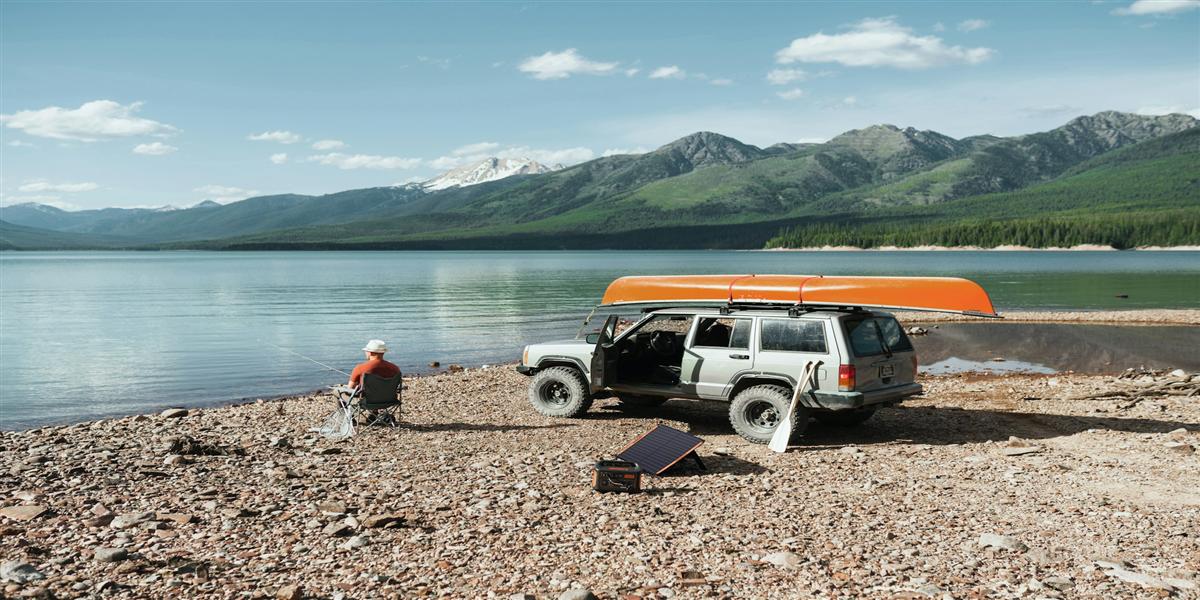
MIDA 40kW Solar-Ready DCDC Charging Piles for Remote Highway Service Areas
Quick Answer
A 40kW solar-ready DCDC charging pile is a modular, PV-couplable DC charger designed for locations where the grid is weak, distant, or expensive to reinforce — the exact conditions found at rural highway service areas, rest stops, and truck lay-bys. By accepting DC input directly from a PV array or battery buffer and converting it to a 150–1000V vehicle DC output, the pile avoids the losses and constraints of an exclusively AC-coupled design. Paired with a 100–200kWh battery and a modest grid connection (or a generator backup), a site of two to four 40kW piles can serve highway traffic reliably, scale in 40kW steps as demand grows, and be serviced by module swap rather than a specialist site visit.
Key Takeaways
- Solar-ready by design: DC-couplable input lets PV feed the charging bus directly, eliminating one conversion step and improving solar-to-vehicle efficiency.
- Weak-grid tolerant: battery buffering means the site’s peak import stays within the feeder’s real capability, so no transformer upgrade is required.
- Off-grid capable: with PV plus storage, a site can operate independently where no viable connection exists at all.
- Modular 40kW granularity: capacity grows in 40kW increments, and one module failure costs a fraction of the site, not the whole installation.
- Wide 150–1000V output: covers 400V and 800V vehicle architectures without derating.
- Built for low-maintenance locations: liquid-cooled or sealed power stages, remote diagnostics, and OCPP 2.0.1 monitoring to a central CSMS.
The Remote Highway Problem: Distance, Weak Grids, and Thin Margins
Highway electrification has an awkward middle. Major motorway service areas are commercially attractive enough to justify high-power hubs with megawatt-class capacity. Urban sites have traffic density. The sites in between — rural rest stops, scenic overlooks, small-town junctions, and truck lay-bys on secondary highways — have steady but modest demand, long distances to the nearest substation, and a grid connection sized for a toilet block and a kiosk.
Three constraints define the design brief for these locations:
- Grid capacity is the binding limit, not charging hardware cost. Upgrading a rural feeder can cost more than the entire charging installation and take longer than the operator is willing to wait.
- Voltage quality is often poor. Long rural feeders suffer voltage sag, phase imbalance, and frequency excursions that trip chargers designed for robust urban networks.
- Service economics are brutal. Sending a technician three hours each way to replace a failed converter destroys the site’s return. Reliability and modular serviceability are financial requirements, not preferences.
Solar-ready, battery-buffered DCDC piles address all three. The PV reduces energy cost and grid import; the battery stabilises the supply and absorbs transients; the modular DCDC conversion makes failures cheap to fix and capacity cheap to add.
Why “Solar-Ready” Is an Architecture, Not an Accessory
Adding a solar canopy to a conventional AC charger creates an AC-coupled system: PV inverters convert DC to AC, the charger converts AC back to DC, and the vehicle receives DC. Each conversion costs energy. A solar-ready DCDC pile is built to accept DC input directly onto its internal bus, so PV and battery power reach the vehicle with one fewer conversion stage — worth roughly 3–6 percentage points of round-trip efficiency, which is significant on a site whose entire margin depends on energy throughput.
The architectural features that make a pile genuinely solar-ready:
- DC input terminals with a voltage window compatible with PV strings and LFP battery banks.
- Maximum power point tracking or DC-optimiser compatibility so PV output is harvested efficiently across irradiance conditions.
- A control layer that arbitrates in real time between PV, battery, grid, and vehicle demand — exporting nothing, importing as little as possible.
- Bidirectional or at minimum load-following behaviour so the site can shave peaks and store surplus for evening charging.
- Wide-voltage output (150–1000V) to serve both 400V and 800V vehicles efficiently.
Sites that expect to remain AC-coupled for simplicity can still specify the same pile and connect it to an AC bus; the point of specifying solar-ready hardware is that the DC option remains open as PV is added in later phases.
Sizing a Remote Site: Four Worked Configurations
Remote highway sites come in distinct sizes, and each has a natural configuration. The table below shows how a 40kW pile platform scales.
| Site type | Piles | Charging output | BESS | PV | Grid connection | Notes |
|---|---|---|---|---|---|---|
| Lay-by, low traffic | 1 | 40kW | 100kWh | 40–60kWp | 60kW or none | Solar-plus-storage primary supply |
| Rural rest stop | 2 | 80kW | 150kWh | 80–120kWp | 80–120kW | Buffered operation, demand-charge defence |
| Small town junction | 3 | 120kW | 200kWh | 120–150kWp | 120–150kW | Serves through traffic and local users |
| Truck lay-by with overnight dwell | 4 | 160kW | 250–300kWh | 150–200kWp | 150–200kW | Long dwell, overnight charging, V2G-ready |
The pattern to note is that PV capacity exceeds charging output in every row. At a remote site, the sun is the cheapest energy source available and the grid connection is the most expensive increment, so oversizing PV relative to charger power is deliberate: it maximises self-consumption during the day and keeps the battery cycling usefully across the shoulder seasons.
Weak-Grid Engineering: What Actually Trips Chargers
Rural connections fail in predictable ways, and a charging site must be designed around each one.
| Grid condition | Typical symptom | Mitigation in a solar-ready DCDC site |
|---|---|---|
| Voltage sag under load | Charger derates or faults at peak | Battery discharge supports the DC bus; adaptive input current limiting |
| Frequency excursion | Protection trips, session ends | Wide tolerance settings and grid-code-compliant protection logic |
| Phase imbalance (three-phase) | Uneven loading, neutral stress | Balanced module loading across phases; single-phase-friendly configs |
| High source impedance | Poor power factor, harmonics | PFC above 0.99 in the rectifier stage; filtering |
| Frequent short outages | Sessions terminate, hardware stress | BESS islanding keeps charging alive; soft-restart sequencing |
Designing for these conditions is not a matter of tolerance settings alone. The battery buffer is what converts a weak connection into a usable supply: the site’s import becomes a bounded, gentle profile while the vehicle-facing output stays strong. In practice this is what allows a 120kW site to run on an 80kW rural feeder.
PV Sizing and Seasonal Reality
Remote highway sites often sit in areas with good irradiance but long winters or heavy snow cover. Generation modelling should be hourly and season-aware.
| Season | PV yield (relative to annual mean) | Battery role | Site behaviour |
|---|---|---|---|
| Spring | 90–110% | Absorb midday surplus | High solar share, low grid import |
| Summer | 110–130% | Avoid curtailment, charge evening | Highest solar share, some grid export if permitted |
| Autumn | 55–80% | Bridge PV and off-peak import | Balanced operation |
| Winter | 25–50% | Off-peak grid charge dominates | Reduced solar share, higher energy cost |
Two implications for remote sites specifically. First, panel orientation should favour the season of highest traffic — if summer tourism dominates, tilt toward the summer sun; if winter truck traffic dominates, a steeper tilt sheds snow and captures low-angle light. Second, the battery must be sized for the shoulder months where PV and demand are both moderate, since that is where the site’s average operating cost is set.
Modular Serviceability: The Financial Case for 40kW Granularity
At a remote site, downtime is not just lost revenue — it is a reputational problem on a corridor where the next charger may be 80km away. This is where a modular platform outperforms a monolithic converter decisively.
| Scenario | Monolithic 120kW charger | 3 × 40kW modular piles |
|---|---|---|
| Single converter failure | Full site outage until specialist repair | One pile out, 80kW still available |
| Module-level failure | Not serviceable on site | Module swap, typically under an hour |
| Capacity expansion | Replace the unit | Add a pile, 40kW at a time |
| Spare-parts strategy | Rare parts, long lead times | One module SKU held on site or at a depot |
| Remote diagnostics | Limited telemetry | Per-module health reporting to CSMS |
Standardising on a common liquid-cooled 40kW/60kW power module across a corridor of remote sites lets an operator hold a small pool of spares at a central depot and dispatch a single technician with one part number. The alternative — a mixed fleet with unique converters at each site — makes remote maintenance unmanageable at scale. MIDA’s wider DC fast charger station platform follows the same modular principle, and the corridor-grade architecture described in the 480kW ultra-fast liquid-cooled motorway deployment shows how the approach behaves where traffic justifies higher power.
Installation and Site Design for Harsh Locations
Remote sites are exposed to conditions that urban installations rarely see, and the specification should reflect that.
- Thermal range: liquid-cooled power stages with a documented operating window from −30°C to +55°C, and heating provisions where sub-zero starts are common.
- Enclosure protection: IP54 minimum, IP65 for dispensers exposed to driving rain and snow; corrosion-resistant coatings for coastal or de-iced roads.
- Cable management: retractable or armoured systems that survive wind, snow load, and being driven over.
- Vandalism and theft resistance: lockable cabinets, tamper alarms, and CCTV where the site is unattended overnight.
- Communications: 4G/5G with a satellite fallback where coverage is absent, because a charger that cannot report faults is a charger that stays broken.
- Grounding and surge protection: rural sites experience more lightning-induced transients and longer cable runs; Type 1+2 protection and a properly designed earth grid are essential.
- Civil design: a small concrete pad, drainage, and provision for a future second bay are far cheaper at install time than retrofit.
Commercial Model: Making Thin Traffic Work
Remote highway sites rarely justify the capital structure of a motorway hub, but they are frequently essential for corridor coverage — which is why they attract public funding and network-obligation support in many markets. The revenue mix typically combines:
- Charging fees priced slightly above urban rates to reflect the site’s scarcity value.
- Grant and subsidy funding for corridor coverage, rural electrification, and renewable generation.
- Reduced energy cost from PV self-consumption, which lifts margin where traffic is thin.
- Demand-charge avoidance through battery peak shaving, which matters more on rural tariffs with sharp capacity components.
- Local services — kiosk, tourism partnerships, or fleet accounts with regional logistics operators.
Because capital is the constraint, phased deployment works best: install one 40kW pile, a battery, and a PV array sized for full build-out; add piles as utilisation crosses thresholds. The trenching, pad, and array are sized once so subsequent phases are incremental and fast.
FAQ
Can a 40kW solar-ready pile run completely off-grid?
Yes, with sufficient PV and battery. A single-pile site needs roughly 60–100kWp of PV and 100–150kWh of storage for year-round reliability in a temperate climate, and more in high latitudes or cloudy regions. Fully off-grid systems cost more per kilowatt than grid-assisted ones, so the decision usually turns on whether any viable connection exists at a reasonable cost.
Why 40kW rather than 60kW or higher for remote sites?
Because remote highway demand is thin and dwell times are long. A 40kW pile charges a 60kWh pack in about 90 minutes — appropriate for a rest stop visit — while keeping the site’s peak load low enough for a weak feeder or a modest PV-plus-battery budget. Where traffic justifies it, additional 40kW piles scale the site without changing the platform.
How does the charger cope with a very weak grid connection?
The battery buffer and adaptive input current limiting hold the site’s grid import below a configured cap, so the charger’s vehicle-facing output is not limited by the feeder’s instantaneous capability. Wide protection tolerances and power-factor correction above 0.99 handle the voltage sag and harmonic conditions typical of long rural feeders.
What happens during a grid outage at a remote site?
With a battery and PV, the site can island and continue charging at a power level set by the inverter rating and available stored energy. Sessions in progress are typically preserved, and the site resumes normal operation automatically when the grid returns.
Is a solar canopy worth it at a remote site with modest traffic?
Usually yes, for two reasons beyond generation: the canopy shades the dispensers and protects cables from UV and snow, and the PV reduces the site’s operating energy cost, which is the dominant lifetime expense when traffic is thin. Grant programmes for rural renewable infrastructure often improve the case further.
How much PV and storage do I need for four 40kW piles?
Roughly 150–250kWp of PV and 250–350kWh of battery for a 160kW site aiming at a 40–60% annual solar share with weak-grid tolerance. The exact figures depend on local irradiance, seasonal traffic patterns, and whether grid export is permitted.
How are remote sites monitored and maintained?
Through OCPP 2.0.1 telemetry to a central CSMS, with per-module health metrics, session data, and fault alerts. Maintenance is planned around module exchange, with one spare module and standard tooling sufficient for most interventions — which is the whole reason modular granularity matters in locations where every service visit costs a day of travel.
The Bottom Line
Remote highway service areas are where EV corridors either hold together or break, and they cannot be built to urban or motorway assumptions. A 40kW solar-ready DCDC charging pile — DC-couplable, battery-buffered, modular, and monitorable — fits the real constraints of these sites: weak grids, thin traffic, harsh conditions, and long service distances. Size PV above charger output, size the battery for the shoulder seasons, hold spare modules centrally, and build capacity in 40kW steps. The corridor gets covered, and the site gets an operating model that survives its own remoteness.
Post time: Sep-15-2026


