
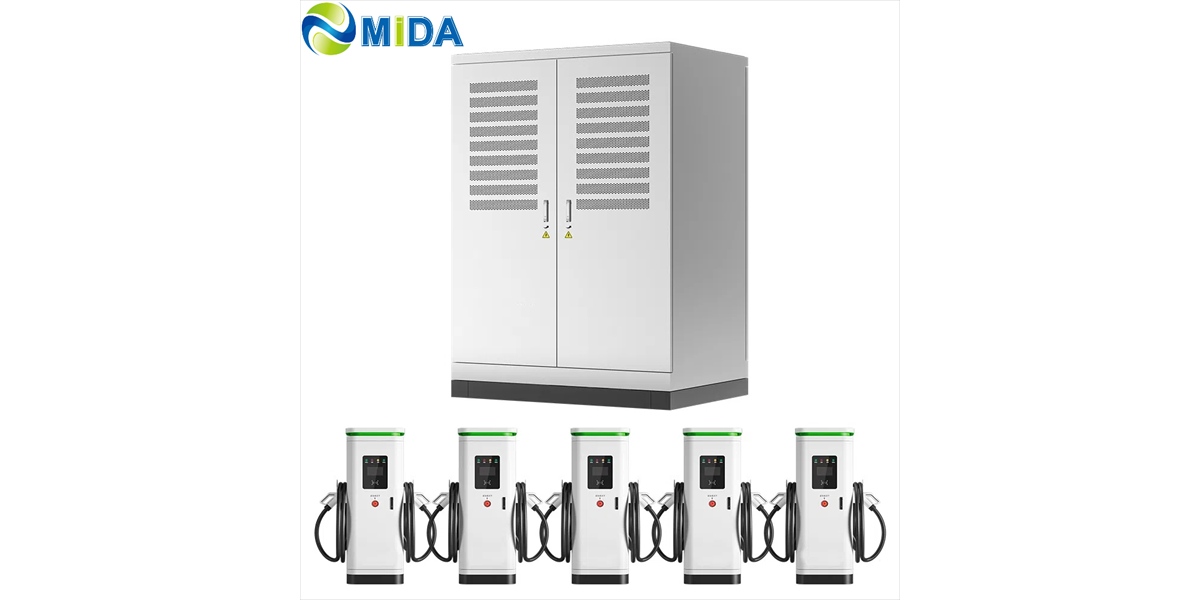
Deciding Between Modular Split DC Systems and Monolithic Integrated Charging Stations
Quick Answer
A modular split DC system distributes power conversion across hot-swappable rectifier modules housed in a shared cabinet, delivering DC to separate dispensers. A monolithic integrated charging station packages conversion, control, and delivery in one sealed unit with fixed internal capacity. The decision hinges on six factors: required total power, stall count, expected demand growth, uptime obligation, site space, and service capability. Modular split systems suit hubs above roughly 300 kW and any site expecting growth, phased investment, or contractual availability targets. Monolithic stations remain appropriate for single-stall installations under 240 kW, temporary deployments, and sites where installation simplicity outweighs lifecycle flexibility.
Key Takeaways
- Modularity is about change management. Modules can be added, upgraded, or replaced individually, so capacity follows demand rather than preceding it.
- Monolithic design optimizes for installation speed and simplicity. It minimizes interfaces, planning effort, and commissioning time — genuinely valuable in some projects.
- Redundancy must be structural. Pooled N+1 modules in a cabinet degrade gracefully; a monolithic unit’s redundancy is limited by its internal layout.
- Upgrade paths differ fundamentally. A modular system scales by adding modules and dispensers; a monolithic station scales only by adding stations.
- Total cost of ownership separates the two more than capital cost. At hub scale, modular architecture typically delivers 15–30% lower ten-year TCO.
Two Philosophies, Not Two Products
The choice between modular split systems and monolithic integrated stations is often presented as a technical comparison of specifications. It is more accurately a comparison of two engineering philosophies applied to the same problem.
The monolithic philosophy says: deliver a complete, self-contained charging capability with minimal external dependencies. Integrate everything into one enclosure, validate it as a unit, ship it, and connect it. The buyer receives a finished capability with a known behavior. Flexibility is exchanged for certainty.
The modular philosophy says: deliver a platform of interchangeable building blocks that can be composed into many configurations. Conversion capacity, dispenser count, and power allocation become variables. The buyer receives a platform they will continue to configure over the asset’s life. Certainty is exchanged for adaptability.
Neither philosophy is wrong. The mistake is applying one to a project shaped by the constraints of the other.
How Modular Split DC Systems Are Structured
A modular split DC system consists of four layers:
- Rectifier modules. Typically 20–40 kW each, hot-swappable, and installed in the cabinet in quantities determined by required output. Modules are the unit of capacity, redundancy, and maintenance.
- Power cabinet. Provides AC input protection, module racks, the DC busbar, cooling, and the site controller. Cabinet size determines maximum module count and therefore maximum conversion capacity.
- Dispensers. Serve vehicles with connector, cable management, user interface, and safety electronics. Two to twelve dispensers commonly attach to a single cabinet.
- Control and orchestration. The site controller allocates power across dispensers, manages grid limits, integrates storage or solar inputs, and reports to the back end over standard protocols.
Because capacity is expressed as a count of modules, the system can be specified to a precise level — 320 kW today, 480 kW next year — without changing the cabinet or the DC backbone. MIDA’s charging modules for EV infrastructure illustrate how module efficiency and thermal performance set the practical ceiling for cabinet output.
How Monolithic Integrated Stations Are Structured
A monolithic integrated charging station builds all conversion stages, the controller, protection, cooling, metering, and the output cable into a single enclosure. Capacity is fixed at manufacture. Internally, the design may use several power stages in parallel, but these are not user-serviceable modules in the field-sense; replacement typically requires manufacturer service or unit exchange.
The strengths are real:
- One enclosure, one connection, one commissioning task. Installation timelines are short and predictable.
- Minimal site planning. No cabinet placement, no DC distribution design, no allocation logic to configure.
- Single-vendor accountability. The whole capability comes from one source with one warranty.
- Predictable behavior. Unit-level validation means the delivered performance is well characterized.
The limitations are equally real, and they scale with ambition: capacity cannot grow, redundancy is bounded by internal design, and each additional stall requires another full station with its own rectifier stack.
The Six Decision Factors
1. Total Required Power
Below roughly 240 kW total site power, monolithic stations are efficient and cost-appropriate. Above 300 kW, the economics shift toward pooling. Above 600 kW — trucks, buses, highway corridors — modular split architecture is effectively the only practical design, because the physical size and thermal load of an equivalent monolithic unit become prohibitive.
2. Stall Count
One to two stalls: monolithic. Three to twelve stalls: modular split. Above twelve: modular split with multiple cabinets on a shared site controller.
The reason is conversion sharing. In a monolithic fleet, every stall carries full conversion capacity that is idle most of the time. In a modular hub, conversion capacity is sized once and shared dynamically, raising utilization of installed power from the 30–60% range to 70–90%.
3. Demand Growth and Phasing
This is the factor that most often decides the question. If the site is expected to grow — additional stalls, higher power per vehicle, or new fleet contracts — a monolithic station must be duplicated or replaced. A modular system absorbs growth through module and dispenser additions.
For a site developer with uncertain demand, modularity converts a large speculative capital commitment into a staged, demand-following investment. The grid connection and DC backbone are built once at the eventual size; conversion and delivery are added incrementally.
4. Uptime Obligation
If the operator has committed to a service-level agreement with availability penalties, monolithic units create per-stall failure domains with limited internal redundancy. A modular cabinet with N+1 modules continues operating at reduced aggregate output when one module fails, keeping every dispenser functional.
For unattended hubs, fleet depots with fixed departure schedules, and highway corridors with no nearby alternative, that distinction is the difference between meeting and missing the availability target.
5. Site Space and Placement
Monolithic stations live entirely in the parking area, consuming 1.2–2.0 m² per stall including clearance, requiring a foundation each, and constraining layout. Modular systems move the heavy equipment to a plant area and leave slim dispensers at the bays, which is decisive in urban garages, low-ceiling structures, and constrained kerbsides. The split-type architecture overview maps these cabinet-to-dispenser combinations to site types.
6. Service Capability and Spares Strategy
Modular systems are maintained at module level: a rectifier module swap is a documented procedure completed with standard tools. Monolithic systems are maintained at unit level, where internal faults may require manufacturer service or unit exchange.
Assess your own service capability honestly. If your organization has field technicians, modular architecture empowers them. If you rely entirely on a third party, confirm that the party supports the architecture you choose and holds the correct spares.
Head-to-Head Comparison
| Criterion | Modular Split DC System | Monolithic Integrated Station |
|---|---|---|
| Capacity model | Module count (20–40 kW each) | Fixed at manufacture |
| Typical power range | 240 kW – 720 kW+ per cabinet | 60 kW – 240 kW per station |
| Stalls served per unit | 2 – 12 dispensers | 1 |
| Redundancy | N+1 / N+2 pooled modules | Limited internal redundancy |
| Failure behavior | Derated output, all stalls live | Stall offline |
| Expansion method | Add modules and dispensers | Add or replace stations |
| Installation complexity | Higher (cabinet placement, DC runs) | Lower (one enclosure per stall) |
| Commissioning time | Longer per hub, faster per stall | Short per unit |
| Footprint in parking area | Minimal (dispensers only) | Substantial per stall |
| Maintenance granularity | Module-level | Unit-level or manufacturer service |
| Spares inventory | Common modules | Multiple station variants |
| Best fit | Hubs, depots, growth sites, high uptime | Single stalls, pilots, temporary, low growth |
| Indicative 10-year TCO at hub scale | Lower by 15–30% | Baseline |
Cost Structure: Where Each Architecture Wins
Monolithic wins on day-one simplicity. Fewer interfaces, less engineering, faster installation, lower planning cost. For a two-stall retail installation, this is genuinely the cheaper route.
Modular wins on unit economics at scale. Above approximately six stalls, pooled conversion reduces capital cost per stall, and the advantage compounds through maintenance, spares, and expansion.
Three cost categories are frequently underestimated in monolithic comparisons:
- Stranded conversion capacity. Capacity installed for peak but idle at average demand. Pooling recovers much of it.
- Growth cost. Adding the seventh and subsequent stalls to a monolithic fleet costs a full station each; to a modular hub, it costs a dispenser and a DC run.
- Grid and demand charges. Site-level power allocation in a modular controller caps coincident demand, which directly reduces monthly demand charges. Monolithic fleets require external load management to achieve the same effect.
Energy-side integration also favors modularity. A shared DC bus allows storage and solar to feed the same conversion stage, as demonstrated in this 200 kWh solar BESS EV charging station deployment. Where heavy vehicles and long dwell distances demand very high power, configurations such as the 600 kW–720 kW liquid-cooled DC charging station for trucks and buses show the design at full scale — multiple dispensers, centralized liquid-cooled conversion, and heavy-duty cable management.
Application Mapping
| Project Profile | Recommended Architecture | Rationale |
|---|---|---|
| Single retail stall, ≤ 120 kW | Monolithic integrated | Lowest total cost, fastest install |
| Two-stall hotel or office, ≤ 240 kW | Monolithic integrated | Simplicity outweighs pooling benefits |
| Four to eight stall urban hub | Modular split | Space, pooling, phased build-out |
| Fleet depot, 10+ stalls | Modular split + storage | High concurrency, demand control, low cost per stall |
| Highway corridor, heavy vehicles | Modular split, liquid-cooled | 600 kW+, thermal load, cable management |
| Temporary or event charging | Monolithic or mobile unit | Deployment speed is the objective |
| Garage retrofit, low ceiling | Modular split | Dispensers fit; cabinet placed in plant area |
| Site with capped grid supply | Modular split + BESS | Pooled power and storage avoid upgrade |
Evaluation Checklist for Procurement Teams
When comparing proposals, score each on the same criteria rather than comparing headline kW:
- Capacity granularity. What increment of power can be added, and at what cost?
- Redundancy depth. Configurations available, and the derated output curve with one module offline.
- Dispenser-to-cabinet ratio. Maximum and minimum supported configurations.
- DC run limits. Maximum distance at rated output current, with voltage-drop documentation.
- Cooling architecture. Liquid or air, and the full-power ambient temperature rating.
- Remote diagnostics. Module-level telemetry and alert granularity available through the back end.
- Field-serviceability. Documented module swap time, tooling, and required skill level.
- Standards and compliance. IEC 61851 / IEC 62196, OCPP version, CE or TÜV or UL certification as applicable to the destination market.
- Protection ratings. IP rating for the cabinet and dispensers separately, plus insulation monitoring and surge protection.
- Warranty structure. Coverage of modules, cabinet, and dispensers, and the spares policy after warranty.
Migration and Coexistence
Few sites replace infrastructure wholesale. Both architectures can coexist: monolithic units can continue serving low-demand periods or secondary parking areas while a modular hub handles high-power sessions. Where a site already has a suitable grid connection and civil works, migration to modular split architecture can proceed in phases — install the cabinet and backbone, add dispensers as demand grows, and decommission monolithic units as their service life ends.
Common Misconceptions
“Integrated stations are more reliable because there are fewer interfaces.” Interfaces are not the dominant failure driver; thermal stress and component aging are. A monolithic unit concentrates heat in an exposed location, while a modular cabinet can be sited and cooled more favorably.
“Modular systems are complicated to operate.” Configuration happens once at commissioning. After that, power allocation is automatic and remote diagnostics are typically more detailed than in monolithic units.
“Monolithic units are always cheaper.” They are cheaper per stall at low stall counts and often comparable at mid counts. Above six stalls the per-stall cost advantage usually reverses.
“Modularity is only for very large hubs.” A 240 kW cabinet with three dispensers is a legitimate small modular deployment and an ideal entry point for sites that expect to grow.
Bottom Line
Choose a monolithic integrated charging station when the requirement is a small number of stalls, a fast installation, and no expectation of significant growth. Choose a modular split DC system when power, stall count, or demand is likely to change, when availability is contractual, when space is constrained, or when total cost of ownership over ten years matters more than capital cost on day one. The question to ask in procurement is not which architecture is better, but which one will still fit the site in five years.
FAQ
What is a modular split DC charging system?
It is a charging system in which AC-to-DC conversion is performed by hot-swappable rectifier modules in a shared power cabinet, and power is delivered to vehicles through separate dispensers. Capacity is set by module count, and stall count by dispenser count.
How is a monolithic station different?
A monolithic integrated station contains all conversion, control, and delivery components in a single fixed enclosure for one stall. Capacity cannot be expanded, and internal faults typically require manufacturer service or unit exchange.
Which is cheaper to install?
Monolithic stations are cheaper and faster to install for one or two stalls. At hub scale, modular split systems tend to be comparable or cheaper per stall while reducing civil works and trenching.
Can I add capacity to a modular system later?
Yes. Additional rectifier modules increase output, and additional dispensers increase stall count, provided the cabinet has spare capacity and DC outputs. This is the primary lifecycle advantage of modularity.
Does modularity improve uptime?
Yes. With N+1 modules, a single module failure reduces aggregate output rather than taking a stall offline, and the repair can be scheduled rather than treated as an emergency.
Are monolithic stations suitable for fleet depots?
Only for very small fleets. Depots typically require many stalls with high concurrency, where pooled power, demand control, and low cost per additional stall make modular architecture the better fit.
Do both architectures support OCPP and back-end integration?
Yes. Both should support OCPP 1.6J or 2.0.1 and expose the telemetry needed for remote monitoring. Modular systems generally provide finer diagnostic granularity, since measurements are available per module and per dispenser.
Conclusion
Modular split DC systems and monolithic integrated stations are both legitimate answers to different questions. Monolithic design answers “how do I get charging running quickly and simply at a small site?” Modular design answers “how do I build a hub that can grow, share power, stay online, and remain economical over a decade?” Match the architecture to the question your project is actually asking — and if the site is intended to grow at all, that question answers itself.
Post time: Sep-17-2026


