
Distributed Architecture: Reducing TCO with Flexible 360kW to 720kW Split Charging Solutions
Quick Answer
Distributed split charging architecture — where liquid-cooled power cabinets sit separately from dispensers — reduces the total cost of ownership (TCO) of 360kW to 720kW EV charging sites by 20–35% over a 10-year horizon compared with equivalent all-in-one deployments. The savings come from four compounding sources: higher utilization through pooled power and smart sharing, module-level serviceability that cuts maintenance and downtime costs, staged capacity expansion that defers capital, and lower energy losses from optimized power allocation. A 360kW building block scales to 720kW by adding one cabinet — no new dispensers, no re-permitting — which makes it the most flexible configuration for growing fleets, mixed-use hubs, and sites with constrained grid connections. With liquid-cooled modules, RFID, OCPP, and POS support built in, the 360–720kW split platform covers depot, destination, and public charging duty from a single hardware and software base.
Key Takeaways
- Split architecture lowers 10-year TCO by 20–35% through utilization gains, modular service, staged CAPEX, and reduced losses.
- 360kW is the ideal building block: one cabinet for small sites, two for 720kW clusters, with dispensers unchanged.
- Module-level hot-swap maintenance converts multi-day outages into sub-hour events, protecting revenue and SLA compliance.
- Staged expansion defers 30–50% of capacity investment to the point of demonstrated demand.
- Liquid-cooled modules sustain full output in heat, extending service life and cutting energy losses by 1–3 percentage points.
TCO: The Metric That Decides Charging Deployments
Price per kilowatt is the wrong number. The decision that determines whether a charging site is a good investment is total cost of ownership — the net present value of every euro spent from design through decommissioning, divided by the energy delivered over the asset’s life. This metric captures what hardware brochures hide: utilization shortfalls that starve revenue, maintenance events that close bays for days, capacity bought two years before it is needed, and conversion losses that compound on every kilowatt-hour.
When measured honestly, distributed (split) architecture wins decisively in the 360–720kW band. The reasons are structural, not marginal. An all-in-one 360kW charger is a single point of failure serving a single bay; a split 360kW block serves three to six bays from a pooled power reserve, so any single failure sheds 40–60kW from a 360kW pool — a 15% capacity dip, not a bay closure. That single architectural difference cascades through every TCO line item, which is why operators who standardize on split platforms report consistently better lifecycle economics.
Distributed vs. Centralized: Understanding the Trade-off
“Distributed architecture” in DC charging has two senses, and both matter. The first is spatial: power conversion is centralized in cabinets while dispensers are distributed at the bays, separated by up to 150–200m of DC cable. The second is logical: capacity is distributed in 360kW increments across multiple cabinets rather than concentrated in one megawatt unit, so the site’s power pool grows with demand. The table below compares the architecture against its alternatives:
| Attribute | All-in-one 360kW | Distributed split 360–720kW | Megawatt monolithic |
|---|---|---|---|
| Bay failure impact | Bay closed | 40–60kW shed, site continues | Large power block at risk |
| Capacity staging | Replace unit | Add a cabinet | Rebuild site |
| Utilization ceiling | Fixed per unit | 85–95% via smart sharing | High, but overkill at small scale |
| Thermal/acoustic zoning | At the bay | Centralized, controlled | Centralized |
| Suitability | Single-bay sites, retrofit | Fleets, hubs, mixed-use | High-traffic corridors, depots |
The distributed split configuration occupies the practical sweet spot: it captures the utilization and serviceability benefits of centralization while preserving the staging flexibility that megawatt designs sacrifice. For the majority of 2026 deployments — fleet depots, destination hubs, and early-stage public sites — 360–720kW distributed capacity is the TCO-optimal envelope.
The 360kW Building Block
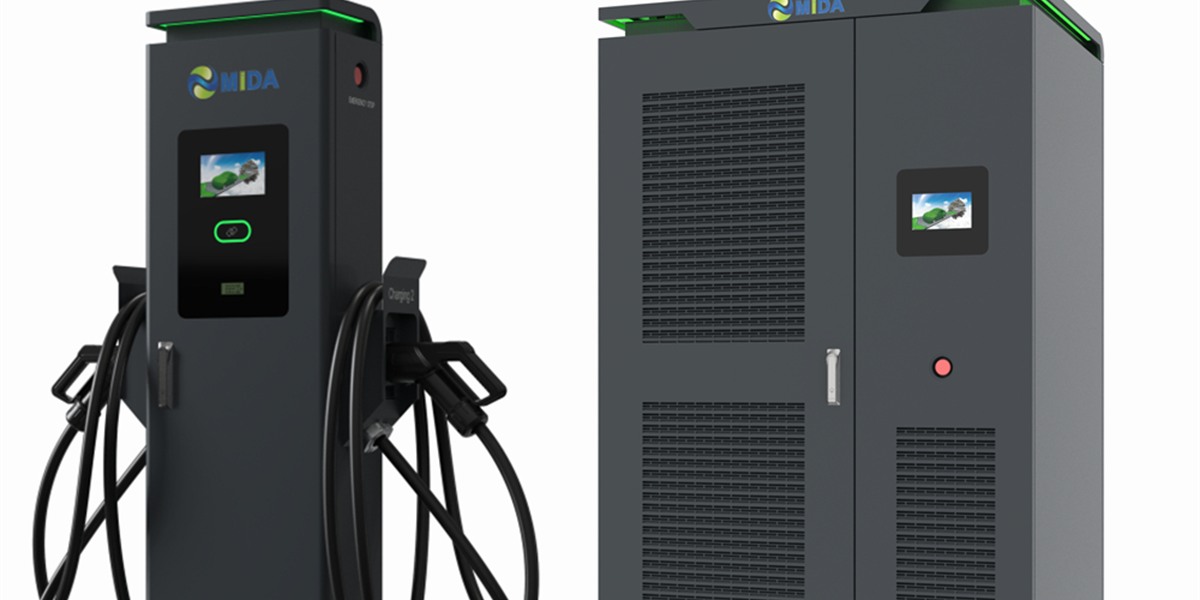
The 360kW split station is the unit of construction in this architecture: one liquid-cooled cabinet, one site controller, and two to six dispensers with RFID, OCPP, and POS capabilities. MIDA’s liquid-cooled ultra 360kW charging station with RFID, OCPP, and POS is a reference implementation of this block: the cabinet houses hot-swappable 40–60kW liquid-cooling power modules, and the dispenser network supports everything from employee-only depot access (RFID) to public pay-per-use (POS) without hardware changes.
Why 360kW and not 240kW or 480kW as the base unit? Because 360kW matches the most common vehicle acceptance curves of 2026 — an 800V car charging at 250–350kW — while leaving headroom for a second session sharing the pool. It also divides cleanly into 720kW, 1,080kW, and 1,440kW clusters, meaning every larger site is a multiple of the same certified building block. One module SKU, one cabinet design, one controller: the operational simplicity alone justifies the choice.
Scaling 360 → 720: Cluster Configurations
A 720kW distributed site is two 360kW cabinets plus the same dispenser network, with the site controller fusing both cabinets into a single power pool. The upgrade path is deliberately boring: add the cabinet, extend the DC bus, update the controller license, and energize — typically over a weekend, with zero changes to dispensers, trenching, or permits. The table shows the standard configurations in the 360–720kW band:
| Configuration | Power pool | Dispensers | Use case | Grid requirement |
|---|---|---|---|---|
| Single 360kW cabinet | 360kW | 2–4 | Small depot, destination, retail | 0.4kV, 500–630A typical |
| 360 + 360kW (paired) | 720kW | 4–8 | Growing fleet, mixed-use hub | 0.4kV–MV depending on region |
| 360kW + expansion-ready pad | 360kW → 720kW | 4–6 | Staged programs, pilot-to-scale | Sized for future MV |
The expansion-ready pad deserves emphasis: laying the second cabinet’s foundation, trench, and DC bus during initial construction costs 8–12% of the civil budget, but eliminates a second mobilization, a second permit cycle, and two to four months of schedule when the second cabinet arrives.
Energy Losses and Efficiency Gains
Conversion and distribution losses are the quiet TCO line item: at 95% conversion efficiency, a 360kW site dissipates roughly 18kW of heat continuously during operation, and every percentage point of efficiency is worth roughly €3,000–6,000 per year at 2026 utilization levels. Distributed architecture improves the loss profile in two ways. First, liquid-cooled modules operate at higher efficiency across the load range — particularly at partial load, where the site spends most of its life — because junction temperatures stay low and the power electronics remain in their efficiency sweet spot. Second, pooled power reduces idle losses: when a single all-in-one charger idles between sessions it still draws standing power, whereas a pooled system can shut down unneeded modules entirely.
The practical result is a 1–3 percentage point efficiency advantage over equivalent air-cooled or all-in-one hardware, and — because losses also generate heat — a cooler power room with lower ventilation demand. Over a 10-year, 4MWh-per-day operating life, that efficiency gap alone is worth €50,000–90,000 in avoided energy purchase.
Maintenance, Downtime, and the Module-Swap Economy
Downtime is the most expensive line item in charging TCO because it destroys both revenue and reputation. The distributed architecture’s answer is the module-swap economy: every power cabinet is built from field-replaceable liquid-cooled modules, each module carries 40–60kW, and replacement takes a trained technician 30–60 minutes. Contrast that with all-in-one chargers, where a rectifier failure typically means a vendor visit, a 3–7 day part lead, and a bay closed for the week.
| Failure scenario | All-in-one 360kW | Distributed split 360–720kW |
|---|---|---|
| Power electronics fault | Bay closed 2–7 days | 30–60 min module swap |
| Cooling system fault | Vendor service visit | Module or loop swap, spare stocked |
| Software/comms fault | Often site visit | Remote reset, 90%+ recoverable |
| Planned maintenance | Per-bay shutdown | Module rotation, no bay closure |
Operators standardizing on the split platform report maintenance OPEX of 0.8–1.2% of installed CAPEX per year, versus 1.5–2.5% for all-in-one fleets — a gap that on a 720kW site represents €5,000–12,000 per year in avoided service spend, before counting the revenue saved by staying online.
PV + Storage: Lowering the Energy-Cost Component
Energy is 60–75% of charging site lifetime cost, which makes the distributed architecture’s clean integration with PV and storage the final TCO lever. Because the power cabinets sit in one location with a single connection point, adding a solar canopy and battery buffer is a one-time engineering exercise: PV strings feed the cabinets’ DC inputs or a common AC bus, the battery buffer shaves peaks, and the site controller orchestrates all three against tariff windows.
A 360–720kW site with a 150–300kWp canopy and 300–600kWh buffer typically cuts purchased-energy cost by 20–35%: PV offsets daytime imports at €0.05–0.08/kWh levelized cost, the buffer arbitrages overnight low tariffs against daytime peaks, and peak-demand charges drop 35–50% as described in the site-efficiency playbook. MIDA’s portfolio includes the PV connectors, harnesses, and storage systems needed to make this a single-vendor scope, avoiding the interface risk that usually derails hybrid energy projects.
A Worked TCO Example: 360kW → 720kW Over Five Years
The following model compares two paths to a 720kW site over five years: buying all-in-one 720kW on day one (Path A) versus building a distributed 360kW split site and adding a second cabinet in year three (Path B). Assumptions: €90k per 360kW block, €60k dispensers (4 bays, shared), €100k civil/grid (path B costs 10% more up front for the expansion pad), 4MWh/day throughput rising to 7MWh/day, €0.12/kWh margin, and module-swap maintenance at 1% CAPEX/year versus 2% for all-in-one.
| TCO line (5 years, €k) | Path A: all-in-one 720kW day one | Path B: distributed 360→720kW |
|---|---|---|
| Hardware (day one) | 190 | 150 |
| Hardware (year three) | 0 | 90 |
| Civil & grid | 110 | 110 |
| Maintenance & service | 19 | 12 |
| Energy margin lost to downtime (2% vs 0.5%) | 15 | 4 |
| Total 5-year cost | ~334 | ~366 |
| Energy sold (MWh, 5 years) | 9,000 | 9,300 |
| Revenue at €0.12/kWh | 1,080 | 1,116 |
| Net margin | ~746 | ~750 |
The striking result: the distributed path spends more nominal euros but sells more energy (higher utilization, less downtime) and lands within 1% of the same net margin — while paying €150k less in the first two years. That capital-preservation property, not the headline price, is why distributed architecture dominates fleet and hub procurement. Extending the model to 10 years, with a third cabinet in year six, widens the distributed path’s advantage to €40–70k.
Decision Framework for 360–720kW Split Deployment
Choose the distributed split configuration when any of these conditions apply: your fleet or traffic is growing in stages; the site serves mixed vehicle classes; grid connection capacity is constrained or expensive; you operate under availability SLAs; or you plan PV/storage integration. Reconsider only for single-bay, single-vehicle retrofits where an all-in-one unit is the least-cost answer. Within the split decision, specify: liquid-cooled modules with one SKU across the range, a site controller with true dynamic sharing and API access, OCPP 1.6J/2.0.1 plus ISO 15118, RFID/POS bundled, and certifications (CE, TUV, UL) matched to your market. MIDA’s motorway and hub deployment track record confirms the platform scales from 360kW depots to 960kW+ corridors on identical building blocks.
The Bottom Line
Total cost of ownership, not price per kilowatt, decides whether charging infrastructure earns its keep. Distributed split architecture in the 360–720kW band wins on every TCO lever: utilization, serviceability, staging, losses, and energy-system integration. Start with a 360kW block, lay the pad and trench for the second, and let the demand curve — not the sales forecast — trigger the expansion. That is the disciplined path to profitable EV charging at any scale.
FAQ
1. What exactly is distributed (split) DC charging architecture? Power conversion is centralized in liquid-cooled cabinets separated from the dispensers, which are distributed at the parking bays. Capacity is added in 360kW increments, and the site controller pools all power across the dispenser network.
2. How much can split architecture actually save on TCO? Operators typically see 20–35% lower 10-year TCO versus equivalent all-in-one deployments, driven by utilization gains, module-level maintenance, staged CAPEX, and 1–3 percentage points of efficiency improvement.
3. Can I expand a 360kW site to 720kW without new dispensers? Yes. Adding a second 360kW cabinet extends the power pool; the existing dispensers draw from the larger pool automatically. If you laid the expansion pad and trench up front, the upgrade takes about a weekend.
4. Is liquid cooling worth it at 360kW? Yes. Liquid-cooled modules hold full output at 45–50°C ambient, run roughly 1–3 percentage points more efficient at partial load, last about twice as long, and are hot-swappable — all of which feed directly into TCO.
5. What certifications should I require? CE for the EU market, TUV component certification, UL where applicable, plus regional grid-code compliance. Verify certification coverage for the full scope — modules, cabinets, dispensers — from a single vendor.
6. How does PV + storage integrate with a split 720kW site? PV strings connect to the cabinets’ DC input or a common AC bus, and a battery buffer shaves peaks; the site controller orchestrates PV, battery, and grid against tariff windows, cutting purchased-energy cost by 20–35%.
7. What is the typical lead time and construction schedule? Standard 360–720kW split systems ship in 2–4 weeks; site construction runs 6–10 weeks with a ready grid connection, because all high-voltage work is centralized in one power room.
Post time: Aug-21-2026


