
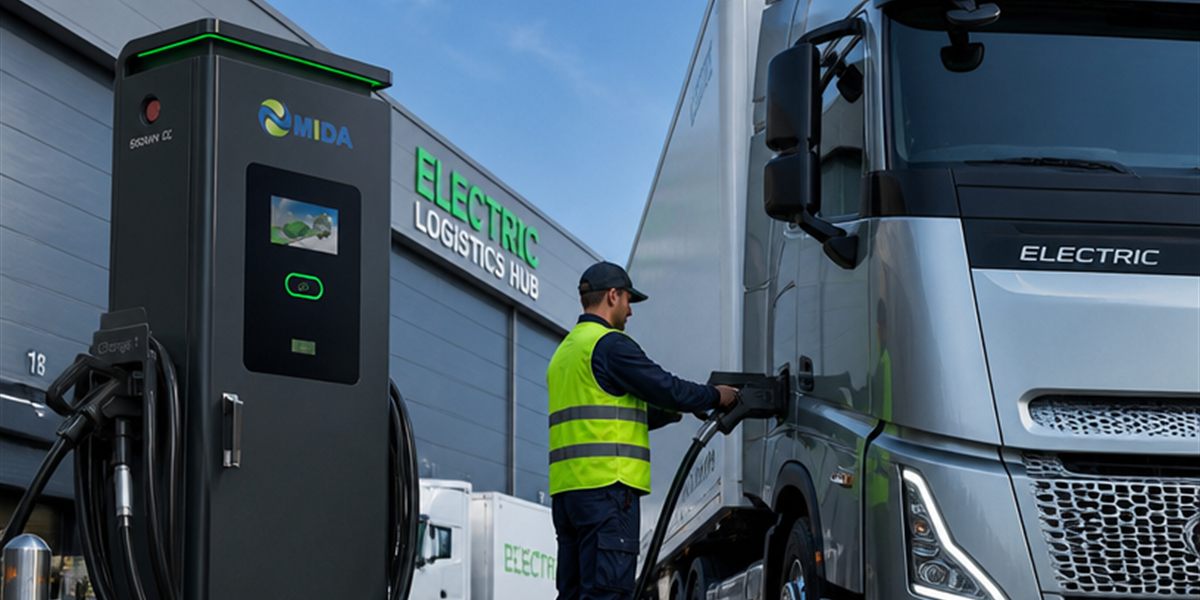
Future-Proofing Logistics Parks: High-Availability 960kW Split DC Charging Infrastructures for 2026
Quick Answer
A 960kW split DC charging infrastructure for logistics parks consists of modular power cabinets located in a dedicated electrical room, feeding remote charging dispensers through liquid-cooled cables at each parking bay. This architecture lets fleets of heavy-duty electric trucks charge at megawatt-class speeds 鈥?typically 480鈥?60kW per lane group 鈥?while keeping the grid connection efficient and maintenance costs predictable. For 2026, this design matters because e-truck battery capacities (400鈥?00kWh) and depot dwell windows (45鈥?0 minutes) demand sustained high power rather than occasional peaks. High availability is engineered through N+X power-module redundancy, hot-swap serviceability, and multi-dispenser failover, so a single module or dispenser failure never takes a charging lane offline. For logistics operators, a 960kW split system turns a truck yard into a predictable, high-throughput energy hub with lower total cost of ownership (TCO) than any integrated-unit alternative.
Key Takeaways
- Split architecture decouples power electronics from the parking bay, so one 960kW system can serve 4鈥? charging lanes from a single compact electrical room.
- N+X module redundancy plus hot-swap design delivers 99%+ charging availability 鈥?critical when an idled truck can cost a carrier over $1,200 per day in lost revenue.
- Liquid-cooled dispensers keep 600A+ cables lightweight and manageable, safe for repeated daily handling by yard staff in all weather.
- Native 800鈥?000V DC output future-proofs the yard for next-generation e-truck platforms and the emerging Megawatt Charging System (MCS) standard.
- Modular 240kW cabinets allow logistics parks to scale capacity in step with fleet growth, protecting capital in a fast-moving market.
Why Logistics Parks Are Rebuilding Their Energy Architecture
The electrification of heavy-duty road freight has moved from pilot programs to procurement reality. By 2026, major European and North American fleets are running delivery schedules that assume battery-electric trucks will complete regional routes of 400鈥?00km, return to the depot, and be ready for the next shift. That assumption collapses if the charging yard cannot deliver enough energy in the available window.
The economics are unforgiving. A Class 8 e-truck with a 600kWh battery needs roughly 300鈥?50kWh of energy to be replenished during a 60鈥?0 minute turnaround. At a conventional 150kW charger, that is a two-to-four-hour session 鈥?far beyond the dwell window. The only practical answer is high-power charging: 300kW, 480kW, and above. And once site capacity crosses roughly 600kW, the physical and electrical advantages of a split architecture become decisive.
This is why logistics parks 鈥?not motorway service areas 鈥?are emerging as the first mass adopters of 960kW-scale charging. A park owns its grid connection, controls its yard layout, and runs vehicles on predictable schedules. It can engineer charging infrastructure the way it engineers a warehouse: for availability, throughput, and lifetime cost.
What a 960kW Split DC System Actually Is
A split DC charging system separates the two halves of a traditional charging station:
- Power cabinet (power conversion unit): houses the AC/DC rectifier modules, control electronics, and cooling system. It converts grid AC power into DC and regulates voltage and current per dispenser.
- Dispenser (charging terminal): a compact kiosk holding the DC cable, connector, user interface, and metering. It contains no large power electronics, so it is small, quiet, and cheap to install.
A 960kW system is typically built from four 240kW power cabinets, each feeding one or more dispensers.
| Architecture Element | Integrated 350鈥?80kW Unit | 960kW Split System |
|---|---|---|
| Power electronics location | Inside each station, at the bay | Centralized power cabinet room |
| Space per parking bay | 1.5鈥? m虏 of station footprint | <1 m虏 for a slim dispenser |
| Cable handling | 350A liquid-cooled or thick 150mm虏 copper | 600A liquid-cooled, ~30鈥?0% lighter |
| Heat load at bay | Significant, HVAC/ventilation needed | Negligible; heat rejected at power room |
| Service access | On-site at each station | Single service point for all modules |
| Expandability | Replace whole station to grow | Add one 240kW cabinet per expansion step |
| Noise at parking bay | 60鈥?0 dB(A) fan noise | <45 dB(A) dispensers |
Matching Power to Duty Cycles: The Data Behind 960kW
The correct site capacity is a function of vehicle energy demand and dwell time, not a marketing number. Fleet operators should size using the effective throughput formula:
Effective energy delivered per lane = average session power 脳 utilization 脳 session duration
Consider a mixed logistics yard in 2026:
| Vehicle Class | Typical Battery (kWh) | Target Session (min) | Required Average Power (kW) |
|---|---|---|---|
| Electric van / light truck | 80鈥?20 | 30鈥?5 | 120鈥?00 |
| Rigid e-truck (18t) | 300鈥?50 | 60鈥?5 | 300鈥?00 |
| Tractor-trailer (40t, regional) | 500鈥?00 | 60鈥?0 | 400鈥?00 |
| Tractor-trailer (long-haul, MCS-ready) | 750鈥?000+ | 45鈥?0 | 750鈥?000 |
A 960kW split system with eight dispensers and dynamic power sharing can comfortably serve a mixed fleet: several lanes at 150鈥?50kW for vans while one or two lanes deliver 600kW+ for tractor-trailers. The power cabinets reallocate DC capacity between dispensers in real time, so no module is ever idle while a truck waits.
Engineering High Availability: N+X Redundancy and Hot Swap
Availability is the feature that separates a charging yard from a charging experiment. In a logistics operation, a failed charger is not an inconvenience; it is a missed dispatch, a penalty clause, or a truck sent to a competitor’s facility.
Split systems deliver availability through three mechanisms:
- N+X module redundancy. A 240kW cabinet is built from smaller power modules (for example, six 40kW liquid-cooled modules). Running the cabinet with one module held as spare 鈥?200kW nominal on six modules, 240kW with five plus one reserve 鈥?means a module failure costs throughput headroom, not a shutdown. Operators choose the redundancy level: N+1 protects against single-module failure; N+2 protects against failure during peak demand.
- Hot-swap serviceability. Modules are replaced without powering down the cabinet or touching the high-voltage bus. A trained technician swaps a failed 40kW module in under 15 minutes 鈥?comparable to replacing a server blade in a data center. This is the difference between 15-minute mean time to repair (MTTR) and a four-hour site visit.
- Dispenser failover and dual-cable lanes. When a dispenser fails, its power allocation is redistributed to neighboring dispensers, and drivers can be redirected to an adjacent lane. High-traffic lanes can be specified with dual cables (CCS1/CCS2 or CCS2/NACS) so any vehicle type can plug in without adapter logistics.
The result is a quantifiable availability target. With N+1 redundancy at module level and a stocked spare-parts kit, logistics parks can contractually plan for 99%+ charging availability 鈥?meaning less than 3.5 days of cumulative unplanned downtime per year across the whole site, most of which is scheduled maintenance.
| Redundancy Scenario | Nominal Output | Failure Behavior | Downtime per Module Failure |
|---|---|---|---|
| 6脳 40kW, no spare | 240kW | One module fails 鈫?cabinet derates to 200kW | None (derated) but peak capacity lost |
| 7脳 40kW, N+1 | 240kW (1 spare) | One module fails 鈫?full 240kW continues | None 鈥?hot-swap at leisure |
| 8脳 40kW, N+2 | 240kW (2 spares) | Two modules fail 鈫?full output holds | None 鈥?window for scheduled swap |
Grid Connection, Storage, and Site Engineering
A 960kW DC load is a serious grid engineering exercise. The transformer, switchgear, and cable runs must be sized for the site’s peak demand, and utilities increasingly charge for that peak through demand tariffs.
Three engineering decisions determine whether a 960kW yard is profitable:
- Transformer sizing. A dedicated 1,000鈥?,250kVA transformer (or existing capacity reallocation) is the conventional route. Because split systems aggregate power in one room, the transformer, main switchboard, and metering are installed once and serve all lanes 鈥?versus multiple distributed transformers in an integrated-unit design.
- Peak shaving with battery storage. Many logistics parks pair the 960kW charger with a battery energy storage system (BESS) to clip demand peaks. The charger draws from storage during the highest-tariff windows and recharges storage overnight. This can reduce demand charges by 30鈥?0% and is one of the fastest payback items in the site energy stack.
- Dynamic load management. OCPP-based load management software coordinates the power cabinets with the building’s other loads (warehouse automation, refrigeration, HVAC), keeping the site under its grid contract without manual intervention.
For parks operating in regions with strict grid codes, the split system’s centralized power room also simplifies compliance: all protection, metering, and disconnection hardware lives in one accessible, code-compliant space.
Future-Proofing: 2026 and Beyond
“Future-proof” is an overused word, but in charging infrastructure it has a concrete meaning: the system must still be economical when the vehicles change. A 960kW split system is designed for that transition:
- Voltage evolution. Current e-trucks are 800V platforms; next-generation platforms are moving toward 1000V+ to cut current and cable losses. MIDA’s power cabinets support output voltages spanning 150鈥?000V DC, so the same cabinet serves today’s 800V fleets and tomorrow’s 1000V fleets.
- MCS readiness. The Megawatt Charging System (MCS) standard will push single-connector power toward 1.2鈥?.75MW. Split architecture is the only practical way to deploy megawatt-scale power in a depot without placing oversized hardware at every bay. Parks can stage the upgrade: add cabinets, upgrade dispensers, and keep the same electrical room.
- Energy management integration. The charging network is becoming part of the site’s energy management system 鈥?arbitrage, demand response, and behind-the-meter solar all connect through the same power room. A centralized architecture is inherently compatible with this roadmap; distributed integrated units are not.
- Protocol longevity. OCPP 2.0.1 support (with ISO 15118 Plug & Charge) is the baseline for fleet billing, smart charging, and roaming. A 960kW site speaking OCPP 2.0.1 integrates with any leading charge management system today and remains compliant as utility requirements tighten.
Total Cost of Ownership: Why Split Wins at Scale
The compounding effect of split architecture is significant: versus four integrated 480kW units, a 960kW split system avoids four separate station pads and service areas, centralizes switchgear and cooling into one power room, and replaces multiple yard-level service points with a single hot-swap service location. Parks typically report 15鈥?0% lower lifetime TCO for split architecture at the 960kW scale, driven mainly by civil works, maintenance labor, and expansion costs.
MIDA’s 960kW Split DC Portfolio
MIDA Power designs and manufactures the full chain of components behind a 960kW split system 鈥?from the 40kW/60kW liquid-cooling power modules that populate each cabinet to the 480kW liquid-cooled ultra-fast charging station proven on motorway corridors. The same module platform scales into 960kW and beyond: combine cabinets, add dispensers, and grow the yard as the fleet grows.
For attended logistics parks that need billing, access control, and payment at the dispenser, MIDA’s 360kW liquid-cooled charging station with RFID, OCPP and POS demonstrates the company’s capability in full-service, driver-facing hardware. Every station in the portfolio 鈥?certified to TUV/CE/UL and built for 10+ years of field service 鈥?is designed for the split architecture, OCPP 2.0.1 smart charging, and the module-level telemetry that logistics operators need for proactive maintenance. Explore the complete commercial DC fast charging range to see how MIDA configures high-availability systems for logistics parks and depots.
FAQ
1. What is a split DC charging system, and why is 960kW split better for logistics parks?
A split system separates the power cabinet (AC/DC conversion, cooling, service) from slim dispensers at each parking bay. At 960kW scale, this centralizes heat, noise, and maintenance in one electrical room while keeping the yard footprint per lane under one square meter 鈥?the only practical layout for high-throughput truck depots.
2. How much can a 960kW system actually deliver to one truck?
With dynamic power sharing, a single lane can receive up to 600kW (or more with dual-cable dispensers) while other lanes are served at lower power. A 600kWh e-truck can gain roughly 60鈥?0% state of charge in a 60-minute window, depending on battery acceptance and voltage.
3. What does N+X redundancy mean for a 240kW cabinet?
It means the cabinet contains one or more spare power modules beyond the number needed for full output. If a module fails, output is unaffected, and the failed module is hot-swapped in minutes 鈥?no truck waits, no lane closes.
4. Is a 960kW charger compatible with 800V and 1000V trucks?
Yes. MIDA power cabinets support DC output from 150V up to 1000V, covering today’s 400V and 800V platforms and next-generation high-voltage trucks. Voltage is negotiated per session with the vehicle.
5. Do I need a new transformer for a 960kW charging yard?
Almost certainly yes, unless the park already has significant spare grid capacity. Typical installations use a dedicated 1,000鈥?,250kVA transformer; pairing the charger with battery storage can reduce the required peak draw and associated demand charges.
6. How long does installation take compared with integrated chargers?
Civil works are simpler because the power room is a single consolidated installation, but transformer and switchgear lead times often dominate. A typical park goes from site survey to operational charging in 3鈥? months; modular cabinet additions afterward take weeks, not months.
7. Can a 960kW split system upgrade to megawatt charging (MCS) later?
Yes 鈥?this is the core future-proofing argument. MCS upgrades are staged by adding power cabinets and swapping dispensers, while the electrical room, switchgear, and grid connection remain. The split architecture is the only depot layout that accommodates megawatt-scale power without rebuilding the yard.
Post time: Aug-21-2026


