
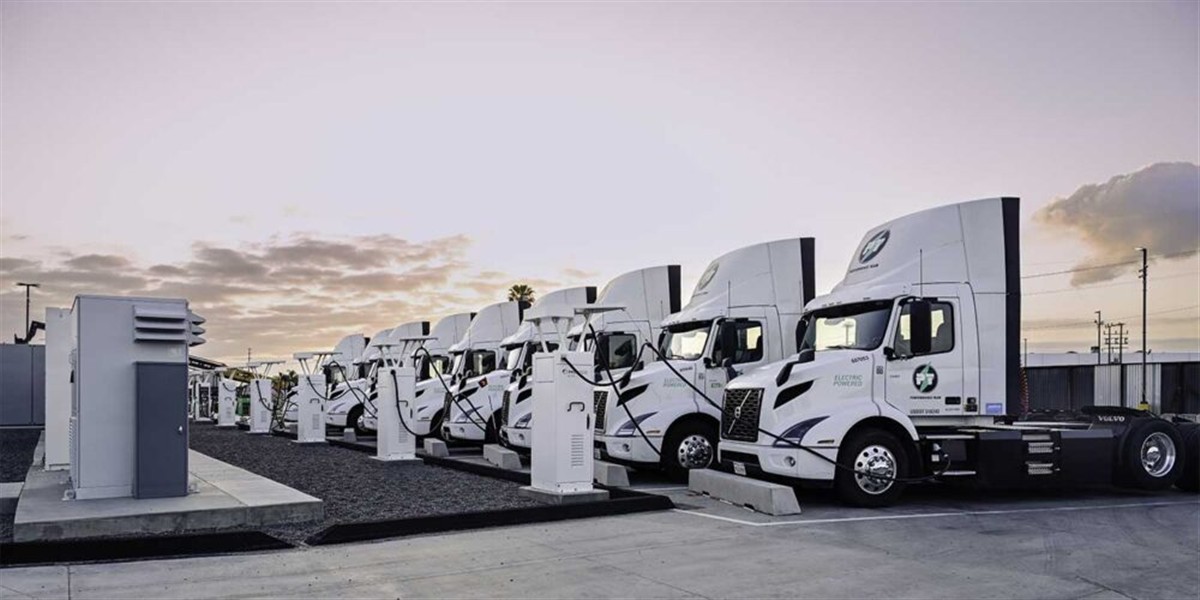
Heavy-Duty Electrification: High-Power DC Charging Solutions for Electric Logistics Trucks
Quick Answer
Electric logistics trucks — from 7.5-tonne urban delivery vehicles to 44-tonne long-haul tractor units — have crossed the economic tipping point, but only where high-power DC charging infrastructure exists. Unlike passenger EVs, trucks carry 200-700kWh batteries and must return to service on depot or route schedules measured in minutes, not hours. That demand cannot be met by 150kW passenger chargers: a 400kWh truck battery would need 2.5+ hours to refill at that rate. The commercially viable answer is high-power DC fast charging in the 240-480kW range with liquid-cooled cables and modular power architecture, complemented by battery energy storage (BESS) to manage grid constraints and demand charges. Real-world deployments show that a 480kW liquid-cooled charger can restore roughly 300km of range to a long-haul electric truck in a 40-minute mandatory rest stop, while depot sites pairing 360kW chargers with BESS cut peak demand charges by 30-60%. This article breaks down the charging requirements of each truck class, the hardware that meets them, and the site economics that make fleet electrification bankable.
Key Takeaways
- Truck batteries (200-700kWh) make high-power DC charging a hard requirement: 360-480kW liquid-cooled chargers are the practical sweet spot for regional and long-haul logistics today.
- Liquid-cooled cables are non-negotiable at 400-600A continuous current — air-cooled hardware derates or fails under truck duty cycles.
- Modular power cabinets let fleets start at 240kW and scale to 480kW+ as the truck fleet grows, protecting capital investment.
- BESS integration cuts peak demand charges by 30-60% and enables megawatt-class charging on limited grid connections — often the difference between an approved and a rejected site permit.
- Megawatt Charging System (MCS) at 1MW+ will define the next decade for heavy trucks; today’s 1000V, OCPP-compliant chargers are the upgradeable foundation.
The Freight Electrification Imperative: Why Logistics Fleets Are Moving Now
Freight transport accounts for roughly 8-10% of global energy-related CO₂ emissions, and heavy trucks are the hardest segment to decarbonize. That is changing faster than most observers predicted. Three forces are converging in 2025-2026:
- Regulation. The EU’s CO₂ standards for heavy-duty vehicles mandate a 45% emission reduction for new trucks by 2030 and 90% by 2040; California’s Advanced Clean Fleets rule and multiple US state adoptions push zero-emission truck sales from 2026 onward. Non-compliance is no longer a reputational risk — it is a legal one.
- Total Cost of Ownership (TCO). With battery prices below $100/kWh at pack level and electricity at $0.08-0.15/kWh versus diesel at $0.9-1.2/liter equivalent, electric trucks already undercut diesel on per-km energy cost by 40-60% in high-utilization urban and regional duty cycles.
- Customer pressure. Retailers and shippers are signing green-logistics contracts with CO₂ clauses. Carriers that cannot demonstrate electric capability lose tenders.
The bottleneck is no longer the truck — it is the charging infrastructure. A 44-tonne electric tractor with a 500-700kWh battery needs 350-600kW charging rates to keep its utilization ratio competitive with diesel. That is a fundamentally different engineering problem from passenger EV charging, and it requires a dedicated hardware category.
Why Passenger Charging Technology Fails for Trucks
It is tempting to assume that a network of 150-350kW CCS2 chargers built for cars can serve trucks. In practice, three mismatches break the assumption:
Power deficit. A regional distribution truck with a 300kWh battery doing two daily cycles needs roughly 600kWh of energy throughput per day. Even a 350kW charger delivers that only with 1.5-2 hours of charging time — acceptable at night, fatal during mid-shift turnaround windows of 30-45 minutes. For long-haul, a 150kW charger is simply unusable: a 40-minute driver rest stop adds only 100kWh, about 100-150km of range.
Mechanical and thermal limits. Truck CCS2 charging routinely demands 400-500A continuous for 45+ minutes. Air-cooled connectors were never designed for that duty cycle; sustained sessions trigger thermal derating that silently slows charging. Liquid-cooled cables — the same technology used in 360-480kW passenger superchargers — are the only hardware that holds 600A continuously.
Fleet management and power sharing. A depot with 20 trucks cannot install 20 individual 480kW chargers; the grid connection alone would be prohibitive. Fleets need intelligent, OCPP-compliant power sharing across modular cabinets — exactly what MIDA’s EV charging solutions portfolio delivers with dynamic load management across stalls.
Truck Class-by-Class Charging Requirements
Charging requirements scale with battery size, duty cycle, and turnaround time. The table below maps the three dominant truck classes to realistic hardware needs.
| Truck Class | Typical Battery | Daily Energy | Duty Cycle | Recommended Charger | Session Target |
|---|---|---|---|---|---|
| Light delivery (3.5-7.5t) | 60-120kWh | 150-250kWh | Urban, returns to depot at night | 60-120kW AC/DC depot + 240kW opportunity | 1-2 hrs overnight; 20-30 min mid-day |
| Regional distribution (7.5-26t) | 200-400kWh | 400-700kWh | 200-400km/day, fixed routes | 240-360kW liquid-cooled DC | 30-60 min depot turnaround |
| Long-haul tractor (26-44t) | 400-700kWh | 800-1400kWh | 600-900km/day, multi-shift | 480kW liquid-cooled + MCS-ready (1MW+) | 40-45 min at rest stops; 6-8 hrs overnight |
Two patterns emerge. First, overnight depot charging (4-8 hours at 60-120kW) covers baseline energy needs cheaply — but it is never enough alone, because multi-shift operations and high daily mileage push energy demand beyond overnight windows. Second, opportunity charging at 360-480kW during mandated rest breaks is what unlocks utilization parity with diesel. A 480kW ultra-fast liquid-cooled DC charging station designed for motorway corridors matches a long-haul truck’s 40-minute rest window to 250-300km of added range — the single most important design parameter for freight electrification.
The Hardware That Makes Truck Charging Work
High-power DC charging for trucks rests on four engineering pillars:
1. Liquid-Cooled Power Modules
Truck charging stresses power electronics harder than any passenger application. MIDA’s 40kW/60kW liquid-cooling power modules for DC EV charging stations are the building blocks of 240-480kW systems: each module maintains stable output at ambient temperatures from -30°C to +55°C, and failed modules can be swapped hot in under 10 minutes — critical for a depot that cannot tolerate downtime.
2. 150-1000V Wide Output Range
Fleet batteries span from 400V-class light trucks to 800V-class tractors. A charger with a 150-1000V DC output range serves every class with a single hardware platform, automatically adapting voltage per CCS2/ISO 15118 negotiation.
3. 500-600A Liquid-Cooled Cables
For 360kW at 800V and 480kW at 1000V, cable current reaches 450-600A. Liquid-cooled cable assemblies — with coolant circulating to the connector tip — sustain these currents indefinitely and keep cable weight manageable for drivers.
4. OCPP and Fleet Orchestration
Depot operators need remote monitoring, power sharing, scheduled charging, and billing integration. OCPP 1.6J/2.0.1 compliance plus open APIs let a fleet management system optimize charging against grid tariffs and vehicle departure times — typically cutting energy cost by 15-25% through smart scheduling alone.
The liquid-cooled ultra 360kW charging station with RFID, OCPP and POS from MIDA packages these four pillars into a deployment-ready unit — the configuration most regional fleets and public corridor operators are standardizing on in 2026.
The Economics: High-Power Charging vs. Diesel — A Fleet-Level View
The table below compares the per-km energy cost of a regional electric distribution truck (300kWh pack, 250km/day) against its diesel equivalent, at 2026 European price levels (electricity €0.18/kWh, diesel €1.10/liter).
| Cost Driver | Diesel Truck | Electric Truck (Depot Charging) |
|---|---|---|
| Energy/fuel cost per km | €0.42 | €0.16 |
| Maintenance per km | €0.12 | €0.06 |
| Total energy + maintenance per km | €0.54 | €0.22 |
| Annual energy cost (75,000 km) | €40,500 | €16,500 |
| Charging infrastructure (amortized) | — | €0.03-0.05/km |
| Effective cost per km | €0.54 | €0.25-0.27 |
Electric trucks cut running cost roughly in half — the savings that fund the higher vehicle purchase price and the charging infrastructure itself. The same math holds in North America and China, where the electricity-to-diesel price ratio is even more favorable.
Where BESS changes the site equation: a depot pulling 480kW peak for three simultaneous fast-charging sessions would face enormous demand charges on most utility tariffs. Adding a battery buffer (e.g., 200-500kWh) allows the site to charge batteries overnight at off-peak rates and discharge during sessions, cutting peak demand by 30-60% and total energy cost by 10-20%. For public corridor sites on constrained grid feeds, BESS is often the difference between a 6-month and an 18-month commissioning timeline.
A Deployment Blueprint for Fleet Operators
Based on MIDA’s deployment experience across Europe, Southeast Asia, and the Middle East, a successful truck-charging rollout follows six steps:
- Audit duty cycles first. Map routes, daily energy, dwell times, and turnaround windows before sizing anything. The charging design follows the schedule, not the other way around.
- Design for peak, then smooth with storage. Size the grid connection to the average load and use BESS to cover peaks; this typically halves connection costs.
- Choose modular hardware. Deploy a 240kW cabinet today with slots for additional liquid-cooled power modules tomorrow, so fleet growth means adding modules, not replacing stations.
- Standardize on 1000V and CCS2, plan for MCS. Every 2026-era charger should output up to 1000V; Megawatt Charging System connectors can be added at the cabinet level later.
- Integrate OCPP-based management for scheduling, load balancing, and tariff optimization from day one — retrofitting software intelligence is more expensive than designing it in.
- Build redundancy. For a fleet, a failed charger is a stopped truck. Hot-swappable modules and N+1 power configurations keep availability above 99%.
The Road Ahead: Megawatt Charging and the 2030 Horizon
The European Union’s AFIR regulation and the global MCS standard are converging on a clear direction: heavy-duty truck charging will move to 1-3.75MW per stall over the next five years. What this means for operators investing today is strategic: buy modular, liquid-cooled, 1000V architecture now, and the 480kW system you install in 2026 becomes the building block of an MCS-ready megawatt site in 2028-2030. The power modules, cooling systems, and BESS integration you deploy today are fully reusable; only the connector and high-current bus evolve. That is the upgrade path MIDA’s liquid-cooled ultra-fast charging family is engineered around — and why fleets that move early are not betting on a dead end, but on the industry’s only viable trajectory.
FAQ
1. How fast can an electric truck charge?
With a 480kW liquid-cooled DC charger, a 400-500kWh regional truck can recover 60-80% of capacity in 45-60 minutes; a long-haul 700kWh tractor gains roughly 250-300km of range in a 40-minute rest stop. Overnight, most trucks can fully charge at 60-150kW in 6-8 hours.
2. Why can’t trucks use regular 150kW EV chargers?
A 150kW charger delivers only 100-125kWh in a 45-minute window — insufficient for the 300-700kWh batteries of freight trucks. Additionally, sustained 400A+ sessions exceed the thermal limits of air-cooled passenger connectors.
3. What is the difference between CCS2 and MCS charging for trucks?
CCS2 (up to 350-500kW in practice) is the current standard used by light and regional trucks. MCS (Megawatt Charging System, up to 3.75MW and 1250A) is the emerging standard for long-haul heavy trucks. Both can coexist on the same cabinet via interchangeable connectors.
4. Do electric trucks need special connectors?
Most electric trucks on the market use standard CCS2 for up to 350-480kW charging. Long-haul trucks with 800V+ systems will increasingly use the heavier MCS connector rated for megawatt power. Charging stations can be configured to support both.
5. How much does a high-power truck charging station cost?
A 360kW liquid-cooled station typically costs $60,000-90,000 in equipment; a 480kW unit with BESS integration and site works ranges from $150,000-250,000 per stall. Fleet payback periods are typically 3-6 years based on fuel savings alone.
6. What grid connection do I need for a truck depot charger?
A single 480kW charger needs roughly 480-520kVA of feed if it runs at full power; a multi-stall depot usually designs for average load plus a BESS buffer, often requiring 250-800kVA instead of several megavolt-amperes.
7. Can a truck charge at a passenger EV fast-charging station?
Physically yes — most trucks use the same CCS2 connector — but practically it is discouraged: session times are long, the truck may block two parking bays, and passenger-station power (150-350kW) is far below what the truck’s schedule demands. Dedicated high-power truck corridors and depots are the correct solution.
MIDA Power supplies liquid-cooled DC fast charging stations, 40kW/60kW power modules, and BESS-integrated charging hubs for freight, logistics, and public corridor operators worldwide. For fleet charging design support, contact MIDA via midapower.com.
Post time: Aug-20-2026


