
Mobile Power Banks for EVs: Enhancing Roadside Assistance with DC Fast Charging
Quick Answer
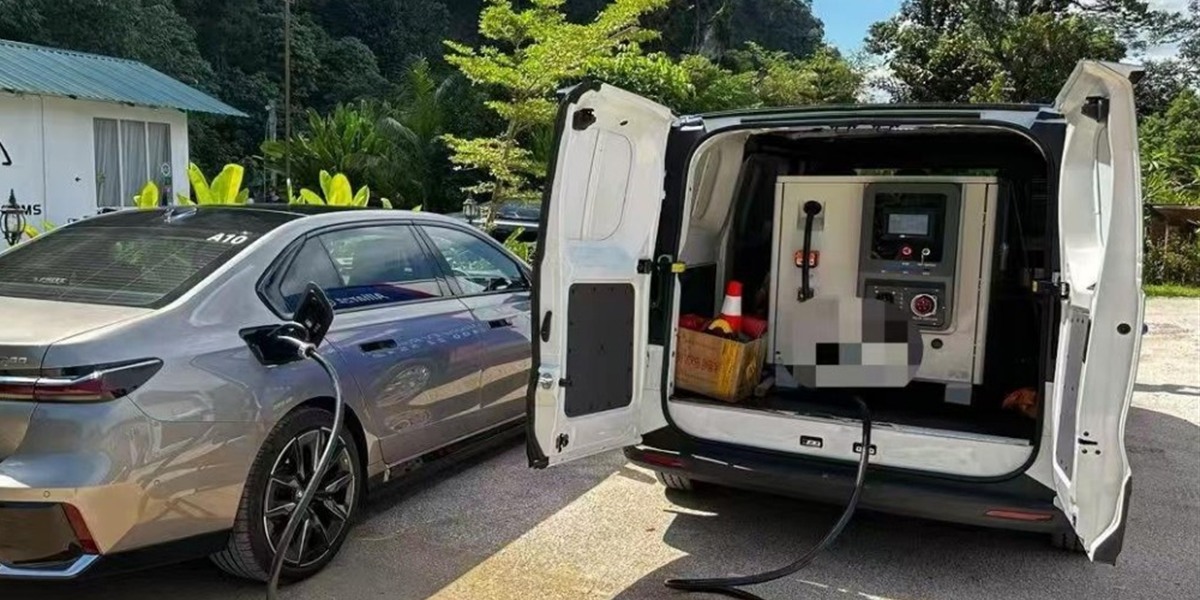
Mobile power banks for EVs — battery-integrated mobile DC fast chargers mounted in vans or trailers — let roadside assistance operators deliver a genuine fast-charge boost at the breakdown site instead of a slow 3.6kW top-up or an expensive tow. A modern unit pairs a 40–100kWh battery pack with a 30–60kW DC charging module (200–1000V output), giving a stranded EV 80–150km of range in 15–30 minutes, enough to reach the nearest public charger or depot. For assistance fleets, this shifts the service from “damage control” to revenue-generating emergency charging, cuts tow costs by 40–60%, and removes the single biggest operational constraint of roadside EV rescue: the lack of a three-phase AC supply at the breakdown location. When the mobile bank returns to base, it recharges overnight from any standard industrial socket or depot grid connection.
Key Takeaways
- Energy independence at the roadside: A 60–100kWh mobile battery bank can serve 3–6 rescue events per day without needing a three-phase connection at the breakdown site.
- Real fast-charge speed: 30–60kW DC output delivers 80–150km of range in 15–30 minutes — 5–10× faster than AC emergency chargers.
- Tow-cost reduction: Enabling the vehicle to drive itself to a charger cuts average EV breakdown costs by 40–60% versus flatbed towing, which can exceed $500–$1,200 per incident.
- Fleet utilization gains: The same unit that rescues stranded EVs can charge depot “orphan” vehicles, service-bay cars, and event fleets between calls.
- Universal compatibility: Wide 200–1000V output and CCS1/CCS2/GBT/NACS connector options cover virtually every EV on the road in 2026.
The Roadside EV Problem: Why Towing Is the Wrong Answer
When an EV runs out of charge on a motorway shoulder, the traditional playbook is flatbed towing to the nearest charger. The economics and engineering of that response are bad on every axis:
- Cost: Tows in North America and Europe routinely run $300–$1,200 depending on distance and time of day.
- Damage risk: EVs have no neutral gear in the traditional sense; towing with wheels on the ground can back-feed the motor and damage the drivetrain. Most manufacturers mandate wheel-lift or flatbed-only protocols, which slows every rescue.
- Time: A 40km tow plus charger queue can strand a driver for 2–4 hours. A boost charge completes in 20–30 minutes.
- Grid dependency: AC emergency chargers need a wall socket or generator at the scene — often unavailable on a highway shoulder or remote rural road.
A mobile power bank breaks all four constraints at once. It carries its own energy, delivers DC fast-charge speed, works on any road, and converts a loss-making tow into a billable, fast, high-margin service.
For assistance networks, the mobile power bank is not just a tool — it is a service-tier upgrade that differentiates the operator from every competitor still dispatching tow trucks.
Anatomy of a 2026-Class Mobile Power Bank
The MIDA mobile power bank integrates four sub-systems into a vehicle-rated package:
- Battery pack (40–100kWh LFP) — The energy reservoir. LFP chemistry is chosen for cycle life (3,500+ cycles), thermal stability, and safe operation in a vehicle environment. The pack is sized so that even after a full day of rescues, the bank can still charge itself overnight on a standard industrial socket.
- DC charging module (30–60kW) — A wide-range 200–1000V DC power stage built on the same 40kW/60kW liquid-cooling power module platform used in stationary chargers, delivering high efficiency and proven reliability in a mobile footprint.
- Smart controller with OCPP 1.6J/2.0.1 — Handles session authorization, metering, billing, and remote monitoring over 4G/WiFi, so rescue sessions can be invoiced automatically through the operator’s existing platform.
- Universal cable kit — CCS1, CCS2, GBT, and NACS (native or adapter) connectors with 5–10m cables, covering the full European, North American, and Asian vehicle mix.
Technical Comparison: Mobile Power Bank vs. Alternatives
| Parameter | 3.6kW AC Emergency Charger | Diesel Generator + 30kW DC | Mobile Power Bank (60kW DC) |
|---|---|---|---|
| Range added in 20 min | ~8–12 km | ~60–90 km | ~80–150 km |
| Noise at roadside | Silent | 75–95 dB(A) | <55 dB(A) |
| Emissions at scene | None | High (idling generator) | None |
| Fuel/energy logistics | Grid socket needed | Diesel supply chain | Recharge at base overnight |
| 3-phase supply required at scene | No (single-phase) | No (self-contained) | No — self-contained energy |
| Cost per rescue (energy + ops) | Low but 5–8× slower | Medium + fuel cost | Medium, fast, billable |
| Vehicle compatibility | All | All | All (200–1000V, all connectors) |
Use Cases That Pay for the Asset
1. Motorway and highway patrol. A 60kW mobile bank in a patrol van gives a stranded EV 100+ km of range in 20 minutes — enough to reach the next service area. Agencies and assistance networks using this model report clearing incidents 3–4× faster than tow-based responses and keeping lanes open longer.
2. Dealerships and service centers. The same unit that rescues customers charges showroom inventory, PDI (pre-delivery inspection) vehicles, and loaner cars in the service bay — converting a roadside-only asset into a daily-use tool with 60–80% utilization.
3. Fleet depot gap coverage. When a delivery van misses its overnight charge slot or returns early for a second shift, a mobile power bank stages it at the loading dock in 25–40 minutes instead of queueing it at a fixed stall.
4. Events, pop-ups, and temporary sites. Festivals, expos, and film locations need EV charging for days or weeks without permanent infrastructure. A trailer-mounted power bank provides it and drives away when the event ends.
5. Off-grid and rural coverage. In areas where charger spacing exceeds vehicle range (mountain passes, remote highways, island roads), a network of mobile banks guarantees coverage where fixed stations are uneconomic.
Operating Model and Safety Engineering
Roadside operation is harsher than any stationary installation: vibration, weather, public proximity, and untrained bystanders. MIDA engineers mobile units accordingly:
- IP54/IP55 enclosure and IK10 impact resistance for outdoor and vehicle-mounted service.
- Integrated Type B RCD and full protection suite — over-temperature, under-voltage, short-circuit, and leakage protection on every session.
- Battery safety per automotive standards — cell-level fusing, gas detection, and fire suppression within the pack enclosure, with certification to UN38.3 and IEC 62619.
- RFID and app authorization to prevent unauthorized use in semi-public settings, with session logging for insurance and billing.
- Active thermal management so the DC module holds full output from −20°C to +50°C ambient, with the battery pack’s thermal conditioning running from the van’s own power.
Fleet Economics: The 12-Month Payback Model
For an assistance operator, the unit economics work like this: at an average billable rate of $150–$250 per fast-charge rescue and 4–6 events per day for a busy patrol van, a $60,000–$90,000 mobile power bank generates $1,800–$3,600 per week in revenue — a 12–18 month payback before counting the tow costs avoided. Margins are structurally better than towing because the incremental cost per rescue is only the electricity (a few dollars) and driver time, not a tow truck, a 40km deadhead, and a second vehicle to return the driver.
For insurance companies and fleet operators, the avoided-cost math is equally strong: every rescue completed on-site at $200 avoids a $600+ tow-and-return process, saving $400 net per incident across thousands of events per year.
FAQ
1. How much range can a mobile power bank add? At 60kW DC output, a typical EV gains 80–150km of range in 15–30 minutes depending on battery size, state of charge, and temperature. Even the smallest 30kW unit adds 40–70km in 20 minutes.
2. How many rescues can one unit handle per day? A 60–100kWh bank serves 3–6 fast-charge rescues per day (using 15–25kWh per event) before returning to base to recharge overnight. Units with onboard charging can also top up between calls from any 32A industrial socket.
3. Does it need a three-phase supply at the breakdown site? No — that is the core advantage. The mobile power bank carries its own energy. It recharges at base, from a depot charger, or overnight from a standard industrial outlet.
4. Can it charge 800V vehicles like the Porsche Taycan or Hyundai IONIQ 6? Yes. The wide 200–1000V DC output range covers both 400V and 800V architectures natively, with no hardware change between sessions.
5. Is it safe to use on a live motorway shoulder? The unit is IP54/IP55 rated with automotive-grade battery safety (UN38.3, IEC 62619), integrated RCD protection, and app/RFID authorization. Operators still follow standard roadside-cone-and-vest protocols; the charger itself adds no additional hazard.
6. What connectors are available? CCS1, CCS2, GBT, and NACS (native or via high-power adapters), with 5–10m cable options to reach vehicles in awkward positions.
7. Can the same asset be used for fleet charging between rescues? Absolutely. Dealerships, depots, and event operators routinely achieve 60–80% utilization by combining roadside rescue with service-bay and staging charging — the versatility is what drives the 12–18 month payback.
Conclusion
Mobile power banks for EVs turn the weakest link in the electric ecosystem — the stranded vehicle — into a fast, billable, and fully electrified service. By carrying their own energy and delivering true DC fast-charge speeds at the roadside, they eliminate the tow, the generator, and the grid dependency that have made EV rescue slow and expensive. For roadside assistance providers, dealerships, and fleets, the portable DC charger range from MIDA — from compact 30kW units to battery-integrated mobile power banks — is the professional tool that makes emergency charging a competitive service rather than a costly exception.
MIDA Power manufactures portable and mobile DC fast charging solutions, including battery-integrated mobile power banks and commercial DC charging stations. For fleet rollout planning and custom vehicle integration, contact MIDA via midapower.com.
Post time: Aug-24-2026


