
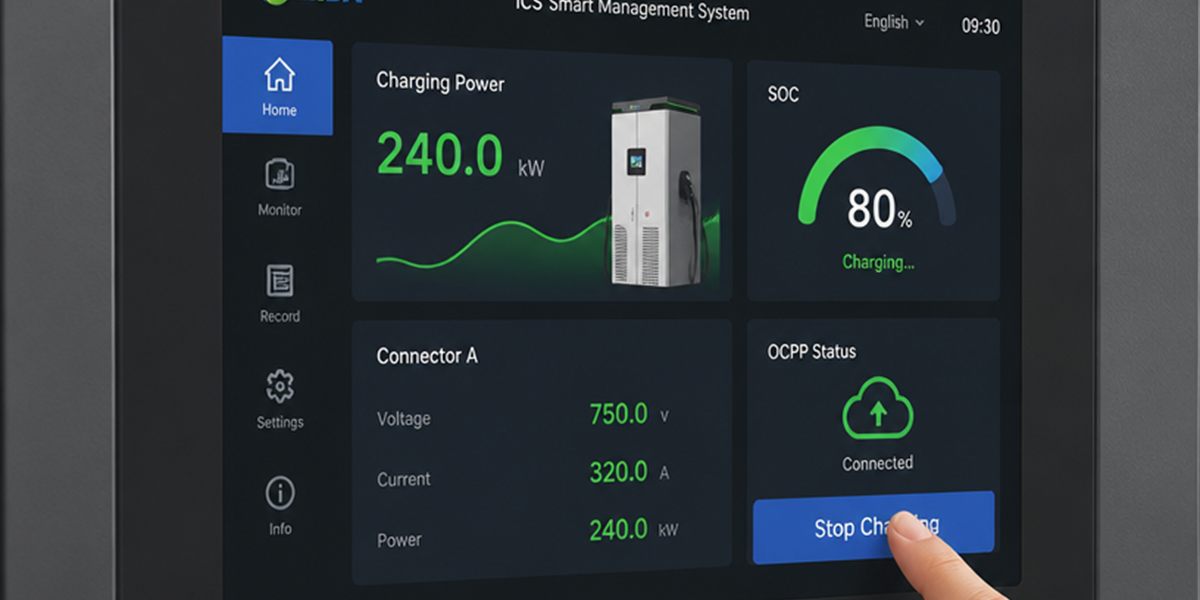
Modular Expansion: How 240kW Split DC Fast Charging Units Scale with Your Network
Quick Answer
A 240kW split DC fast charging unit is the smallest standard building block in MIDA Power’s modular charging architecture: one power cabinet (with 150–1000V DC output and liquid-cooled modules) plus one or more dispensers, expandable in predictable 240kW increments to 480kW, 720kW, 960kW, and beyond. For charge point operators (CPOs), fleet managers, and property owners, modularity converts charging infrastructure from a large, risky capital bet into a staged investment that follows demand. Each expansion step adds only the hardware that revenue justifies: one cabinet, dispensers, and a software license for the additional capacity — with the same grid connection, the same power modules, the same management platform, and the same spare-parts kit. Because every cabinet shares identical 40kW/60kW liquid-cooling power modules, scaling a network from one 240kW unit to a 20-site, multi-megawatt fleet is an operational routine, not a re-engineering project. In 2026, modular expansion is the difference between a network that grows with the market and one that must be torn out and rebuilt.
Key Takeaways
- The 240kW split unit is the atomic building block: one cabinet, 150–1000V output, liquid-cooled modules, one or more dispensers.
- Expansion follows a repeatable formula — add cabinets, add dispensers, extend software licenses — with no changes to power modules, cabling standards, or the CSMS.
- Staged deployment cuts initial capex while preserving the final site design: size civil works and grid connection once, buy hardware in steps.
- Identical modules across all cabinet sizes mean one spare module, one training program, and one service contract for an entire network.
- OCPP 2.0.1-based load management recognizes new cabinets automatically, so utilization, billing, and reporting stay consistent as sites grow.
The Scaling Problem in Charging Networks
Every charging network operator faces the same dilemma. EV adoption forecasts are notoriously volatile at the local level: a site can be oversubscribed within months or run at 20% utilization for two years. Committing to a fixed large installation — say, 960kW on day one — risks stranded capital if traffic is slow. Installing too little risks long queues, lost revenue, and a reputation for unreliability just when the site is establishing itself.
Integrated charging hardware makes this trade-off worse. An all-in-one 480kW station is a monolithic purchase: you buy the whole station, install it in one construction project, and if you need more power later, you buy another station and often another grid connection. Modular split architecture dissolves the problem. The operator buys a 240kW unit, validates the site’s real utilization, and then adds capacity in increments that match observed demand — sometimes in the same electrical room, with the same transformer, in a single day’s work.
Anatomy of the 240kW Building Block
The 240kW split unit is designed to be the smallest economically rational deployment for commercial fast charging — and the easiest to grow:
- One power cabinet containing six 40kW liquid-cooled power modules (or four 60kW), with N+1 optional redundancy and a hot-swap design.
- 150–1000V DC output spanning 400V, 800V, and future 1000V vehicles — the same voltage capability at 240kW as at 960kW, so expansion never requires an equipment swap.
- One or two dispensers connected via liquid-cooled cables, typically rated to draw up to the full cabinet output when the vehicle demands it.
- OCPP 1.6J/2.0.1 control with module-level telemetry, ready to join any OCPP-compliant management platform.
The unit is self-contained: it has its own cooling loop, its own protection and metering, and its own control interface. It does not depend on any other cabinet to operate — which is exactly what makes it a safe first purchase and a safe incremental purchase.
The Expansion Formula: From 240kW to Multi-Megawatt
Expansion in a modular system is arithmetic. Each step adds one 240kW cabinet (optionally a dispenser) and a software capacity license. The cabinets are daisy-chained to the same DC or AC bus and the same control network, and the stack controller treats them as a single power pool.
| Network Stage | Cabinets | Dispensers | Site Capacity | Typical Use Case |
|---|---|---|---|---|
| Stage 0 — Pilot | 1× 240kW | 2 | 240kW | Validate demand at one site |
| Stage 1 — Baseline | 2× 240kW | 4 | 480kW | Retail park, small fleet depot |
| Stage 2 — Growth | 3× 240kW | 6 | 720kW | Busy corridor, mid fleet depot |
| Stage 3 — Hub | 4× 240kW | 8–12 | 960kW | Motorway plaza, large depot |
| Stage 4 — Megasite | 6× 240kW | 12–24 | 1440kW | Regional super hub with BESS |
The key insight is that Stages 1–4 reuse the Stage 0 investment. The grid connection, the power room, the switchgear, the management platform, and the dispenser standard are all designed for the final capacity — so expansion is limited to hardware procurement and installation, not site re-engineering. An operator can even pre-install the conduits and dispenser pads for Stage 4 while commissioning only Stage 1, making later expansion a plug-and-connect exercise.
Staged Capital: The Financial Case
The financial logic of modularity is straightforward: match capital outlay to observed revenue. Consider a site operator comparing a fixed 960kW build versus a staged 240kW → 480kW → 960kW path:
| Financial Dimension | Fixed 960kW on Day 1 | Staged Expansion (240→480→960kW) |
|---|---|---|
| Initial capex | ~4× cabinet cost + full civils | ~1× cabinet + full civils (phased civils possible) |
| Capacity at month 6 | 960kW, possibly idle | 240kW, matched to demand |
| Expansion triggers | None — capacity already bought | Utilization threshold (e.g., >70%) |
| Idle capital | High if adoption lags forecast | Near zero — capacity follows demand |
| Grid connection cost | Full size from day one | Sized for final, billed once |
| Utilization at maturity | Similar | Similar (dynamic sharing) |
| Risk profile | Demand forecast must be right | Demand forecast can be wrong twice |
The staged path typically reduces first-year capital by 50–75% while achieving the same mature-state capacity — at the cost of managing two or three procurement cycles instead of one. For most operators, that is a trade worth making; for sites with genuinely certain demand (contracted fleets, confirmed anchor tenants), the fixed build remains the simpler option.
Why One Module Platform Makes a Network Operable
The hidden cost of charging networks is operational complexity: spare parts, technician training, firmware versions, and documentation multiplied across every site and every hardware generation. Modular architecture attacks this cost directly by standardizing the smallest serviceable unit.
When every cabinet in the network — 240kW, 480kW, 960kW, 1440kW — is built from the same 40kW/60kW liquid-cooling power modules, the operator gains:
- One spare module per N sites. A single 40kW module in each regional warehouse covers any cabinet failure across the network, because modules are interchangeable regardless of site size.
- One training program. Technicians learn one hot-swap procedure that applies to every cabinet.
- One firmware track. All cabinets run the same control software line, simplifying version management and security patching.
- One service contract. The vendor services a homogeneous fleet, so SLAs are enforceable site-by-site with no “special hardware” exceptions.
- Consistent telemetry. The CSMS reads the same data model from every cabinet, so utilization analytics, energy accounting, and maintenance scheduling behave identically across the network.
This is the network-effect benefit of modularity: each new site makes the whole fleet cheaper to operate, rather than introducing a new exotic hardware variant.
Sizing the Site Right: Civil Works for the Final Capacity
The one decision that must be made on day one — not deferred — is the site’s ultimate design envelope. Modular hardware can be added later; undersized civil works cannot be cheaply enlarged.
| Day-One Decision | Why It Matters | Modular-Friendly Approach |
|---|---|---|
| Transformer and switchgear rating | Determines maximum site capacity | Size for 960kW/1440kW target from the start |
| Power room footprint | Must fit all future cabinets | Allocate space for N cabinets; install fewer |
| Conduit and trench runs | Costly to retrofit | Pre-install to dispenser pad locations |
| Dispenser pad count | Avoids re-paving and re-permitting | Pour all pads; mount dispensers as needed |
| Cable standard | Must handle future current | Specify liquid-cooled 600A cable throughout |
| Grid connection agreement | Sets demand-charge baseline | Contract the target capacity, draw what you need |
Operators who follow this discipline report that expansion steps after the initial build are measured in weeks — cabinet delivery, installation, wiring to the existing bus, CSMS configuration — rather than the months required for new grid connections or civil works.
Network-Level Scaling: Software Recognizes the Growth
Expansion is not only hardware. In a well-designed modular network, the software layer absorbs growth automatically:
- The stack/site controller discovers a newly connected cabinet and adds its capacity to the dynamic load-balancing pool; no manual power budget reconfiguration is required.
- The CSMS (via OCPP 2.0.1) sees new connectors as ordinary additions — they appear in dashboards, billing, and reporting with the same data model as existing ones.
- Fleet and roaming integrations continue to work unchanged, because the protocol layer is agnostic to cabinet count.
- Demand-response and peak-shaving logic re-optimizes automatically for the larger pool, keeping the site under its grid contract even as capacity grows.
For a CPO running 50 sites, this standardization is decisive: a network-wide expansion program (say, upgrading 20 sites from 480kW to 960kW) becomes a procurement and logistics exercise, not a 20-individual engineering projects.
MIDA’s Modular Expansion Portfolio
MIDA Power has organized its commercial DC charging line around exactly this modular principle. The 40kW/60kW liquid-cooling power modules are the interchangeable heart of every cabinet; the 480kW liquid-cooled ultra-fast charging station shows how multiple 240kW-class cabinets combine for motorway throughput, and the 360kW liquid-cooled charging station with RFID, OCPP and POS demonstrates the attended-site configuration where billing, access control, and payment hardware integrate with the same platform. All are OCPP 1.6J/2.0.1-ready, TUV/CE/UL-certified, and built for the 150–1000V vehicle range.
The commercial message is simple: MIDA’s split DC fast charging range starts at one 240kW unit and scales to megawatt-class hubs — using the same modules, the same training, and the same software across the entire network. Operators who standardize on the 240kW building block are not just buying chargers; they are buying an expansion path that stays economical no matter how fast the market grows.
FAQ
1. What exactly is a 240kW split DC charging unit?
It is a modular building block consisting of one power cabinet (240kW AC-to-DC conversion, 150–1000V output, liquid-cooled modules) plus one or more dispensers. Multiple units combine to form larger systems such as 480kW, 960kW, or 1440kW.
2. Can I add capacity without a new grid connection?
Often yes. If the transformer, switchgear, and power room are sized for the final capacity from day one, adding a cabinet is a hardware installation only. The grid connection and demand contract remain unchanged.
3. How long does a 240kW expansion step take to commission?
In a prepared site — with conduits, pads, and bus capacity in place — a cabinet can typically be installed, wired, and recognized by the management software within one to two weeks, including testing. No civil works are required.
4. Do larger systems need different power modules?
No. Every MIDA cabinet from 240kW to 1440kW uses the same 40kW/60kW liquid-cooling module family. This is what keeps spares, training, and firmware common across an entire network.
5. Is it cheaper to buy a 960kW system at once than to stage it?
In pure hardware terms, no — staged purchases cost slightly more per cabinet due to multiple procurement cycles. But staged expansion avoids idle capital, and the total cost of ownership usually favors staging unless demand is certain and immediate.
6. How does the management software handle a new cabinet?
The site controller discovers the new cabinet automatically and adds its capacity to the dynamic load-balancing pool. The CSMS (OCPP 1.6J/2.0.1) sees the new connectors through the standard protocol, so dashboards, billing, and reporting continue unchanged.
7. What is the maximum size a 240kW modular system can reach?
There is no hard ceiling in the architecture — MIDA systems combine cabinets to 960kW, 1440kW, and beyond for megawatt-class hubs. Practical limits are set by the site’s grid connection, power room space, and dispenser layout, which is why day-one sizing of civils is the critical planning step.
Post time: Aug-21-2026


