
Peak Shaving and V2G: Turning DC Chargers into Smart Grid Assets
Quick Answer
DC fast charging stations are no longer passive loads on the distribution grid. When paired with battery energy storage (BESS) and bidirectional V2G power electronics, they become dispatchable smart grid assets that can cut peak demand charges by 30–50%, earn recurring revenue through energy arbitrage and demand response programs, and support grid frequency regulation. The enabling technology stack — OCPP 2.0.1, ISO 15118 (Plug & Charge), and liquid-cooled power modules — is commercially available today from manufacturers like MIDA Power. Operators who deploy peak-shaving-ready and V2G-capable chargers now protect themselves against rising energy tariffs and unlock a second revenue stream from hardware they already own.
Key Takeaways
- Peak demand charges can account for 30–50% of a DC charging site’s total electricity bill; peak shaving with an integrated BESS directly attacks this cost center.
- V2G-enabled chargers turn parked EV batteries into dispatchable storage, creating new revenue via frequency regulation, demand response, and energy arbitrage.
- ISO 15118 (Plug & Charge) and OCPP 2.0.1 are the two standards that make bidirectional charging commercially viable and interoperable.
- Liquid-cooled power modules improve round-trip efficiency and thermal reliability — both prerequisites for profitable grid services.
- Procurement strategy: specify V2G-capable, storage-integrated hardware now; retrofitting later costs 2–3× more than building it in at the factory.
The Grid Reality: Why Peak Demand Is the Hidden Cost of Fast Charging
Every DC fast charger is, from the grid’s perspective, a sudden and massive load. A single 360kW charger can draw more power in one session than 100 average homes, and a highway site with four 120kW units can spike to 480kW in minutes. Utilities do not absorb this cost — they bill for it through demand charges, which in markets such as the United States, Germany, and Australia can reach $15–$30 per kW per month.
The financial impact is brutal. A site with a 400kW monthly peak paying $20/kW in demand charges carries a fixed cost of $8,000 per month — $96,000 per year — before a single kWh is sold. This is precisely the problem that peak shaving solves. Peak shaving is the practice of flattening a site’s power draw by discharging a local battery during high-demand windows and recharging it when grid demand (and electricity price) is low. For charging operators, the math is simple: every kW shaved off the monthly peak is $15–$30 of permanent monthly savings, which compounds into a battery payback period of typically 3–5 years in demand-charge-heavy markets.
What Is Peak Shaving, Technically?
Peak shaving works by decoupling site consumption from grid supply. A BESS-equipped charging site runs on battery power during peak windows, then replenishes the battery overnight or during off-peak periods when tariffs drop to one-third or less of peak rates. The site’s grid connection can even be downsized — a significant capital saving, since grid connection upgrades can cost tens of thousands of dollars per site.
Three mechanisms create value:
- Demand charge reduction: The battery caps the site’s measured peak, permanently lowering the demand-charge base for 12 months in most utility billing cycles.
- Energy arbitrage: The site buys energy at off-peak rates (often $0.03–$0.06/kWh) and displaces energy purchased at peak rates ($0.15–$0.30/kWh), capturing a spread of $0.10–$0.20 per kWh cycled.
- Grid service revenue: Storage capacity can be offered to the grid operator or aggregator for frequency regulation, spinning reserve, or demand response events, paying $50–$150 per kW-year in active markets.
How DC Fast Chargers Become Smart Grid Assets
Scenario 1: Storage-Integrated Charging Sites (Peak Shaving)
The fastest path to grid-asset status does not require vehicle participation at all. A site integrating a BESS — for example, a 200kWh battery behind a 360kW charger — can shave the peak, arbitrage energy, and even run islanded during outages. This is the architecture MIDA Power deploys in its storage-integrated charging solutions, where the battery is sized to the site’s duty cycle rather than bolted on as an afterthought. The charger’s liquid-cooling power modules maintain high efficiency under sustained high load, which matters because every percentage point of efficiency loss in a 360kW session is roughly 3.6kWh of wasted energy — money that peak-shaving economics cannot afford.
Scenario 2: V2G — Bidirectional Energy Flow
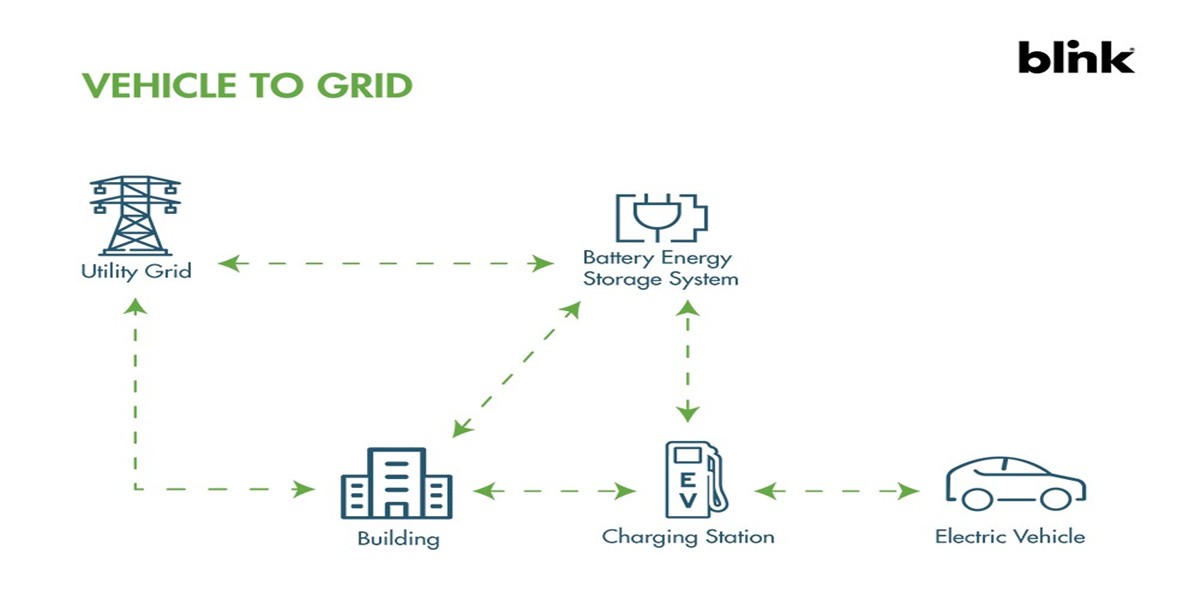
V2G (vehicle-to-grid) inverts the charging paradigm: instead of the grid feeding the vehicle, the vehicle’s battery feeds the grid. A V2G-enabled DC charger with a bidirectional power stage can deliver up to 60–120kW back to the site or grid per connected vehicle. The aggregate potential is enormous — a fleet of 10 electric buses with 300kWh packs each represents 3MWh of dispatchable storage, comparable to a small grid-scale battery.
V2G revenue models are already commercial in pilot-to-scale programs across the UK, the Netherlands, Japan, California, and China. A heavy-duty vehicle providing frequency regulation can earn €5,000–€15,000 per year per vehicle in European markets, on top of the value of its mobility. The charger hardware must support ISO 15118, which enables Plug & Charge and the signed energy-transfer messaging required for grid settlement, and the site controller must speak OCPP 2.0.1 to handle the advanced transaction and smart-charging profiles.
Scenario 3: Demand Response and Frequency Regulation
Once bidirectional power electronics are in place, a charging site can participate in demand response events within seconds. The site controller — typically the charger management system — receives a signal from the utility or aggregator (via OCPP, OpenADR, or IEC 61850 gateways) and curtails charging or injects power accordingly. This transforms the charger from a source of grid stress into a reliability resource, which is precisely the behavior regulators and network operators are starting to reward with preferential tariffs and capacity payments.
Site Architecture Comparison
The following table compares the three operating models from a site operator’s perspective:
| Dimension | Unmanaged Charging | BESS-Assisted (Peak Shaving) | V2G-Enabled Site |
|---|---|---|---|
| Peak demand control | None — grid spikes at will | Battery caps site peak | Battery + vehicles cap site peak |
| Demand charge reduction | 0% | 30–50% | 40–60% |
| Energy arbitrage | No | Yes (site battery) | Yes (site + vehicle batteries) |
| Grid service revenue | None | Frequency regulation (site battery) | Frequency regulation + demand response (aggregated vehicles) |
| Outage resilience | None | Minutes to hours of backup | Hours of backup with connected vehicles |
| Hardware requirements | Standard charger | Charger + BESS + EMS | Bidirectional charger + ISO 15118 + OCPP 2.0.1 |
| Typical incremental capex | Baseline | $150–$250/kWh (BESS) | +10–20% per charger (bidirectional power stage) |
| Payback period | N/A | 3–5 years | 4–7 years including V2G revenue |
The pattern is clear: each step up the maturity curve adds revenue optionality. The V2G-enabled site is not just a charger — it is a small power plant with a fleet of customer-owned batteries attached.
The Economics: A Worked Example
Consider a highway site with four 120kW chargers (480kW total), a monthly peak of 400kW, and a demand charge of $20/kW/month in a market with a $0.05/kWh off-peak / $0.20/kWh peak tariff spread.
| Metric | Without BESS | With 200kWh BESS | With V2G (10 × 80kW average vehicle export) |
|---|---|---|---|
| Monthly peak demand | 400 kW | 240 kW (shaved) | 160 kW (shaved + V2G export) |
| Annual demand charges | $96,000 | $57,600 | $38,400 |
| Annual arbitrage saving | $0 | $18,250 (200kWh × 250 cycles × $0.15 spread × 0.9 efficiency) | $18,250 + V2G energy sales |
| Annual grid service revenue | $0 | $15,000 (site battery) | $40,000 (site + vehicles) |
| Net annual benefit | — | ~$71,650 | ~$115,850 |
| Payback on incremental investment | — | ~3.5 years | ~4.5 years |
These figures are illustrative but grounded in published demand-charge rates and European frequency-regulation remuneration. The decisive insight is that the hardware cost of V2G capability is small relative to the revenue optionality it creates — which is why forward-thinking operators are specifying bidirectional stations today even before their local market opens V2G programs.
Technology Foundations: What Makes a Charger Grid-Ready
Not every “smart” charger can participate in these markets. Three technology pillars separate grid assets from plain chargers:
1. OCPP 2.0.1. The Open Charge Point Protocol 2.0.1 adds smart charging profiles, device model management, and signed transactions. It enables the site controller to dynamically limit or schedule charging in response to price or grid signals — the control layer every peak-shaving and V2G use case depends on. The 360kW liquid-cooled charging station with RFID, OCPP, and POS integration from MIDA Power ships with OCPP 1.6J/2.0.1 support, giving operators a future-proof control plane.
2. ISO 15118 (Plug & Charge). This standard defines secure, automatic authentication and, critically, the messaging for bidirectional energy transfer (ISO 15118-20). It enables V2G sessions where the vehicle, charger, and grid operator exchange signed energy contracts without manual payment steps — a legal and commercial prerequisite for selling energy back to the grid.
3. High-efficiency liquid-cooled power electronics. Grid services demand sustained operation at high power with minimal losses and maximum thermal stability. Air-cooled systems derate in hot weather and suffer efficiency losses of 2–4% at high ambient temperatures; 40kW/60kW liquid-cooling power modules maintain >96% efficiency across the load range, directly improving the round-trip economics of every stored or exported kWh.
From Standalone Charger to Grid Asset: An Implementation Roadmap
- Audit your site’s load profile. Install metering and analyze 12 months of half-hourly data to quantify the current peak and the demand-charge exposure.
- Size the BESS. A common rule of thumb is 0.5–1.0 kWh of storage per kW of charger capacity; a 480kW site typically pairs with 200–400kWh of storage.
- Specify grid-ready chargers. Require OCPP 2.0.1, ISO 15118 readiness, and liquid-cooled power stages in the tender. Bidirectional capability should be a factory option, not a field retrofit.
- Deploy an EMS/controller. The energy management system decides when to charge the battery, when to discharge, and how to respond to grid signals. This is the software brain of the grid asset.
- Register for grid programs. Sign up for demand response, frequency regulation, or wholesale market participation through an aggregator — often the fastest route to revenue without building in-house market infrastructure.
- Monitor and iterate. Track effective peak, battery throughput, and service revenues monthly; tune the EMS logic quarterly as traffic patterns and tariffs change.
Why High-Power Sites Lead the Transition
The business case concentrates at high power. A 480kW ultra-fast liquid-cooled DC charging station for motorways draws more power in a single session than a 120kW urban site does in hours — so its demand charges, arbitrage potential, and grid-service value are proportionally larger. Motorway and depot sites are therefore the natural first adopters of peak-shaving and V2G architectures, and the equipment purchased for them today will define the grid-integrated charging standard of the next decade.
FAQ
1. What is peak shaving in the context of EV charging?
Peak shaving is the practice of capping a charging site’s maximum power draw from the grid by discharging an on-site battery during high-demand windows and recharging it during low-tariff periods. It directly reduces demand charges, which can be 30–50% of a DC fast charging site’s electricity bill.
2. Can existing DC fast chargers be retrofitted for V2G?
Most first-generation chargers cannot. V2G requires a bidirectional power stage inside the charger or a separate bidirectional inverter, plus ISO 15118 communication and an OCPP 2.0.1-capable controller. Retrofitting typically costs 2–3× more than buying V2G-capable hardware upfront.
3. How much money can peak shaving save a charging site operator?
Depending on the market, a storage-integrated site can cut demand charges by 30–50% and capture $0.10–$0.20/kWh through energy arbitrage. In the worked example above, a 480kW highway site saved roughly $71,000 per year with a 200kWh battery, with payback in about 3.5 years.
4. What is the difference between V2G, V2H, and V2L?
V2G (vehicle-to-grid) exports power back to the grid or a building for grid services and revenue. V2H (vehicle-to-home) powers a home during outages or peak tariffs. V2L (vehicle-to-load) simply powers appliances via a socket. Only V2G requires bidirectional grid-tied inverters, ISO 15118-20, and grid program participation.
5. Which standards enable bidirectional charging?
ISO 15118 (especially Part 20) defines Plug & Charge and bidirectional energy transfer messaging, while OCPP 2.0.1 handles smart charging profiles and signed transactions at the site level. Together they make V2G commercially operable and auditable.
6. Does V2G shorten EV battery life?
Bidirectional cycling adds battery wear, but modern EV battery management systems bound the impact. Research and pilot data suggest a well-managed V2G operation adds roughly 5–10% extra degradation over a decade — while earning €5,000–€15,000 per vehicle per year in active frequency-regulation markets. Operators can also limit depth of discharge to protect pack longevity.
7. What size BESS do I need for a typical highway charging site?
A practical rule of thumb is 0.5–1.0kWh of storage per kW of charger capacity. A four-120kW (480kW) highway site typically pairs with 200–400kWh of storage, sized to the site’s peak windows and session patterns rather than installed charger nameplate alone.
Conclusion
The grid is no longer a constraint on fast charging — it is a market. Peak shaving converts a fixed monthly cost into a controllable variable, and V2G converts parked vehicle batteries into revenue-generating assets. The hardware, software, and standards to do both are available today; the differentiator is whether operators specify grid-ready, storage-integrated, liquid-cooled equipment now or pay the retrofit premium later. For charging site owners planning capacity for 2026 and beyond, the question is not whether to become a smart grid asset — it is how quickly they can start.
Post time: Aug-20-2026


