
Powering the Next-Gen EV Revolution: High-Voltage 960kW Split DC Fast Charging Stacks
Quick Answer
A high-voltage 960kW split DC fast charging stack is a modular assembly of power cabinets — typically four 240kW units — that outputs DC across a 150–1000V range, purpose-built for the next generation of 800V and 1000V electric vehicles. High voltage is the defining engineering trend of the 2026 EV market: by raising pack voltage from 400V to 800V, automakers halve the current required for a given power, cutting cable losses, weight, and charge times. A 960kW stack matches this evolution because it can deliver 600kW+ to a single 800V truck, 350kW to an 800V passenger car, and 150kW to a legacy 400V vehicle — all from the same hardware, with voltage negotiated per session. The split architecture keeps the heavy liquid-cooled power electronics in a central power room while slim dispensers serve the bays. For charge point operators, fleet owners, and highway networks, the 960kW high-voltage stack is the highest-throughput, most future-proof power platform available for commercial DC charging in 2026.
Key Takeaways
- High-voltage (800–1000V) vehicle platforms are the industry standard for new EVs and e-trucks, doubling power delivery at the same current versus 400V systems.
- A 960kW split stack with 150–1000V output serves every vehicle generation — 400V, 800V, and 1000V — from one hardware platform.
- Liquid-cooled 40kW/60kW power modules deliver sustained 600A+ output without thermal derating, enabling true 480–600kW single-vehicle sessions.
- Split architecture concentrates cooling, heat, and service in a power room, making megawatt-class stacks physically deployable in depots and highway plazas.
- Module-level telemetry and OCPP 2.0.1 integration let operators monitor efficiency and plan maintenance as stack utilization grows.
The 800V Revolution and Why It Changes Charging Infrastructure
The most consequential shift in EV powertrain design since mass-market electrification is the migration from 400V to 800V (and soon 1000V) battery architectures. The physics is simple: electrical power equals voltage times current (P = V × I). To deliver 350kW, a 400V system must push 875A; an 800V system needs only 437A. Cutting the current in half reduces resistive losses in cables and connectors by a factor of four (I²R scaling), allows thinner cabling, and unlocks charging speeds that 400V hardware cannot reach without prohibitive weight and heat.
| Vehicle Platform | Battery Voltage | Typical Fast-Charge Power | Current at Full Power | Charging Time (10–80%, 100kWh) |
|---|---|---|---|---|
| Legacy EV (2020–2023) | 400V | 150–250kW | 375–625A | 35–50 min |
| Current-gen premium EV | 800V | 250–350kW | 312–437A | 18–25 min |
| 2026 e-truck | 800–1000V | 400–600kW+ | 400–600A | 35–50 min (300kWh) |
| MCS-class (2027+) | 1000V+ | 750kW–1.2MW | 750A+ | 20–30 min (600kWh) |
By 2026, virtually every newly launched EV platform from major automakers is 800V-class, and commercial vehicles are pushing toward 1000V to enable megawatt charging within existing cable cross-sections. Charging infrastructure that cannot output above 500V is already serving a shrinking share of the vehicle population — and will be stranded within a few years.
What a 960kW High-Voltage Stack Is Built From
A 960kW split DC stack is a stack in the truest sense: a vertical (physical or logical) arrangement of modular power blocks. The canonical configuration:
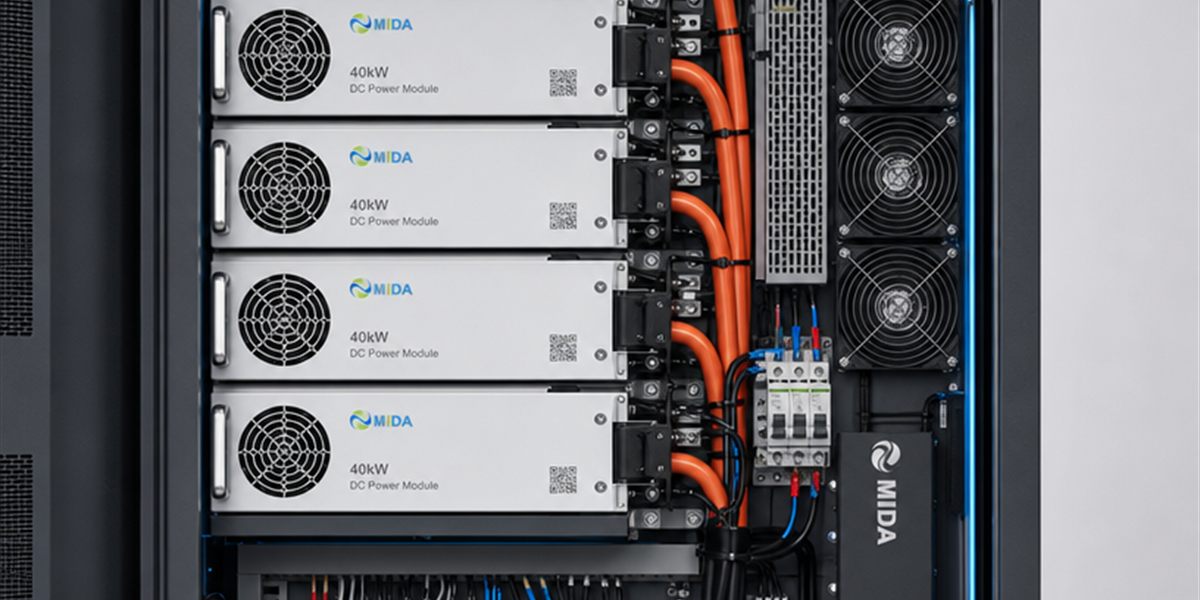
- 4× 240kW power cabinets, each containing six 40kW liquid-cooled power modules (or four 60kW modules) plus one optional spare for N+1 redundancy.
- A stack controller that aggregates the cabinets into a single virtual power pool, negotiates voltage with each connected vehicle, and distributes current.
- Dispensers — up to 8–12 across the site — connected via liquid-cooled cables, each capable of drawing from the full pool when the vehicle demands it.
- A site integration layer: transformer, switchgear, and (increasingly) BESS and solar, all coordinated through OCPP 2.0.1-based load management.
The stack’s defining capability is voltage agility. Because each cabinet’s modules can be configured in series to reach 1000V, and the controller negotiates per session, the same stack serves:
- A 400V fleet van at 150kW
- An 800V passenger EV at 350kW
- An 800V e-truck at 600kW
- A future 1000V vehicle at up to 960kW (single-connector MCS-ready configurations)
This is the difference between a charger and a charging platform: the platform serves the entire vehicle population today and the vehicles that will arrive in the next five years.
Liquid Cooling: Sustaining Megawatt-Class Power in a Compact Footprint
High power and high voltage converge on one engineering challenge: heat. A 960kW stack converting grid AC to DC rejects tens of kilowatts of waste heat; at 600A continuous, connector and cable heat is severe. Air cooling simply does not scale — it requires enormous heatsinks, high airflow, loud fans, and it derates in hot climates and dusty depots.
Liquid cooling is the enabling technology for high-voltage stacks, for three reasons:
- Sustained output without derating. Liquid-cooled modules hold rated output at 45–55°C ambient where air-cooled units typically derate 10–30%. For a depot operator, this means the 960kW nameplate is the deliverable power, not a theoretical best case.
- Compact modules. Removing heat with liquid instead of airflow shrinks the module volume, which is what allows four 240kW cabinets to fit in a standard plant room.
- Dispenser ergonomics. Liquid-cooled 600A cables keep the driver-side hardware light and flexible — essential when a 960kW stack feeds 8–12 connectors and drivers plug and unplug all day.
MIDA manufactures its own liquid-cooling power modules in 40kW and 60kW variants, giving the stack a consistent, serviceable building block and letting operators stock a single spare module for an entire site.
Charging Curves: What a 960kW Stack Actually Delivers Per Session
The marketing question is “960kW,” but the engineering question is: what does a driver experience? The answer is defined by the vehicle’s charging curve — the power the battery accepts at each state of charge — and by the stack’s ability to match it.
| Session Type | Vehicle | Peak Power Drawn | Energy in 30 min | Session Notes |
|---|---|---|---|---|
| 800V passenger EV | 100kWh pack, 800V | 350kW | ~150–160kWh | Full 10–80% in ~20 min |
| 800V e-truck | 600kWh pack, 800V | 600kW | ~270–300kWh | Fast top-up for next dispatch |
| 400V van (down-conversion) | 100kWh pack, 400V | 150kW | ~70kWh | Served at legacy rates by same stack |
| Future 1000V e-truck | 800kWh pack, 1000V | 800kW+ | ~350kWh | MCS-class, near-term capability |
The stack’s controllers manage the conversion efficiency across this range. Modern silicon-carbide (SiC)-based modules hold efficiency above 96% across the typical operating band, which matters at scale: at 960kW and 96% efficiency, the system wastes ~38kW of heat; at 93% it wastes ~67kW. The difference is more heat to reject, more electricity to pay for, and more wear on cooling systems.
High-Voltage Compatibility: One Stack, Every Generation
The transition period between 400V and 800V fleets is the most expensive trap in charging infrastructure. Operators who buy only 800V-optimized hardware strand their 400V customers; operators who buy only 400V hardware strand tomorrow’s trucks. The 960kV high-voltage stack avoids both outcomes:
- Wide output range (150–1000V): the stack adapts per session, so 400V and 800V vehicles charge at their respective optimal points.
- Active power sharing: the stack can simultaneously serve an 800V truck at 600kW and a 400V van at 150kW from different dispensers, because each dispenser negotiates independently with the stack controller.
- MCS upgrade path: as the Megawatt Charging System standard matures, the stack adds cabinets and MCS dispensers while the existing CCS dispensers continue operating — the stack grows, it does not get replaced.
| Compatibility Question | 400V-Only Charger | 800V-Only Charger | 150–1000V Split Stack |
|---|---|---|---|
| Serves 400V vehicles | Yes (native) | Derated or blocked | Yes (native) |
| Serves 800V vehicles | No (max ~500V) | Yes (native) | Yes (native) |
| Serves 1000V trucks (future) | No | Partial | Yes (MCS-ready) |
| Fleet usable today | Shrinking pool | Growing pool | Full pool |
Telemetry, Efficiency Monitoring, and Operations at Scale
A 960kW stack concentrates enough power that operational intelligence becomes a requirement, not a luxury. The split architecture’s centralized power room makes this practical:
- Module-level telemetry. Each liquid-cooled module reports output power, temperature, coolant flow, and efficiency through the stack controller. Operators see a failing module trending toward failure before it interrupts service — and hot-swap it during off-peak hours.
- Energy accounting. Per-connector metering gives the operator exact energy revenue per session, per lane, per day — the data needed to price sessions and justify demand-response participation.
- Efficiency optimization. The controller can idle unused modules to run the active set at peak efficiency (a 240kW cabinet running at 80% load is more efficient than four cabinets at 20%).
- OCPP 2.0.1 integration. All telemetry and control flow through the standard protocol, so the stack integrates with any major charge management platform without custom software.
MIDA’s High-Voltage Stack Architecture
MIDA Power’s high-voltage stack is built on in-house components engineered for the 2026 vehicle mix. At its core are the 40kW/60kW liquid-cooling power modules that give each 240kW cabinet its sustained output and 150–1000V range; the modules are certified, field-proven, and interchangeable across cabinet sizes — from a single 240kW unit to a 960kW, four-cabinet stack. The stack’s dispensers inherit the ergonomics and reliability of MIDA’s 480kW liquid-cooled ultra-fast charging station, already deployed on motorway corridors where sustained high-current sessions are the norm.
For attended sites, the 360kW liquid-cooled charging station with RFID, OCPP and POS illustrates how MIDA integrates billing, access control, and payment into driver-facing hardware — capabilities that scale directly to high-throughput hubs. Whether an operator needs a single 240kW cabinet or a full 960kW stack, the commercial DC fast charging portfolio delivers the same module platform, the same certifications (TUV/CE/UL), and the same OCPP 2.0.1 connectivity — reducing spare-part inventory, training, and integration risk across the entire network.
FAQ
1. Why is high voltage (800V/1000V) important for EV charging?
Higher voltage delivers the same power at lower current, reducing resistive losses by roughly a factor of four and enabling much faster charging with thinner cables. It is the standard architecture for new EVs and e-trucks through 2026 and beyond.
2. Can a 960kW stack charge a 400V vehicle?
Yes. The stack’s 150–1000V output range allows per-session voltage negotiation, so 400V vehicles charge at their optimal power (typically 150kW) while 800V vehicles receive much more — from the same hardware.
3. What is the difference between 960kW total and 960kW to one vehicle?
Total stack capacity is shared dynamically. A 960kW stack can deliver up to ~600kW to a single high-voltage dispenser while other dispensers receive lower power — or, in MCS-ready configurations, concentrate more to one connector as vehicle standards evolve.
4. Do liquid-cooled modules really outperform air-cooled ones?
Yes, especially in hot climates and at high utilization. Liquid cooling holds full rated output at elevated ambient temperatures where air-cooled units derate, and it enables the compact cabinet footprints that make split stacks deployable in standard rooms.
5. Is a 960kW stack overkill for a site with mostly passenger cars?
It depends on the mix. A stack with dynamic sharing serves passenger cars at 250–350kW and e-trucks at 600kW from the same pool — so if truck or high-end EV traffic is expected, the headroom pays for itself in session revenue and future-proofing.
6. What efficiency should I expect from a high-voltage stack?
Modern liquid-cooled, SiC-based modules sustain above 96% conversion efficiency across the typical operating range. Operators should request module-level efficiency data and telemetry access to verify performance in their climate and duty cycle.
7. How does the stack upgrade to megawatt charging (MCS) later?
By adding power cabinets to the stack and fitting MCS-capable dispensers. The electrical room, switchgear, grid connection, and control platform remain — the stack scales without re-engineering, which is the core future-proofing benefit of modular split architecture.
Post time: Aug-21-2026


