
Smart Peak Shaving with Battery Energy Storage Systems in Large Charging Hubs
Smart Peak Shaving with Battery Energy Storage Systems in Large Charging Hubs
Quick Answer
Smart peak shaving uses an energy management system (EMS) and a battery energy storage system (BESS) to cap the charging hub’s grid import below a configured threshold, shaving the 15-minute peaks that drive demand charges. In demand-charge-heavy markets — the US, Germany, Australia — a 1 MWh LFP system at a 6–12 stall hub typically cuts demand charges by 30–50%, saving $2,000–$6,000 per month and reaching simple payback in 3–5 years. Forecast-based EMS (predicting arrivals, session power, and solar output) outperforms simple threshold control by 15–25%, and future ISO 15118 V2G capability turns the same battery into a revenue-earning grid asset. This article explains the utility-bill mechanics, the control logic, sizing, and the payback math behind smart peak shaving.
Key Takeaways
- Demand charges are 30–70% of a hub’s utility bill; smart peak shaving cuts them by 30–50%.
- Forecast-based EMS beats fixed-threshold control by 15–25% in both cost savings and battery-life preservation.
- A 1 MWh LFP system saves $2,000–$6,000/month on typical commercial tariffs — 3–5 year simple payback.
- Solar + BESS synergy lifts solar self-consumption above 90% and stabilizes hub import in all weather.
- V2G and grid-service revenue (frequency regulation, demand response) can shorten payback by 6–12 months.
Anatomy of the Utility Bill: Where the Money Goes
Most operators optimize the wrong number. Energy charges (kWh) get all the attention, but at a charging hub the demand charge is frequently the larger line item. A demand charge is a fee per kilowatt of the highest 15-minute average draw in the billing month — one bad afternoon can set the tariff for all 30 days. On US commercial tariffs, demand charges run $10–$30/kW; on German and Australian networks, similar structures apply through peak-window capacity charges.
Consider a 6-stall, 480 kW hub with a monthly peak of 420 kW:
| Cost component | Rate | Monthly cost | Share |
|---|---|---|---|
| Energy (120,000 kWh) | $0.12/kWh | $14,400 | 63% |
| Demand (420 kW peak) | $20/kW | $8,400 | 37% |
| Fixed charges | — | $500 | 2% |
| Total | $23,300 | 100% |
If peak shaving lowers the monthly peak to 250 kW, the demand charge falls to $5,000 — a saving of $3,400/month, or $40,800/year, before any energy arbitrage. That single line item usually finances the entire BESS.
How Smart Peak Shaving Works
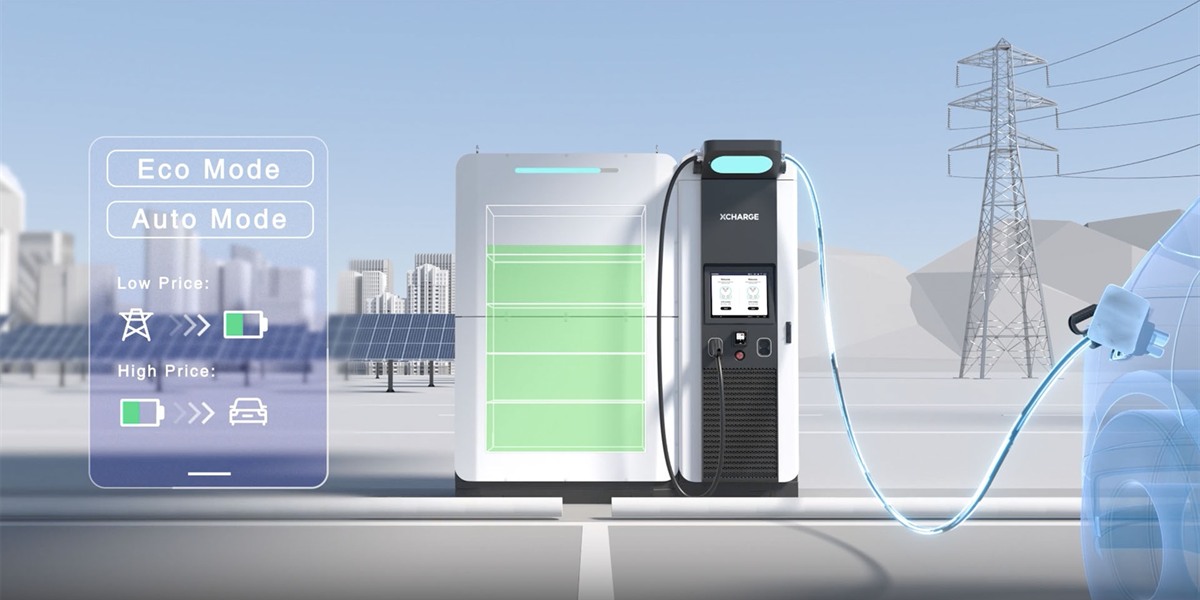
The mechanism is simple; the execution is not. The BESS charges during low-load, low-tariff windows (typically overnight and midday solar surplus) and discharges during charging peaks, keeping site import below a setpoint. Three control layers determine how well this works:
- Threshold control (baseline). When import approaches the limit, the EMS discharges the battery at fixed power. Simple, but reactive: it waits for the peak to arrive, wastes battery on short transients, and can leave the battery empty when the real peak hits.
- Schedule-based control. The EMS uses day-ahead and intraday tariff data to plan charge/discharge windows. Good for arbitrage, blind to demand variability.
- Forecast-based smart control. The EMS predicts the next 15–60 minutes: expected arrivals (from session history and telematics), per-session power curves, solar output, and temperature effects on charging speed. It pre-positions the battery — charging aggressively when a rush is predicted, holding SoC when the site is quiet. This is the “smart” in smart peak shaving, and it is the difference between 30% and 50% demand reduction.
The battery’s SoC strategy matters as much as the algorithm: the EMS must reserve headroom for the evening peak while opportunistically charging from cheap midday power. MIDA’s EMS implements these strategies over OCPP 2.0.1, coordinating with the charger management system so the battery and the dispensers act as one site controller.
Sizing the System: Power, Energy, and Control Headroom
Sizing errors usually come in two flavors: too much energy (idle capital) or too little power (peaks still hit the grid). The practical method:
- Measure the load profile — at least 4 weeks of 15-minute interval data from the site or a comparable hub.
- Define the target peak — usually the grid permit (kVA) or a chosen demand-charge tier.
- Size PCS power to cover the worst-case gap between demand and the target peak.
- Size energy to cover the busiest hour plus 20–30% reserve — one peak-shaving cycle per day is the design norm.
| Hub size | Typical peak | BESS recommendation | Expected monthly saving |
|---|---|---|---|
| 4–6 stalls / 360–480 kW | 350–420 kW | 500–750 kWh / 300 kW | $1,500–$3,000 |
| 8–12 stalls / 720 kW–1 MW | 600–850 kW | 1.0–1.5 MWh / 600 kW | $3,000–$6,000 |
| 16–20 stalls / 1.5–2 MW | 1.2–1.7 MW | 2.0–3.0 MWh / 1 MW | $6,000–$12,000 |
Liquid cooling is not optional at these C-rates: a 600 kW PCS discharging a 1 MWh battery pulls 0.6C sustained, and air-cooled racks derate under back-to-back peak events. Liquid-cooled LFP holds cell temperature variance within ±3°C, preserving the 6,000–8,000 cycle life at 80% DoD that the payback model assumes.
Solar + BESS: The Synergy That Compounds
Hubs with PV carports unlock a second, often larger, saving stream. Without storage, a solar-equipped hub exports midday surplus at wholesale rates and buys evening power at retail — self-consumption lands at 30–40%. With a BESS, the surplus charges the battery and discharges into the evening charging rush, lifting self-consumption above 90% and capturing the full retail-to-EV margin on every kWh.
The EMS coordinates three assets — solar, battery, chargers — with three priorities: (1) never export surplus at wholesale prices, (2) never exceed the grid permit, (3) always maximize charger power. On sunny days the hub can run nearly grid-neutral; on overcast days the battery still shaves the peak. This hybrid use case is why most new hub designs put solar and storage on the same DC-coupled bus, saving 1.5–2.5 percentage points of round-trip efficiency.
Grid Services and the Road to V2G
A peak-shaving battery is available 80–90% of the day for secondary services, because shaving peaks is a short-duration job. The same asset can earn incremental revenue:
- Frequency regulation — the PCS responds to grid signals in milliseconds, earning $50–150/kW-year in deregulated markets.
- Demand response — utility events pay the hub to reduce import on request; the battery makes this effortless.
- Time-of-use arbitrage — charging at $0.05–0.08/kWh and displacing $0.15–0.30/kWh adds $0.10–0.20 per cycled kWh.
ISO 15118 opens the next phase: V2G. When vehicles support bidirectional charging, the parked EV fleet itself becomes a distributed battery — the hub’s BESS strategy extends to vehicle batteries, and drivers earn credits for grid support. Hubs deploying MIDA’s liquid-cooled ultra-fast charging stations with ISO 15118-capable hardware are already positioned for this revenue when the market matures.
Payback Math: A Realistic Model
| Assumption | Value |
|---|---|
| System | 1 MWh LFP, 600 kW PCS, liquid-cooled |
| Installed cost | $320,000 (incl. EMS, integration) |
| Demand-charge saving | $4,000 / month ($48,000 / year) |
| Arbitrage + solar revenue | $1,200 / month ($14,400 / year) |
| Grid-service revenue | $500 / month ($6,000 / year) |
| O&M (service contract) | –$600 / month (–$7,200 / year) |
| Net annual benefit | $61,200 |
| Simple payback | ~5.2 years |
With higher tariffs or grid-service stacking, payback drops to 3.5–4 years; with V2G revenue, the incremental return accelerates further. The battery’s 10+ year design life (6,000–8,000 cycles at one cycle/day) means the asset earns for 5–7 years past payback.
Deployment Checklist for Hub Operators
- Collect 15-minute interval data for 4+ weeks before sizing — never size from nameplate alone.
- Demand a forecast-based EMS, not a fixed-threshold controller; require evidence of performance on similar sites.
- Specify liquid cooling for any site above 300 kW of BESS power or sustained peak events.
- Require OCPP 2.0.1 integration so the battery, chargers, and solar share one platform and one set of priorities.
- Plan for V2G and grid services now — ISO 15118-capable hardware and a PCS with four-quadrant operation cost little today and unlock revenue tomorrow.
- Negotiate a throughput-based warranty tied to MWh cycled, and confirm the 10-year augmentation plan.
For hubs built around MIDA’s ecosystem, peak shaving is a configuration, not a retrofit: the 40kW and 60kW liquid-cooled power modules power both the chargers and the BESS PCS, the EMS coordinates all assets through one OCPP backend, and highway-scale deployments — such as the 480kW ultra-fast liquid-cooled DC charging station for motorways — are engineered to run on a fraction of their nominal grid requirement. MIDA Power delivers the full stack, so the “smart” in smart peak shaving is implemented, tested, and warranted by a single vendor.
FAQ
1. What is peak shaving in EV charging? Peak shaving caps the site’s grid import by discharging a battery during the highest-demand windows, so the utility sees a flatter load profile. Because demand charges are set by the single highest 15-minute average of the month, shaving that peak directly reduces the bill.
2. How much can a BESS save on demand charges? Operators typically cut demand charges 30–50% with a correctly sized system. For a 6–12 stall hub, that is $2,000–$6,000 per month — enough to pay back a 1 MWh system in 3–5 years.
3. Why is “smart” peak shaving better than a simple threshold controller? A threshold controller reacts after import hits the limit, wasting battery on transients and running empty when the real peak arrives. A forecast-based EMS predicts arrivals, session power, and solar output, pre-positioning the battery — typically 15–25% better cost savings and gentler on battery life.
4. How do I size a BESS for my charging hub? Measure 15-minute interval load data for at least four weeks. Size PCS power to cover the worst-case gap between demand and the target peak, and energy to cover the busiest hour plus 20–30% reserve. Use the 0.5–1.0 kWh-per-kW rule of thumb as a sanity check.
5. Can the battery do other things when it is not peak shaving? Yes. The same asset earns revenue from energy arbitrage, solar self-consumption, frequency regulation, and demand response — typically adding 30–50% more value than demand savings alone. ISO 15118 V2G-ready hardware extends this to vehicle batteries in the future.
6. Is liquid cooling necessary for a peak-shaving BESS? Above roughly 300 kW of battery power, or when the hub has sustained back-to-back peak events, yes. Liquid cooling holds cell temperature variance within ±3°C, preventing derating and preserving the 6,000–8,000 cycle life that the payback model assumes.
7. Does peak shaving reduce the charging power customers receive? No — that is the point of the design. The battery adds power on top of the grid feed, so chargers run at full output even when the site’s grid connection is small. Without the battery, either the grid would cap charger power or the operator would pay enormous demand charges.
Post time: Aug-24-2026


