
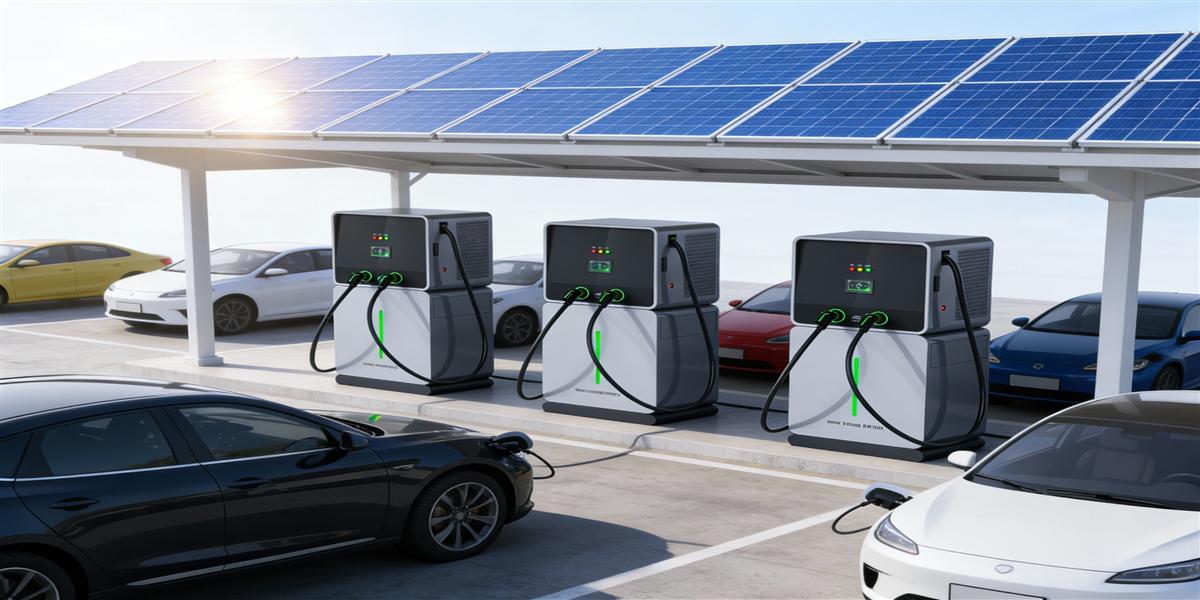
Sustainable Public Charging: Synergy Between BESS and Distributed MIDA DC Stacks
[Image Placeholder: Thumbnail 400*350, ~30KB — public charging forecourt with a solar canopy, an enclosed battery energy storage cabinet, and several compact distributed DC charging dispensers serving electric vehicles]
Quick Answer:
Sustainable public charging is achieved when one site simultaneously lowers its carbon intensity, reduces its burden on the local grid, and improves the operating margin of every stall. In 2026 the most bankable way to reach that state is the deliberate synergy between a Battery Energy Storage System (BESS) and a fleet of distributed MIDA DC charging stacks — centralized liquid-cooled power cabinets feeding multiple slim dispensers, with a site-level battery acting as the buffer between the grid and the vehicles. The battery time-shifts cheap or renewable energy into the evening charging peak, shaves demand charges, and allows the site to run on a 25–40% smaller grid connection. Real deployments report 60–90% renewable self-consumption with solar-plus-storage, 30–50% lower demand charges, and a materially faster payback than charging-only designs. The synergy, not the battery alone, is what makes public charging sustainable in both the environmental and financial sense.
Key Takeaways:
- Distributed Beats Monolithic: Centralized power cabinets with remote dispensers cut trenching, equipment count, and site footprint while placing charging where drivers actually park.
- The BESS Is the Arbitrage Engine: A site-level battery converts midday renewable surplus into premium evening charging energy, which is the largest single margin uplift available to a public hub.
- Grid Connection Is the Hidden CAPEX: A BESS-buffered site typically installs a 25–40% smaller utility connection, which frequently saves more capital than the battery itself costs.
- Standards Are Non-Negotiable: OCPP 2.0.1 smart charging, ISO 15118 Plug & Charge, and module-level telemetry are the control foundation for any storage-integrated public site.
- Modular MIDA Hardware De-Risks the Build: Hot-swappable liquid-cooled power modules let an operator open with charging only and add storage and capacity as utilization proves out.
Why Public Charging Has to Be Sustainable and Profitable
Public charging is no longer a novelty amenity — it is regulated infrastructure with an explicit environmental mandate. Municipal tenders, retail landlords, and fleet customers now write renewable-energy share, CO2 per kWh, and demand-response readiness into their procurement documents. At the same time, the operators who must satisfy those requirements are squeezed by three cost drivers that do not appear on a datasheet:
- Demand charges. A site that briefly pulls 480 kW but averages only 120 kW pays for the peak, not the average. In Germany, California, and New York, monthly demand charges at a high-power public hub routinely reach €8,000–€25,000.
- Grid connection cost and lead time. Reinforcement of a weak urban feeder can take 12–36 months and cost more than the charging equipment itself.
- Low utilization. Even well-sited public hubs sit idle for 70–80% of the day, which means the infrastructure must earn its keep in fewer, sharper peak hours.
A charging-only design answers none of these. It provisions the grid for the worst-case simultaneous session, pays demand charges on that peak, and leaves the site exposed to whatever the tariff does at 19:00. The distributed DC stack answered with a BESS changes the physics of the problem: the battery becomes the shock absorber, and the grid sees a smooth, predictable profile instead of a spiky one.
This is the architecture MIDA Power builds end-to-end — from DC fast charging stations to the liquid-cooling power modules that make continuous high-power operation possible.
What a Distributed DC Stack Actually Is
A distributed (split) DC stack separates power conversion from the point of delivery:
- Power cabinet: 240–480 kW of liquid-cooled DC modules, installed in a utility area, service corridor, or enclosure away from drivers. This is where the heat, the noise, and the serviceable electronics live.
- Dispensers: Compact, robust terminals at the parking bays containing only the cable, the connector, the user interface, and the safety interlocks. No power electronics, no fans, no large enclosures.
- DC bus and long dispenser runs: A single cabinet can feed dispensers 100+ meters away, which means one power block can serve an entire parking level or forecourt.
- Dynamic power sharing: The site controller allocates cabinet capacity across dispensers in real time, so a 480 kW block serves six to eight stalls without six to eight grid connections.
Two reference configurations illustrate the range. The 360kW liquid-cooled charging station with RFID, OCPP, and POS represents the attended public hub, with access control and payment integrated at the terminal. The 480kW ultra-fast liquid-cooled DC charging station for motorways shows the same platform scaled to corridor duty, where separated power conversion and dispensers protect uptime and simplify maintenance. Both are built on the same module family, which is what allows an operator to standardize a national network on one spare-parts kit and one software platform.
The Synergy Model: How the BESS Multiplies the Value of Every Stack
The word “synergy” is often used loosely. Here it has three precise, measurable mechanisms operating on three different timescales.
Within the day — energy arbitrage
Solar generation peaks at midday, when public charging demand is typically at its lowest. Without storage, that energy is either exported at wholesale prices or curtailed entirely. With a site-level BESS, midday surplus charges the battery, and the battery discharges into the 17:00–21:00 charging peak at retail-plus margins. This single behavior typically adds €0.06–€0.13 per kWh of value versus exporting, and it is the largest uplift available to a public site that already owns generation.
Within the month — demand management
A BESS-buffered site draws a flatter profile from the utility. The battery covers everything above the contracted capacity, so the site’s peak demand — and therefore its monthly demand charge — is set by design rather than by the worst simultaneous session of the month. Peak shaving of 30–50% is routine, and in high-demand-tariff markets this is frequently the difference between a profitable hub and a loss-making one.
Within the year — grid services
Where organized flexibility markets exist, the battery’s spare capacity earns frequency-regulation, capacity, or demand-response payments. That revenue accrues while the charging business continues unaffected, because grid-service discharge is absorbed by the battery rather than by a customer’s vehicle.
[Image Placeholder: Content 1200*600, ~250KB — energy-flow schematic of a public charging hub showing solar canopy, BESS cabinet, centralized MIDA power cabinet, and distributed dispensers connected through an energy management system]
Configuration Comparison: What Each Public Site Design Delivers
| Metric | Grid-Only Site | Grid + BESS | Solar + BESS + Distributed Stacks |
|---|---|---|---|
| Renewable self-consumption | 0–5% | 0–5% | 60–90% |
| Grid connection size | 100% (reference) | 60–75% | 50–70% |
| Demand charges (relative) | 100% | 50–70% | 40–60% |
| Energy cost per kWh (relative) | 100% | 95–100% | 80–90% |
| CO2 per kWh delivered (relative) | 100% | 95–100% | 10–40% |
| Peak session capability | Grid-limited | Grid + battery | Grid + battery |
| Payback of energy assets | — | 4–6 years | 5–8 years |
| Occupancy of dispensers | Independent | Shared | Shared, EMS-optimized |
The economically optimal configuration for most public sites in 2026 is the third column: distributed MIDA DC stacks for delivery, a BESS for time-shifting and peak control, and a solar canopy where the site geometry and irradiance support it.
Sizing and Control: The Five Decisions That Determine Payback
1. Size the battery to the grid gap, not to the station. Compute the delta between peak session demand and the contracted grid capacity; the battery covers that delta for the duration of a realistic peak event. A 480 kW cabinet cluster on a 250 kW connection generally needs 300–600 kWh of usable storage.
2. Size the power cabinet to concurrent demand. With dynamic sharing, cabinet capacity can be materially lower than the sum of dispenser ratings — the EMS guarantees that total delivered power never exceeds the cabinet’s rating, so no dispenser can starve the site.
3. Choose the coupling. DC coupling the battery to the charging DC bus avoids one conversion stage, improving round-trip efficiency by roughly 3–5% compared with AC-coupled designs. On a site that cycles a 500 kWh battery once daily, that efficiency delta is worth thousands of euros per year.
4. Specify a protocol-complete control plane. OCPP 2.0.1 with smart charging profiles and signed transactions, ISO 15118 for Plug & Charge, plus grid-code-compliant export control (for example VDE-AR-N 4105 in Germany or Rule 21 in California). Retrofitting these capabilities onto legacy hardware is expensive; specifying them on day one is nearly free. MIDA’s commercial platforms ship protocol-complete across the EV charging solutions portfolio.
5. Instrument for carbon reporting. Attribute each session’s energy to its source — solar, battery discharge, or grid — through site metering and export the data via OCPP. Municipalities, corporate tenants, and green-finance lenders increasingly require this evidence, and it is also the fastest way to prove the sustainability business case internally.
Deployment Pattern: The Urban Retail Forecourt
A representative 2026 build: a retail forecourt with a 250 kWp solar canopy, a 400 kWh BESS, and two 240 kW MIDA split cabinets feeding six compact dispensers. The site’s utility connection is 150 kW instead of the 480 kW a charging-only design would demand. During daylight, solar charges the battery and simultaneously serves sessions; in the evening, the battery discharges into the charging peak; overnight, it refills on cheap off-peak power. Ownership reports from comparable European deployments show a 70–85% renewable energy share, roughly 40% lower demand charges, and grid connection costs cut by about half — while drivers consistently receive 150–350 kW sessions without the congestion queuing that plagues undersized monolithic hubs.
The Organizational Case: Why Synergy Wins the Procurement Argument
Sustainability requirements increasingly arrive as pass/fail criteria rather than scoring preferences. A site that can demonstrate renewable self-consumption, avoided emissions, demand-response readiness, and a documented CO2-per-kWh figure satisfies the municipal, landlord, and corporate buyer in a single submission. Technical teams, meanwhile, gain something less obvious but equally valuable: a distributed architecture with a battery means the site grows by adding modules and dispenser runs, not by renegotiating a grid connection. Because MIDA’s module platform is standardized and hot-swappable, capacity upgrades are scheduled service activities rather than construction projects — one of the quietest but most decisive advantages of designing the synergy in from the start.
FAQ
1. Can a public charging site be sustainable without solar?
Yes. A BESS alone delivers demand-charge reduction and price arbitrage, which are financial sustainability. Solar multiplies the environmental benefit and improves the energy cost, but it is not a prerequisite for a viable site.
2. How much storage does a typical public hub need?
Most four-to-eight-stall public hubs land between 200 kWh and 600 kWh of usable capacity. The correct number is derived from the gap between peak session demand and grid contract, multiplied by the duration of the evening peak.
3. Do distributed dispensers cost more to maintain than an all-in-one charger?
No — usually less. Dispensers contain no power electronics, so there is less to fail. All the serviceable components are concentrated in one weather-protected cabinet, which reduces the number of site visits required per year.
4. How does dynamic power sharing prevent grid-limit violations?
The site controller enforces a hard ceiling on aggregate site draw. It allocates available power to dispensers based on each vehicle’s state of charge and request, prioritizing vehicles that are nearly complete so stalls turn over quickly without ever exceeding the contracted limit.
5. Is a BESS compatible with existing charging hardware?
It is compatible at the AC bus with any compliant station, and far more efficient at the DC bus — but only if the chargers were designed with an accessible DC bus. MIDA’s split architecture exposes that bus by design; most legacy monolithic units do not.
6. What happens during a grid outage?
A BESS with islanding capability can keep a defined number of dispensers energized, which is valuable for emergency-response fleets and municipal resilience commitments. Confirm islanding and backup configurations during design, since they affect transfer equipment and protection settings.
7. Which certifications apply to a solar-plus-BESS public charging site?
Battery and fire safety per UL 9540/NFPA 855 or local equivalents, grid interconnection per the applicable national grid code, and EVSE certification (CE, TUV, UL) for the charging equipment. Specifying a single vendor for the full stack collapses these into one compliance file.
Conclusion
Sustainable public charging is not a sacrifice made for appearances — it is a structurally better business. Distributed MIDA DC stacks deliver the driver experience, footprint efficiency, and utilization that monolithic designs cannot match, while a site-level BESS converts the site from a grid burden into a renewable, grid-friendly, margin-generating asset. Operators who standardize on this paired architecture today satisfy the regulatory, tenancy, and carbon-reporting requirements of 2026 while building a payback story that lenders and boards can underwrite. MIDA Power’s integrated portfolio of DC fast charging stations, liquid-cooling power modules, and storage-integrated control platforms supplies every building block of that architecture from a single source.
Post time: Sep-15-2026


