
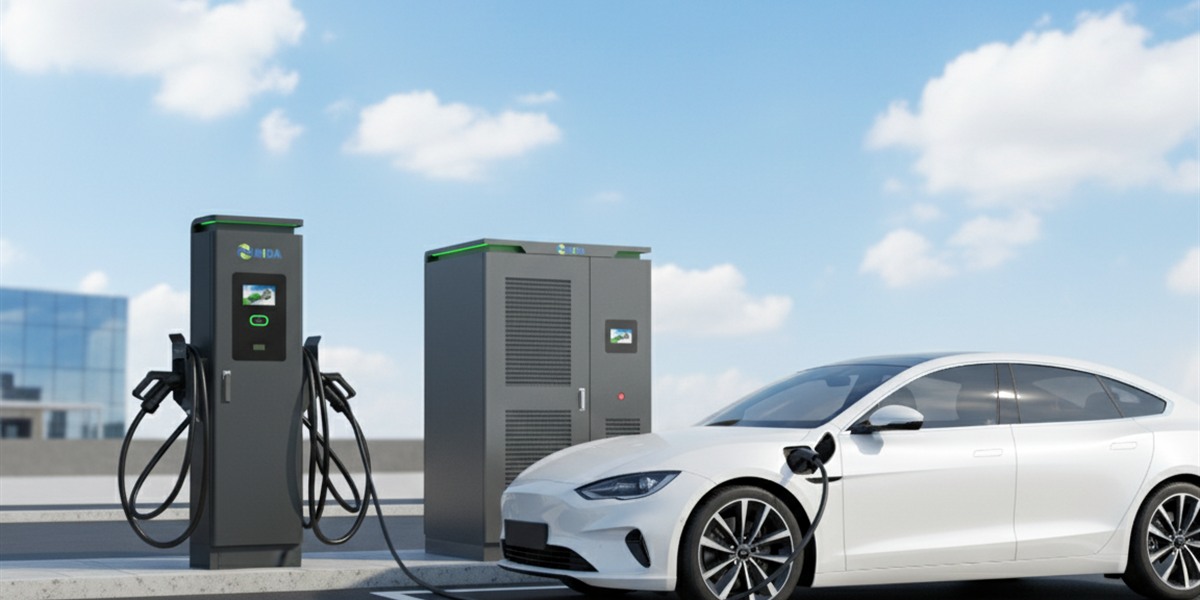
The Rise of High-Power Hubs: Designing 480kW Split DC Charging Stations for Motorways
Quick Answer
A 480kW split DC charging station is the reference design for motorway high-power hubs in 2026: liquid-cooled power cabinets deliver up to 480kW through a pooled architecture feeding four to eight dispensers, with dynamic power sharing that serves passenger EVs at 150–350kW today and heavy-duty trucks at up to 480kW as fleets scale. This configuration satisfies EU AFIR obligations (150kW+ per vehicle for cars, 350kW+ for heavy-duty by 2027) while keeping the site buildable — the power electronics live in a central, acoustically treated room, dispensers sit on simple plinths under canopies, and liquid cooling sustains full output through summer heat. For motorway concessionaires and CPOs, the split design also means faster permitting, 20–30% shorter construction schedules, and module-level serviceability that keeps corridor availability above 98.5%.
Key Takeaways
- 480kW pooled split systems serve both the car and truck segments from one power block, future-proofing AFIR compliance through 2030.
- Liquid-cooled architecture sustains 480kW in 40°C+ ambient and extends module life versus forced-air cooling.
- Centralized power rooms cut noise, heat, and permitting risk at motorway service areas.
- Dynamic smart sharing keeps 4–8 dispensers at 85–95% utilization, the economic core of corridor charging.
- Remote OCPP telemetry and module-level hot-swap service keep corridor availability above 98.5%.
The Motorway Mandate: Regulation Meets Driver Expectations
Motorway charging is no longer an amenity; it is regulated infrastructure. The EU AFIR requires that by 2025, all TEN-T core network service areas offer at least 150kW per charging point for light vehicles (600kW+ per station), and that by 2027, heavy-duty-capable charging of at least 350kW is available every 60 km on core corridors — with 600kW hub requirements emerging by 2030. National implementations in Germany, France, and Spain are already stricter than the floor, and UK motorway service area operators face parallel commercial pressure from franchise agreements that mandate minimum high-power capacity.
Driver expectations have converged with regulation. A 2026 motorway EV driver does not want a 20-minute meal stop plus a 45-minute charge; they want a 20-minute charge and a 10-minute stop. For a 100kWh passenger EV, that means 300kW+ sustained; for an electric truck, it means 350kW–1MW. The only hardware that reconciles “600kW+ per station” and “fast enough to be invisible” is a high-power pooled architecture — and 480kW per power block has emerged as the practical unit of construction, because two blocks (960kW) cover the largest AFIR station classes while one block (480kW) covers the majority of mid-size service areas.
Why 480kW Is the Sweet Spot for Corridors
A 480kW split station balances four constraints that pull in different directions: grid connection cost, thermal engineering, dispenser economics, and regulatory sufficiency.
- Grid economics. 480kW is the upper edge of what many sites can deliver from an existing 0.4kV connection with modest reinforcement, avoiding a full medium-voltage rebuild. Where MV is needed, 480kW still qualifies for standardized transformer sizes with 8–12 month lead times.
- Thermal reality. Sustained 480kW output in a roadside cabinet demands liquid cooling; air-cooled designs derate sharply above 35°C, and motorway summer afternoons are exactly when demand peaks. Liquid-cooled modules hold rated power at 45–50°C ambient — a revenue-critical difference on the hottest days.
- Dispenser economics. Four to eight dispensers per 480kW block keeps per-dispenser cost sensible while providing enough bays to absorb arrival bursts. Each dispenser can deliver up to the full block output, so no bay is ever starved by configuration.
- Regulatory sufficiency. One 480kW block exceeds the AFIR heavy-duty threshold per station, and two blocks satisfy the most demanding 600kW+ hub classes — meaning the same hardware platform scales across the entire corridor portfolio.
MIDA’s 480kW ultra-fast liquid-cooled DC charging station for motorways embodies exactly this balance, and the deployment experience from that program informs the design guidance below.
Split Architecture for Motorway Constraints
Motorway service areas are among the most constrained sites in the charging industry: limited land, strict acoustic limits, fire-safety requirements, and zero tolerance for driver-facing equipment failures. The split architecture was effectively invented for this environment.
Space. A conventional all-in-one 480kW solution would scatter eight refrigerator-sized cabinets across the forecourt. A split design concentrates everything in one power room of roughly 10–14 m² — often a prefabricated enclosure delivered ready-to-energize — freeing forecourt space for what actually generates revenue: parking bays and retail dwell.
Noise. Night-time limits of 55–60dB(A) at the site boundary are common, and 480kW of air-cooled electronics at 2m distance can exceed them. In a split layout, fans and pumps live inside the acoustically treated power room; dispensers at the bays emit under 45dB(A), so compliance is designed in rather than fought in mitigation.
Fire and safety. Concentrating all high-voltage conversion in one bonded, fire-rated enclosure with a single earth grid simplifies compliance with national electrical codes and insurance requirements — one inspection point instead of eight.
Maintenance. The motorway environment punishes reactive maintenance: lane closures, night work premiums, and driver dissatisfaction. Module-level hot-swap service means a 480kW station’s power fault is fixed in under an hour by a single technician with one spare module, rather than a crane and a depot visit.
Liquid Cooling: The Reliability Enabler
Liquid cooling is often framed as a premium option; at 480kW on a motorway, it is a necessity. The engineering case is threefold. First, sustained output: forced-air systems derate 20–40% above 35°C, while liquid-cooled systems hold rated power at 45–50°C — on a July afternoon, that is the difference between a 480kW station and an effective 320kW station. Second, component longevity: junction temperatures of power semiconductors drop by 15–25°C with liquid cooling, roughly doubling IGBT/SiC module life and halving the expected failure rate in the 10-year operating window a motorway concessionaire needs. Third, noise: liquid-cooled systems run at far lower acoustic output, which is decisive for night-time operation near residential areas adjacent to motorway exits.
The operational model is simple: each cabinet houses 40–60kW liquid-cooling power modules that are individually field-replaceable. Spare-module stock at the regional service center (or on-site for high-traffic hubs) converts the classic “charger down for days” event into a “module swapped in an hour” routine. For corridor operators running 98.5%+ availability SLAs, this is the single most important hardware decision.
Designing the Site: Power Room, Bays, and Canopy
The physical layout of a 480kW motorway station follows a standard pattern that has proven itself across dozens of European and Asian deployments:
- Power room. 10–14 m² enclosure adjacent to the grid connection point, housing the cabinets, site controller, metering, and (optionally) 200–400kWh battery buffer. Position it as close to the transformer as possible to minimize MV/LV cabling cost.
- Dispenser bays. Four to eight plinths at 3.5–4m spacing, oriented for either car-size (4.5m) or truck-compatible (12m+) pull-through bays. Every bay is a candidate for a 480kW draw — no bay is pre-assigned a power tier.
- Canopy and services. Canopies shade vehicles during dwell (reducing cabin cooling load is a secondary benefit) and host lighting, signage, and optional PV. Ducting from the power room to each bay carries DC cables and the communications bus; oversize the duct by 30% for future dispensers.
- Communications. A fiber or hardened Ethernet backbone to the site controller, with 4G/5G fallback, running OCPP 1.6J/2.0.1 to the CPO platform and remote diagnostics.
The design rule that saves the most money downstream: build the civil envelope for two blocks even if you energize one. Trench width, power-room footprint, and transformer pad sized for 960kW today cost 10–15% more at construction but eliminate a full second construction project when traffic justifies expansion.
Availability SLAs and Remote Management
Motorway charging is judged by one number: availability at the moment a driver plugs in. The 2026 CPO landscape treats 98.5% monthly availability as table stakes on corridors, with concession agreements increasingly imposing financial penalties below that threshold. Achieving it at 480kW scale requires three systems working together:
- Predictive monitoring. The site controller streams module temperatures, coolant flow, and power-stage telemetry continuously; anomaly detection flags a degrading module before it fails, scheduling replacement during off-peak windows.
- Remote reset and diagnostics. Over 60% of “charger down” events are software or communications faults resolvable remotely. A hardened controller with reboot logic and full OCPP telemetry typically recovers these within minutes, without a truck roll.
- Module-level service. When hardware does fail, the fix is a 30–60 minute hot-swap. Stocking two spare modules per corridor (one per 4–6 stations) is the standard operating model.
The Cost Model: CAPEX and OPEX per Bay
| Cost component | Typical range (480kW split station, 6 bays) | Notes |
|---|---|---|
| Power cabinets + modules | €60k–95k | Liquid-cooled, 480kW pooled |
| Dispensers (6 × dual-cable) | €45k–80k | CCS2, 1000V-class |
| Site controller + software | €8k–15k | OCPP, smart sharing, API |
| Civil works + grid connection | €80k–180k | Highly site-dependent |
| Battery buffer (optional) | €60k–120k | Peak shaving, 200–400kWh |
| Annual OPEX (ex-energy) | €18k–35k | Service, telemetry, maintenance, land share |
| Revenue potential (energy margin) | €90k–180k/year | At 60–80 sessions/day, €0.22–0.25/kWh margin |
The split design’s OPEX advantage compounds over time: module-level service contracts run 20–30% below equivalent all-in-one maintenance, and the liquid-cooled module fleet’s lower failure rate cuts the single largest unplanned cost — emergency call-outs at premium night rates.
Partnering with a Single Vendor
Corridor programs are won or lost on execution risk, which is why the vendor decision deserves the same rigor as the site design. The ideal partner offers the complete stack — power modules, cabinets, dispensers, site controller, and software — with CE/TUV/UL certification coverage and OEM/ODM flexibility for concessionaire branding. MIDA Power supplies exactly this integrated model: the 480kW liquid-cooled motorway station is a reference product, the 360kW stations with RFID, OCPP, and POS demonstrate the shared-software platform, and the module-level architecture keeps one SKU across the fleet. When one vendor owns the module-to-dispenser interface, the mean-time-to-repair on multi-vendor faults disappears, and corridor availability targets become contractually credible.
The Bottom Line
The 480kW split DC station is the workhorse of the motorway network: large enough to satisfy AFIR car and truck obligations, small enough to build on existing grid connections, and pooled enough to keep every dispenser earning. Its success rests on four decisions made early: liquid-cooled, module-level power architecture; a centralized, acoustically treated power room; a civil envelope sized for 960kW expansion; and a single-vendor accountability model. Motorway concessions are multi-decade assets — design them like it, and the 480kW block you install in 2026 will still be the revenue core of the corridor in 2036.
FAQ
1. How many vehicles can a 480kW motorway station serve per day? Typically 60–120 light-vehicle sessions (20–50kWh average delivery) or 20–35 heavy-duty sessions, or a mix. At 480kW pooling, a well-run station moves 4–6MWh per day.
2. Is 480kW enough for AFIR heavy-duty compliance? Yes. AFIR requires 350kW+ HDV-capable charging by 2027; a 480kW pooled station exceeds the per-station requirement and, with dual blocks, covers 600kW+ hub classes emerging by 2030.
3. Why liquid cooling at 480kW instead of air cooling? Air-cooled systems derate 20–40% above 35°C and run louder; liquid-cooled systems hold rated power at 45–50°C, roughly double module life, and cut acoustic output — all decisive at motorway sites.
4. How long does construction take for a 480kW split station? 6–10 weeks on-site with a ready grid connection, versus 8–14 weeks for equivalent all-in-one layouts, because all high-voltage work is centralized in one power room.
5. Can a 480kW station charge trucks and cars simultaneously? Yes. With smart sharing, one bay can deliver 350–480kW to a truck while other bays serve cars at 100–150kW each, all within the same site power cap.
6. What availability level can a 480kW split station actually achieve? >98.5% monthly is achievable with predictive monitoring, remote diagnostics, and module-level hot-swap service — the architecture is designed to eliminate single-point failures at the charger level.
7. What does a spare-module strategy look like for a corridor? Stock two spare 40–60kW modules per 4–6 stations at the regional service center; a trained technician performs hot-swaps in 30–60 minutes, keeping downtime per event under one hour.
Post time: Aug-21-2026


