
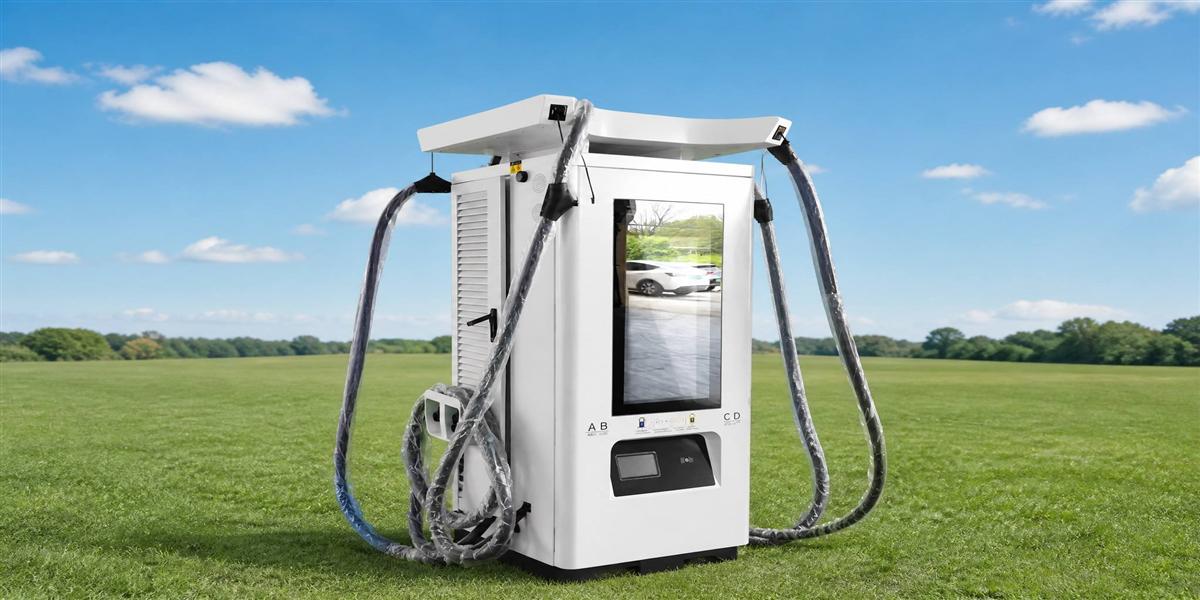
Advanced Thermal Management: MIDA 360kW 4-Gun DC Fast Charger for All-Weather Use
Quick Answer
The MIDA 360kW 4-gun DC fast charger is engineered for all-weather reliability through advanced thermal management: a fully liquid-cooled power stage and liquid-cooled 600A cables that maintain full output from −30°C to +55°C ambient, with sealed, high-IP-rated enclosures protecting electronics from dust, salt, humidity, and wash-down water. Where air-cooled chargers derate in summer heat, ingest dust and salt through fan intakes, and struggle in cold starts, the MIDA system removes heat at the source — power modules, cables, and connectors — keeping four guns at rated power in desert heat, coastal salt air, alpine winters, and high-altitude sites. Sealed liquid-cooled modules deliver a materially higher mean time between failures (MTBF) than fan-cooled equivalents, and OCPP 1.6J/2.0.1 remote telemetry tracks module temperatures in real time for predictive maintenance. For operators in harsh climates — deserts, coastlines, mountains, northern winters — the 360kW 4-gun station is the difference between a charging asset that performs year-round and one that fails in the season that matters most.
Key Takeaways
- Full liquid cooling — modules, cables, and connectors — sustains rated 360kW output across a −30°C to +55°C ambient range without thermal derating.
- Sealed enclosures with IP55–IP65 protection exclude dust, salt, and wash-down water, eliminating the contamination failures that kill air-cooled chargers in yards and coastal sites.
- Four independent guns remain fully available in extreme weather: no fan intakes to clog, no air filters to service, no cold-start constraints on the power stage.
- Module-level temperature telemetry over OCPP 1.6J/2.0.1 enables predictive maintenance, cutting unplanned downtime in remote or seasonally harsh locations.
- Higher MTBF from cooler, sealed operation lowers lifetime service cost — the decisive TCO factor for sites in extreme climates.
Why Thermal Management Decides Charger Lifespan
Power electronics obey an unforgiving rule: every 10°C reduction in junction temperature roughly doubles semiconductor lifetime. In a 360kW DC charger, the power modules switch thousands of amperes and dissipate kilowatts of heat; how that heat is removed determines both the station’s sustained output and its service life. Thermal management is not a support function in high-power charging — it is the core engineering discipline that decides whether a station delivers 360kW on a 45°C afternoon, or silently throttles to 260kW while drivers wait.
The stakes are higher outdoors. A highway or depot charger must survive not just the electrical load but the environment: 50°C asphalt heat in desert summers, −30°C nights in Nordic winters, salt spray on coastal motorways, dust storms in the Middle East, and the constant humidity of tropical climates. Air-cooled chargers fight all of these at once — fans pull in dust, salt, and moisture, then blow that contamination across the very electronics they are meant to protect.
Air-Cooled vs. Liquid-Cooled: The Failure Mode Comparison
| Environmental Stress | Air-Cooled Charger | MIDA 360kW Liquid-Cooled |
|---|---|---|
| Summer heat (40°C+) | Derates output; fans at full speed, high noise | Rated output sustained; coolant removes heat at source |
| Dust and sand | Clogs filters and heat sinks; requires frequent cleaning | Sealed enclosure; no air path into electronics |
| Salt air (coastal) | Corrodes fins and connectors through airflow | Sealed modules; corrosion exposure minimized |
| Humidity/condensation | Moisture ingress through vents | Sealed, potted power stage |
| Cold start (−30°C) | Lubricants and fan bearings stiffen; controller warm-up delays | Liquid loop warms modules; immediate controlled start |
| Noise at bay | 60–70 dB(A) fan noise | Minimal — cooling is remote from the dispenser |
Every row in that table is a real failure mode documented across operating networks. The MIDA design eliminates the entire class of air-path failures by making the cooling loop a sealed, closed system.
How the Liquid-Cooling Architecture Works
The 360kW 4-gun station manages heat at three levels:
- Liquid-cooled power modules. Each module — MIDA’s 40kW/60kW liquid-cooling power modules — circulates coolant through an internal cold plate bonded to the switching devices. Junction temperatures stay far below air-cooled equivalents at the same output, extending module life and preserving rated power in high ambient temperatures.
- Liquid-cooled DC cables. At 360kW and 800V, the cable current is 450A+; at boosted single-gun output it approaches 600A. Liquid-cooled cable assemblies keep the cable and connector within safe temperature limits without the thick copper and stiff jacket of air-cooled equivalents — lighter for drivers to handle, and free of thermal derating.
- Sealed enclosure with managed heat rejection. The cabinet is sealed to IP55–IP65, with heat rejected through a liquid-to-air heat exchanger (or remote radiator where site conditions demand), not through fan-driven airflow across the electronics. Wash-down, rain, and dust simply run off the enclosure.
The result is a station whose thermal behavior is largely independent of the outside air: the coolant loop absorbs, moves, and rejects heat in a controlled path, while the electronics sit in a sealed, stable environment.
All-Weather Performance Across Climate Zones
The all-weather claim is only credible if it is defined across the full range of operating environments. The MIDA 360kW 4-gun station is engineered for:
- Desert and high-heat sites (up to +55°C): Full rated output maintained; the coolant loop and sealed enclosure prevent the thermal derating and dust ingress that plague fan-cooled units in Gulf and Southwest US deployments.
- Cold climates (down to −30°C): The liquid loop supports controlled cold starts, with module temperature management that avoids the thermal shock and condensation issues of air-cooled designs. Winter road-salt exposure is mitigated by the sealed enclosure.
- Coastal and high-humidity sites: Salt spray and persistent humidity are the top environmental killers of outdoor electronics. The sealed power stage and corrosion-resistant materials give coastal motorway and port sites a charger that survives what the ocean throws at it.
- High altitude: Reduced air density impairs fan cooling efficiency. A liquid-cooled system is largely immune to altitude effects — a meaningful advantage for mountain-corridor and plateau deployments above 2,000m.
Operators in these environments do not have the luxury of seasonal maintenance cycles: the charger must perform during the heatwave, the blizzard, and the monsoon, because that is precisely when the fleet cannot afford downtime.
Predictive Maintenance Through Thermal Telemetry
Thermal management is also an information asset. The station exposes per-module temperature, coolant temperature, flow status, and efficiency telemetry through OCPP 1.6J/2.0.1, giving operators a continuous picture of thermal health:
- Trend monitoring: A gradual rise in module temperature at constant load signals coolant degradation or a failing pump before it becomes a failure.
- Alert-driven dispatch: Threshold alerts trigger maintenance workflows automatically — the technician arrives with the right part on the first visit.
- Seasonal profiling: Historical temperature data shows how the station performs across seasons, informing service intervals and cooling-system maintenance.
For remote sites, where a failed charger means a long service drive, this telemetry is the difference between scheduled preventive visits and emergency truck rolls.
Four Guns, Full Availability, Any Weather
The 4-gun topology multiplies the all-weather value. When a site must charge multiple vehicles in a storm, a heatwave, or a cold snap, the station keeps all four connectors available — there are no shared fan arrays to fail, no single air-filter blockage that takes the whole station down. Each gun’s liquid-cooled cable performs independently, and the sealed cabinet protects the shared power core. In fleet terms: four vehicles keep their charging slots in exactly the weather when backup capacity is hardest to find.
The TCO Case for All-Weather Charging
The premium for liquid-cooled, sealed construction is repaid quickly in harsh environments. Model a coastal or desert site with ten stations over a five-year horizon:
| Cost Factor | Air-Cooled Station | MIDA 360kW Liquid-Cooled |
|---|---|---|
| Filter and fan maintenance | Quarterly cleaning, seasonal filter replacement | None — sealed system |
| Derating losses (hot season) | 10–30% output loss for 3–5 months/year | None — rated output sustained |
| Contamination failures | Recurring module and fan replacements | Rare — sealed power stage |
| Emergency service visits | Multiple per year per site | Predictive, scheduled |
| Uptime | Degrades in peak season | Consistent year-round |
For an operator whose revenue peaks in summer (tourism corridors) or whose fleet depends on winter reliability (cold-climate logistics), the availability delta in the worst months is worth more than any headline power number.
Why MIDA for All-Weather Quad Output Charging
MIDA Power has built its quad output family on the same advanced thermal platform, so the all-weather engineering is not a special edition — it is the baseline. The 360kW 4-gun station shares its sealed, liquid-cooled architecture with the MIDA 480kW ultra-fast charging system with quad connector support for high-throughput corridors and the MIDA 320kW 4-gun DC fast charger with OCPP 2.0.1 for grid-integrated sites, and scales down to the MIDA 240kW quad output DC charger for fleet operators for depot deployments. For heavy-duty logistics in extreme climates, the same platform powers the MIDA 360kW quad output DC station for heavy-duty electric trucks.
Every station ships with TUV/CE/UL certification, IP55–IP65 enclosure protection, OCPP 1.6J/2.0.1 connectivity, and module-level thermal telemetry. For operators procuring charging infrastructure in deserts, mountains, coastlines, or northern winters, the MIDA 360kW 4-gun station delivers the one property that cannot be bought at any price in the peak season: guaranteed, rated-power charging in whatever weather the site throws at it.
FAQ
1. What temperature range does the MIDA 360kW 4-gun charger operate in?
The station is engineered for sustained rated output across approximately −30°C to +55°C ambient, with sealed liquid cooling that prevents thermal derating in heat and supports controlled cold starts.
2. Why is liquid cooling better than air cooling for outdoor chargers?
Liquid cooling removes heat at the source through a sealed loop, so the electronics never depend on fans pulling ambient air — eliminating dust, salt, and humidity ingress while keeping junction temperatures far lower at the same output.
3. What IP rating does the station have?
The enclosure is sealed to IP55–IP65, protecting the power stage from dust, water jets (including wash-down), rain, and coastal salt exposure.
4. Will the charger derate in summer heat?
No. The liquid-cooled power modules and cables sustain rated output up to +55°C ambient — unlike air-cooled units that throttle 10–30% during hot-season peaks.
5. How does the station handle freezing temperatures?
The liquid cooling loop supports controlled cold starts, with module temperature management that avoids thermal shock and condensation — and the sealed enclosure keeps winter road salt out of the electronics.
6. How do operators monitor thermal health?
Per-module temperature, coolant flow, and efficiency telemetry are exposed over OCPP 1.6J/2.0.1, enabling trend monitoring, threshold alerts, and predictive maintenance scheduling.
7. Is the all-weather version more expensive to maintain?
Typically less, despite the more sophisticated cooling: sealed modules need no filter cleaning, survive longer in harsh environments, and fail predictably with remote telemetry — reducing emergency service visits and seasonal maintenance.
Post time: Aug-26-2026


