
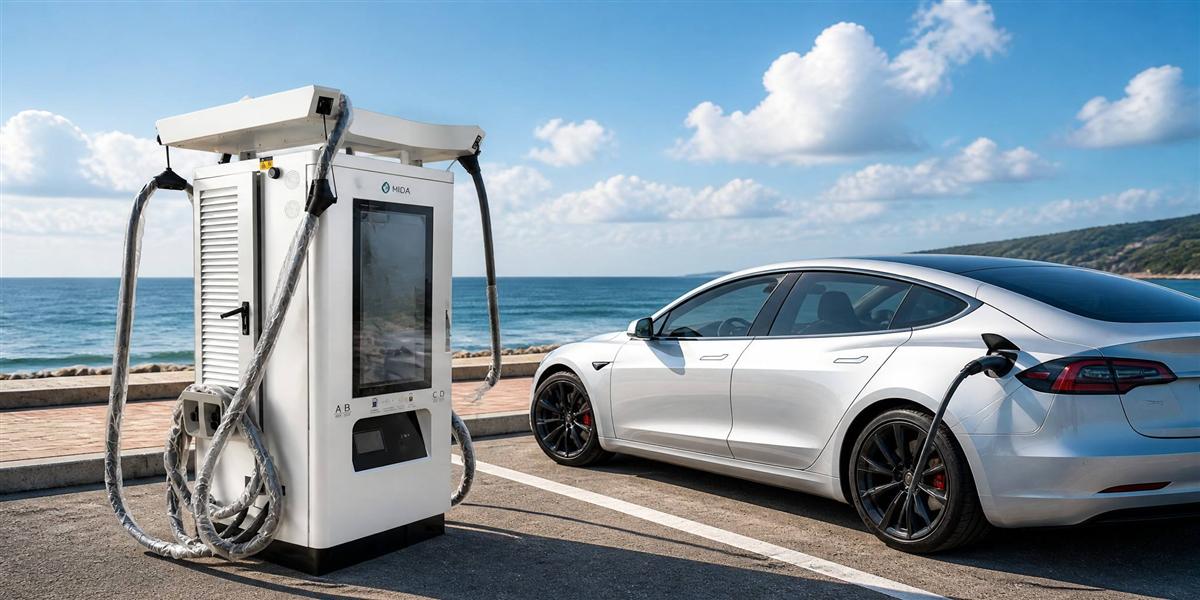
Future-Ready Superchargers: MIDA 480kW Ultra-Fast Charging System with Quad Connector Support
Quick Answer
The MIDA 480kW ultra-fast charging system is a future-ready supercharger built around quad connector support: four liquid-cooled guns share one 480kW power core, so a highway or hub site can serve four vehicles simultaneously while still delivering an individual 10–15 minute charge window to a single 800V vehicle at full power. Liquid-cooled cables sustain 600A+ continuous current without thermal derating, and the wide-voltage (200–1000V) platform charges today’s 400V fleet and tomorrow’s 800V/1000V vehicles at their maximum acceptance rates. The system supports CCS1, CCS2, and NACS connectors, is built on modular 40kW/60kW liquid-cooled power modules for hot-swap serviceability, and ships with OCPP 1.6J/2.0.1 — positioning it for the megawatt-class (MCS) charging era without stranding today’s investment. For CPOs, utilities, and highway operators, the 480kW quad connector system is the throughput architecture that future-proofs high-traffic charging sites.
Key Takeaways
- Quad connector support turns one 480kW cabinet into four simultaneous charging sessions, tripling to quadrupling site throughput versus single-output superchargers.
- Liquid-cooled 600A+ cable assemblies deliver sustained ultra-fast power without derating — essential for 800V EVs claiming 10–15 minute charge times.
- The 200–1000V wide-voltage platform covers 400V legacy EVs, 800V mainstream EVs, and next-generation 1000V trucks from one cabinet.
- Modular 40kW/60kW liquid-cooled power modules enable hot-swap maintenance, keeping the station online while modules are replaced.
- MCS-ready architecture and OCPP 2.0.1 mean the system scales to megawatt-class charging through firmware and module upgrades, not replacement.
The Supercharging Throughput Problem
Highway and urban fast-charging sites fail on one metric more than any other: utilization per grid connection. A conventional 480kW station with a single output delivers 480kW of hardware capacity but serves one vehicle at a time. During a peak hour, that means roughly three to four vehicles per 480kW — each waiting for a 20–40 minute session to finish before the next driver can plug in. Queue length, not charge speed, becomes the binding constraint on revenue.
The economics are brutal for CPOs: a single-output 480kW charger generates revenue only when a vehicle is attached, and the gap between sessions is pure cost. Quad connector support changes the equation by letting four vehicles charge in parallel from the same grid connection. Four simultaneous sessions, four billing events, four satisfied drivers — from one cabinet, one transformer feed, and one service contract.
Why Quad Connector Support Is the Supercharger Standard
“Ultra-fast” is a headline; “quad connector” is an architecture. The MIDA 480kW system demonstrates why the two belong together:
| Configuration | Peak Power | Vehicles Served Simultaneously | Sessions per Peak Hour | Revenue per Peak Hour (relative) |
|---|---|---|---|---|
| Single-output 480kW | 480kW to one vehicle | 1 | ~3–4 | 1x |
| Dual-output 480kW | 240kW per vehicle | 2 | ~6–8 | ~2x |
| Quad connector 480kW | ~120kW per vehicle, or full boost to one | 4 | ~10–14 | ~3x |
Dynamic power allocation is what makes quad connector support commercially superior to four fixed 120kW ports. The station’s controller negotiates with each vehicle’s charging curve: an 800V sedan arriving at 10% state of charge can pull the full 480kW in boost mode for 10–15 minutes, while three other vehicles charge at balanced rates in parallel. When the boost session finishes, the station returns to balanced mode — the same grid connection, the same power, and a continuous flow of completed sessions.
Liquid Cooling: The Enabler of 600A+ Continuous Output
The engineering constraint on ultra-fast charging is not the power electronics — it is the cable in the driver’s hand. At 480kW and 800V, the current is 600A. An air-cooled cable rated for that current is thick, heavy, and stiff, and it derates in hot weather. The MIDA system uses liquid-cooled cable assemblies that circulate coolant through the cable jacket, removing heat at the source:
- Sustained 600A+ output without thermal derating, even in 40°C ambient conditions.
- Lighter, more flexible cables (roughly 30–50% lighter than air-cooled equivalents) that drivers can handle comfortably.
- Compact dispensers that house only the cable, connector, display, and metering — no massive heat sinks or fan arrays.
- Longer cable runs between the power cabinet and the connector position, simplifying site layout for highway plazas and urban hubs.
Liquid cooling also protects the power modules themselves. The 480kW system uses MIDA’s 40kW/60kW liquid-cooling power modules, sealed against dust and humidity, running cooler and longer than air-cooled equivalents — which translates directly into mean time between failures (MTBF) and station availability.
Connector Flexibility: CCS1, CCS2, and NACS
A future-ready supercharger cannot bet on a single connector standard. The global market in 2026 is converging on three: CCS2 across Europe, most of Asia, and Australia; CCS1 across much of North America; and NACS, which is rapidly becoming the default for North American automakers and is being adopted by charging networks from coast to coast. The MIDA 480kW system supports all three, with quad connector configurations that can be mixed per site:
- All-NACS for North American highway corridors serving the latest OEM fleets.
- All-CCS2 for European motorways where CCS2 is the regulatory default.
- Mixed configurations (e.g., two CCS1 + two NACS) for transitional sites where legacy and next-generation vehicles share the plaza.
For CPOs, connector flexibility is risk management: the site is not hostage to a single OEM’s standard transition timeline, and the dispensers can be reconfigured as the vehicle population evolves.
800V and 1000V: Charging at the Vehicle’s Maximum Rate
The 480kW system’s wide-voltage power core (200–1000V) is the quiet hero of future-readiness. Vehicle architectures are shifting decisively toward 800V — and the next wave of heavy-duty trucks is moving to 1000V. A charger with a narrower voltage range (say, 200–750V) would deliver only ~66% of rated power to an 800V vehicle, turning a “480kW” station into an effective 320kW station on the most modern vehicles. The MIDA system delivers its rated current across the full 800V band, so:
- An 800V passenger EV charges at its full acceptance rate — a 10–80% session in roughly 15 minutes.
- A 1000V-class electric truck charges at full rate today, without waiting for a future hardware revision.
- A 400V legacy EV charges at its optimal rate, protecting the site’s ability to serve the existing fleet.
Modular Serviceability: Uptime by Design
Supercharging sites are high-utilization assets — they must not go dark for maintenance. The 480kW system’s modular architecture addresses this at every level. The power stage is built from hot-swappable liquid-cooled modules: when a module fails, a technician swaps it in under 30 minutes without tools beyond a standard kit, and the remaining modules continue serving all four connectors at reduced total power. Remote diagnostics over OCPP expose module-level telemetry — temperatures, efficiencies, run hours — so failures are identified and parts dispatched before a truck rolls onto the site.
This is the difference between a station that advertises 480kW and a station that delivers it reliably for a decade. For CPOs contracting service levels and utilities under regulatory uptime scrutiny, module-level serviceability is a procurement requirement, not a preference.
Scaling to Megawatt-Class: The MCS Pathway
The industry’s roadmap points to megawatt charging for heavy-duty vehicles — the Megawatt Charging System (MCS) standard, which will deliver 1MW+ to electric trucks. A future-ready supercharger must not dead-end at 480kW. The MIDA system is architected for this transition:
| Capability | Today (480kW System) | MCS Pathway |
|---|---|---|
| Power core | 480kW from liquid-cooled modules | Add modules to the same cabinet platform |
| Voltage range | 200–1000V | Extends toward 1250V MCS envelope |
| Cooling | Liquid-cooled cables and modules | Same liquid-cooling architecture scales to 1MW+ |
| Control | OCPP 1.6J/2.0.1 | OCPP 2.0.1 smart-charging framework carries forward |
| Connectors | CCS1/CCS2/NACS | MCS connector adds alongside existing guns |
For a CPO, this means the civil works, grid connection, and cabinet platform bought for 480kW today are not stranded when the first MCS trucks arrive — they are upgraded.
Why MIDA for Future-Ready Supercharging
MIDA Power brings proven high-power pedigree to the 480kW quad connector system. The platform builds directly on the 480kW liquid-cooled ultra-fast charging station for motorways, which has demonstrated sustained ultra-fast operation on highway corridors, and shares its component base with the MIDA 360kW quad output DC station for heavy-duty electric trucks — meaning operators standardizing on MIDA quad output hardware can manage 360kW depot stations and 480kW corridor stations with identical software, spare parts, and service procedures.
For sites that need smarter grid behavior, the system carries the same OCPP 2.0.1 smart-grid integration as the MIDA 320kW 4-gun DC fast charger with OCPP 2.0.1, and for harsh climates the MIDA 360kW 4-gun DC fast charger for all-weather use applies the same liquid-cooled, high-availability architecture with enhanced environmental protection. All stations ship with TUV/CE/UL certification, OCPP 1.6J/2.0.1, and the module-level telemetry that turns a charging asset into a managed, measurable grid service.
FAQ
1. What is quad connector support on a 480kW charger?
It means the station has four independent liquid-cooled DC connectors sharing one 480kW power core, so four vehicles charge simultaneously — with dynamic allocation that can concentrate the full 480kW onto a single vehicle for rapid top-ups.
2. How fast can a vehicle actually charge on the 480kW system?
An 800V EV with a high charge-acceptance rate can complete a 10–80% session in roughly 15 minutes in boost mode. Parallel sessions at balanced rates typically add 20–40 minutes depending on vehicle and state of charge.
3. Does liquid cooling make a difference in hot climates?
Yes, critically. Liquid-cooled cables sustain 600A+ without thermal derating in high ambient temperatures, and liquid-cooled modules run cooler and longer than air-cooled equivalents — preserving both charge speed and component lifetime in summer conditions.
4. Which connectors are available?
CCS1, CCS2, and NACS, with per-site mixing. North American sites can configure all-NACS, all-CCS1, or mixed connector layouts; European sites typically standardize on CCS2.
5. Can the 480kW system charge 1000V trucks?
Yes. The wide-voltage power core (200–1000V) delivers rated current at 1000V, so next-generation high-voltage trucks charge at full rate — no derating.
6. What happens if a power module fails?
The station continues operating at reduced total power across all four connectors, and the failed module is hot-swapped in under 30 minutes using standard tools. Remote telemetry identifies the module before the technician arrives.
7. Is the system ready for megawatt charging (MCS)?
Architecturally yes. The liquid-cooled module platform, cabinet, and OCPP 2.0.1 control framework carry forward to MCS; adding megawatt capability is a module and firmware upgrade on the same platform, not a site rebuild.
Post time: Aug-26-2026


