
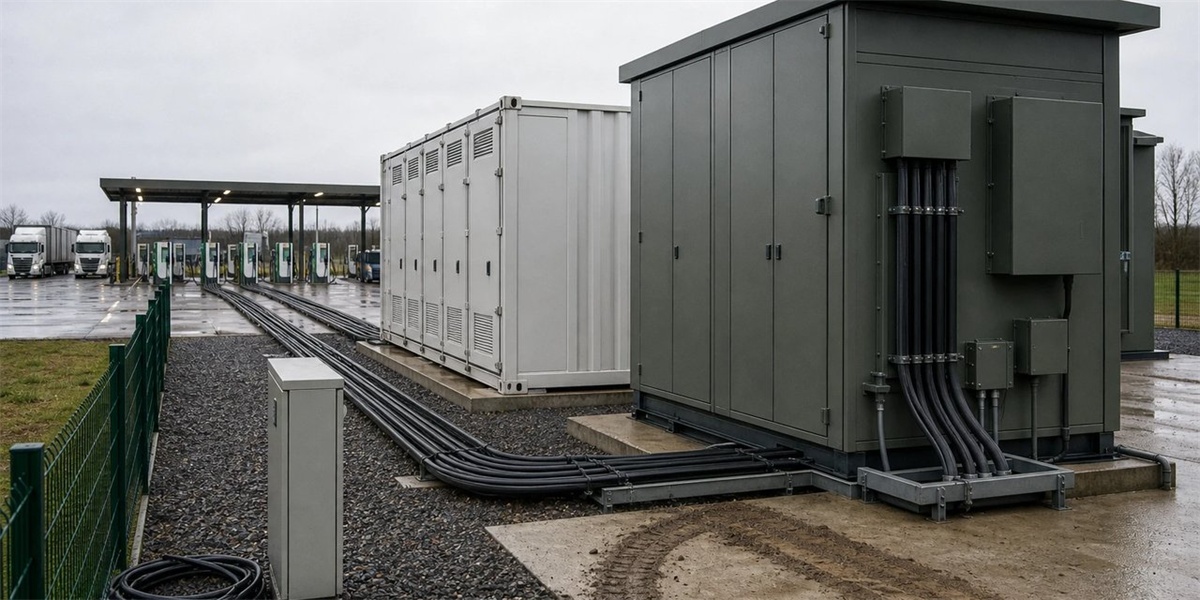
Reducing Installation Complexity: The Wiring Advantages of Remote DC Power Units
Quick Answer
A remote DC power unit is a split charging architecture in which the AC-to-DC conversion stage sits in one centralised cabinet — the “remote power unit” (RPU) — while the dispensers at the parking bays contain only a cable, a connector, a user interface, and safety interlocks. Because power conversion happens once, at a single point, the site’s electrical distribution is carried as low-current three-phase AC from the utility transformer to the RPU, and as high-voltage DC from the RPU to the dispensers over long, thin, liquid-cooled cable runs of 30 to 150 metres or more. Compared with an integrated all-in-one charger at every bay, a remote DC power unit typically eliminates 60–80% of the trenching and conduit, reduces copper cross-section by 50–70%, and cuts on-site electrical labour by a third or more. In 2026, as sites move from single-stall pilots to 6–24-stall hubs, installation complexity — not equipment cost — has become the dominant driver of project overruns, and the remote DC architecture is the most direct way to remove it.
Key Takeaways
- Wiring is the hidden cost centre. Trenching, conduit, cable, terminations, and site labour routinely account for 30–50% of a charging project’s total cost — often more than the chargers themselves.
- Remote DC power units move conversion, not power. The RPU centralises rectification so the costly, thick, high-current conductors are short and the cheap, thin conductors are long — the exact inverse of an integrated design.
- DC on long runs beats AC on long runs. A single RPU feeding dispensers over a DC bus avoids repeating AC/DC conversion at every bay and removes the need for one protection and metering chain per dispenser.
- Civil works shrink measurably. One power feed plus a thin dispenser bus means fewer trenches, fewer pads, fewer penetrations, and dramatically less reinstatement of paving and landscaping.
- The wiring advantage compounds with scale. Every dispenser added to an existing RPU reuses the same power room, the same feeder, and the same control network — so incremental installs get faster, not slower.
Why Installation Complexity Is the Real Bottleneck
For a decade, the EV charging conversation has focused on the charger: its power rating, its connectors, its price. Owners who have actually built hubs know that the equipment line item is rarely what breaks a budget. The cost that surprises them sits in everything the charger needs around it: the trench from the transformer, the concrete pad, the conduit bank, the feeder cable, the earthing grid, the communications backbone, the permits, and the electricians’ hours to tie it all together.
That cost scales with the number of places you must deliver power and the amount of power you deliver to each. An integrated 240kW charger at every bay means a 240kW-class feeder, protection, and metering chain at every bay. A six-bay site therefore contracts six high-current AC feeds, six sets of switchgear interfaces, and six cable routes — each one trenched, inspected, and terminated separately. The civil and electrical work multiplies with the stall count, and so does the schedule risk: every additional trench is another chance for a buried service, a permit hold, or a weather delay.
A remote DC power unit inverts the multiplication. The number of expensive connections is fixed at one; only the cheap connections multiply. That single change is the difference between a site that installs in weeks and a site that installs in quarters.
Anatomy of a Remote DC Power Unit
The remote DC power unit is the centralised power block of a split system. It contains everything that is hot, heavy, noisy, or serviceable:
- Liquid-cooled power modules — typically 40kW or 60kW units, hot-swappable, providing the AC-to-DC rectification. A single RPU holds six to twelve of them.
- Isolation, protection, and metering — input breaker, surge protection, DC insulation monitoring, and revenue-grade or operational metering.
- The cooling loop — a sealed liquid cooling circuit with a heat exchanger or chiller, moving heat out of the electronics without drawing unfiltered site air across them.
- The site controller — dynamic power sharing, dispenser arbitration, load-limit enforcement, and the OCPP/ISO 15118 communication stack.
- The DC bus interface — the terminals from which the dispenser runs depart.
The dispensers are deliberately minimal: cable management, the connector head, a display or RFID/POS interface, an emergency stop, and the safety interlocks. No rectifier, no large enclosure, no fan, no meaningful heat. This division of labour is what makes the wiring economics so favourable — you are not running high-current AC to every bay and then converting it again; you are running one high-current feed to one cabinet and then distributing DC along a thin bus.
The Wiring Advantage: DC Bus Versus AC Distribution
The core engineering claim of the remote DC architecture is simple: for a given delivered power, distributing at a higher voltage with a controlled current is cheaper, lighter, and easier than distributing at low voltage with a high current. The table below compares the three common topologies at a representative six-stall, 480kW site.
| Design Parameter | Integrated (all-in-one at each bay) | AC-Distributed (AC to each bay, convert locally) | Remote DC Power Unit (central convert, DC to dispensers) |
|---|---|---|---|
| Conversion stages | One per bay (6×) | One per bay (6×) | One (centralised) |
| High-current runs | 1 per bay (6 long runs) | 1 per bay (6 long runs) | 1 total (to the RPU) |
| Feeder cable, relative copper mass | 100% | 90–100% | 30–50% |
| Trenching, relative length | 100% | 100% | 20–40% |
| Concrete pads required | 6 (one per charger) | 6 (one per bay) | 1 (RPU) + lightweight dispenser bases |
| Protection/metering chains | 6 | 6 | 1 central + lightweight dispenser interlocks |
| On-site electrical labour | 100% | 95–100% | 60–70% |
| Typical install duration (6-bay site) | 6–10 weeks | 4–8 weeks | 2–4 weeks |
| Expansion cost per new stall | Full feed + charger install | Full feed + converter install | Dispenser + cable run only |
The pattern is unambiguous. By concentrating conversion, the remote design converts six expensive electrical problems into one expensive problem plus six cheap ones. For operators building anything beyond a single-stall pilot, the labour and civil savings alone frequently exceed the price premium of a split system, and they arrive with a shorter, lower-risk schedule.
Conductor Economics: Why Long DC Runs Make Sense
A frequent objection to split systems is intuitive but wrong: “isn’t it wasteful to run power 100 metres to a dispenser?” The answer lies in what is being run.
- AC distribution to each bay carries power at 400V three-phase. For a 240kW charger, that is roughly 350A per phase. The conductor must be thick, the protection large, and the installation heavy at every bay.
- DC distribution from a remote power unit carries power at 750–1000V DC. The same 240kW at 950V is about 250A on a two-conductor bus — and, critically, that bus is shared across all dispensers, not duplicated per stall.
Because current (not voltage) sets conductor cross-section, the higher the distribution voltage, the less copper you move. Liquid-cooled DC cable, which actively removes heat from the conductor, further raises the permissible current density for a given cross-section, allowing a compact, flexible, easily routed dispenser run where a conventional feeder would need a rigid, heavy, hard-to-bend cable.
The practical outcomes are concrete:
- Smaller conductors — 50–70% less copper by mass for the same delivered power.
- Tighter bend radii — easier routing through car-park decks, along walls, and around existing services.
- Fewer terminations — DC bus terminations at the RPU and dispenser, versus a full AC protection, metering, and conversion chain at every bay.
- Lower voltage drop for the same copper — higher distribution voltage keeps losses manageable over the 30–150m runs that real sites require.
Civil Works: The Savings That Never Appear on a Datasheet
The wire is only half the story. The trench that carries it, the pad it lands on, and the permits that authorise it are where schedules are lost. Centralising conversion changes all three:
| Civil Element | Integrated/AC-Distributed | Remote DC Power Unit | Effect |
|---|---|---|---|
| Trench length | Complete network of bays | One primary route + thin dispenser spur | 60–80% reduction |
| Trench depth/width | Sized for thick LV feeders | Sized for RPU feeder; shallow DC spur | Lower excavation volume |
| Concrete pads | One per charger | One for the RPU | Fewer pours, faster cure |
| Ground penetrations | Many | Few | Lower leak and waterproofing risk |
| Paving reinstatement | Extensive | Minimal | Fewer traffic-management days |
| Utility/wayleave approvals | Multi-point | Single-point | Faster permissions |
| Landscaping impact | High | Low | Better landlord acceptance |
On constrained urban sites — retail decks, hotel basements, depot yards — this reduction is not merely a cost saving; it is often the difference between a feasible project and one that cannot physically be built. A remote power unit can sit in an existing plant room or service corridor, leaving the entire usable surface for vehicles.
Placement and Serviceability: The Side Benefits of Centralisation
Centralising the power electronics also centralises the maintenance burden. In an integrated site, a failed rectifier takes a stall out of service and sends a technician to a bay exposed to traffic, weather, and, in urban settings, the public. In a remote DC site, all serviceable components live in one controlled location:
- Safer service — technicians work in a protected area, not in a live car park.
- Faster repair — hot-swap a 40kW or 60kW module in place, in under an hour, without touching the dispensers.
- Fewer site visits — one cabinet to inspect, filter, and monitor instead of six.
- Consistent security — the RPU can be locked, alarmed, and monitored as a single asset.
This is why fleet operators with strict availability targets increasingly default to split architecture: the wiring simplification and the maintenance simplification arrive as one package.
How MIDA Delivers the Wiring Advantage
MIDA Power has engineered its commercial DC line around exactly this centralised-conversion principle. The building block is the 40kW/60kW liquid-cooling power module, which populates every cabinet from a single 240kW unit to multi-megawatt clusters, so the DC bus interface, the cooling loop, and the control stack remain identical as a site grows. The 360kW liquid-cooled charging station with RFID, OCPP, and POS shows the architecture configured for attended hubs, where access control and payment sit at the dispenser while all power conversion stays in the cabinet. The 480kW ultra-fast liquid-cooled station for motorways demonstrates the same centralised-conversion logic at corridor scale, where separating power from the point of delivery protects uptime and shrinks the civil scope.
For a site planner, the practical consequence is that MIDA’s commercial DC fast charging range lets you specify one RPU, one feeder, and one control network — then place dispensers wherever the vehicles park, within the DC bus reach, without redesigning the electrical distribution for each new stall.
FAQ
1. What is a remote DC power unit, in one sentence?
It is a split charging architecture in which all AC-to-DC conversion is centralised in one cabinet — the remote power unit — while the dispensers at the bays contain only a cable, a connector, a user interface, and safety interlocks, connected to the cabinet by a DC bus.
2. Doesn’t running DC 150 metres to a dispenser lose energy?
Losses are manageable and usually lower than AC-distributed alternatives, because the DC bus runs at 750–1000V and carries a controlled current, and liquid-cooled cable handles the heat. Higher voltage for the same copper means less voltage drop than an equivalent low-voltage AC feeder.
3. How much trenching does a remote DC design actually save?
On a typical six-stall hub, operators report a 60–80% reduction in trench length and a corresponding drop in concrete pads, ground penetrations, and paving reinstatement compared with integrated or AC-distributed designs.
4. Does a split system require special cable?
The dispenser run uses the manufacturer’s liquid-cooled DC cable, which is specified as part of the system. This cable is thinner and more flexible than an equivalent high-current AC feeder, which simplifies routing through decks and service corridors.
5. Can I install the power unit indoors?
Yes. Because the electronics are liquid-cooled and sealed, the remote power unit can be sited in a plant room, service corridor, or dedicated enclosure, keeping noise, heat, and high-voltage gear out of the driver area — often improving both permitting and acoustics.
6. Is expansion more expensive in a split design?
No — expansion is cheaper. Adding a stall requires only a dispenser and its DC cable run, reusing the existing power unit, feeder, and control network, instead of a new high-current feed and a new charger installation.
7. Does centralised conversion reduce reliability?
It increases effective reliability when the power unit is modular. With hot-swappable modules and N+1 options, a single module failure sheds only its share of capacity, and both the cabinet and all other dispensers keep running while the module is swapped.
The Bottom Line
Installation complexity is the quiet tax on every charging project: it inflates budgets, stretches schedules, and turns a straightforward infrastructure purchase into a civil-engineering programme. The remote DC power unit removes that tax by changing where conversion happens. Rather than running heavy AC to every bay and converting it repeatedly, the site converts once, centrally, and distributes DC over a thin, flexible bus. The result is 60–80% less trenching, half the copper, a third less on-site electrical labour, and an expansion path that adds stalls without adding civil works. For operators planning 6, 12, or 24 stalls in 2026, the wiring advantage of the remote DC power unit is not a marginal refinement — it is the difference between a hub that gets built on schedule and one that stalls in the trench.
Post time: Sep-17-2026


