
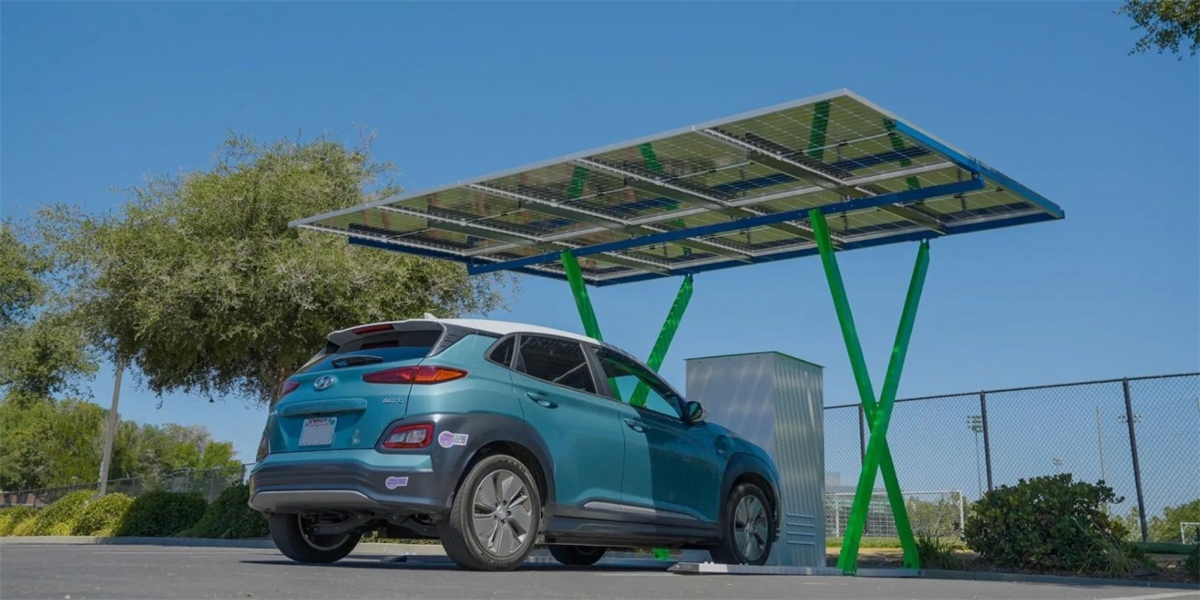
Smart Microgrids: Leveraging Split Type DCDC Chargers for Solar EV Stations
Quick Answer
A smart microgrid for EV charging is a site that generates, stores, and manages its own energy locally — typically a solar PV array, a battery, and the charging load — while staying grid-tied and grid-friendly. Split type DCDC chargers are the enabling component: instead of converting PV DC to AC and then back to DC at the charger, a DCDC converter connects the solar array’s DC bus more directly to the EV’s DC bus, removing one or more conversion stages and improving round-trip efficiency by roughly 2–5%. Because a split architecture separates the power conversion stage from the dispensers, the same DCDC platform can serve multiple stalls, integrate storage at the DC bus, and, where permitted, island the site to keep chargers running during a grid outage. For solar EV stations in 2026, the combination of local generation, DC-coupled conversion, and smart control delivers higher renewable self-consumption (typically 60–90% with storage), lower energy cost per kWh, and a resilience level that a grid-only site cannot provide.
Key Takeaways
- Conversion stages are losses. Every AC↔DC transition costs efficiency; DCDC-coupled solar-to-vehicle paths remove at least one stage and recapture 2–5% of delivered energy.
- Split DCDC chargers scale a solar station cleanly. Centralised conversion feeds multiple slim dispensers, so one power block serves a whole array of parking bays.
- Storage is what makes solar charging dispatchable. A battery moves midday generation into the evening peak, converting intermittent production into reliable fast charging.
- Smart control is the differentiator. Forecasting, load shaping, and islanding logic — not panels or batteries alone — define whether a microgrid is genuinely “smart.”
- Resilience is a revenue-adjacent feature. Islanding keeps critical chargers alive during outages, which is increasingly a procurement requirement for municipal and fleet sites.
What Makes a Microgrid “Smart” in 2026
The word microgrid is often used to describe any site with solar panels. That is not a microgrid; it is a site with panels. A smart microgrid has four distinguishing capabilities:
- Local generation — a solar array (or other source) that produces a meaningful share of site energy.
- Local storage — a battery that decouples generation from consumption in time.
- Intelligent control — an energy management system that forecasts generation and demand, dispatches storage, shapes charging load, and enforces grid limits.
- Controllable interaction with the grid — the ability to import, export, or island according to tariffs, grid codes, and site priorities.
A solar canopy over a car park may satisfy only the first. A smart EV microgrid satisfies all four, and it does so around the charging load — the largest and most flexible demand on the site.
Why Conversion Topology Matters
The efficiency of a solar EV station depends heavily on how many times energy is converted between DC and AC. Solar panels produce DC. Batteries store DC. EV batteries charge from DC. The grid, and most legacy building loads, operate on AC. Every boundary between the two worlds costs efficiency, and the losses compound.
| Energy Path | Conversion Chain | Approximate Stage Losses | Relative Efficiency |
|---|---|---|---|
| PV → grid → AC charger → vehicle | DC/AC → AC/DC | Two or more stages | Lowest (baseline) |
| PV → battery → grid → charger → vehicle | DC/DC → DC/AC → AC/DC | Three or more stages | Low |
| PV → AC-coupled battery → charger → vehicle | DC/AC → AC/DC (battery) + AC/DC (charger) | Multiple stages | Moderate |
| PV → split DCDC charger → vehicle (DC-coupled) | DC/DC (single stage) | One stage | Highest |
| PV → DCDC → DC bus (battery + dispensers) | DC/DC with shared bus | One stage, shared | Highest, most flexible |
The DC-coupled path with split DCDC conversion is the most efficient because the solar array’s DC output is matched directly to the DC bus that feeds the vehicle and the battery. Only one conversion stage stands between generation and delivery, and that stage can be engineered for high efficiency and wide input range.
The Split DCDC Architecture
A split type DCDC charging station separates the conversion and delivery layers, exactly as its AC counterpart does, but with a DC input stage:
- The power conversion unit houses the DCDC converter, the MPPT (maximum power point tracking) stage that draws the best available power from the array, the optional battery interface, protection, and metering. It is the hot, heavy, serviceable heart of the system.
- The DC bus distributes power from the conversion unit to the dispensers and to the storage interface, at a voltage that keeps current — and therefore cable mass and losses — modest over useful distances.
- The dispensers at the parking bays carry only the cable, connector, user interface, and safety interlocks, so they occupy minimal footprint and require minimal service.
- The microgrid controller orchestrates PV production, battery charge and discharge, dispenser demand, and grid interaction, and implements islanding when required.
This separation delivers the same site-level benefits as AC split systems — compact dispensing hardware, centralised service, modular expansion — while adding the efficiency of a DC-coupled generation path.
Sizing and Design: The Four Decisions
Designing a solar EV microgrid is a sequence of four coupled decisions. Getting them right matters more than any single component choice.
1. Size the array to load, not to roof area. The array should target a meaningful share of site energy consumption — commonly 50–100% of annual kWh for a well-designed station — rather than simply filling available roof or canopy space. Oversized arrays export cheaply; undersized arrays under-deliver on the sustainability case.
2. Size storage to the generation-demand mismatch. The battery must absorb midday surplus and discharge it into the evening charging peak. A useful rule is to size usable capacity to cover the evening peak’s energy requirement that generation cannot meet in real time.
3. Size the DCDC conversion to concurrent demand. With dynamic sharing, the conversion unit can be rated below the sum of dispenser ratings, because total delivered power never exceeds its capacity. This is the same principle that makes AC split stacks economical.
4. Design the control plane for the site’s obligations. Tariffs, grid codes, carbon reporting, and islanding requirements all shape what the controller must do. These are design inputs, not afterthoughts.
| Site Type | Array Size | Storage | DCDC Conversion | Grid Interaction | Typical Outcome |
|---|---|---|---|---|---|
| Urban rooftop hub | 50–150kWp | 100–300kWh | 60–120kW | Grid-tied, export-limited | High self-consumption, demand shaving |
| Suburban retail canopy | 150–400kWp | 300–800kWh | 120–240kW | Grid-tied, smart export | Renewable share 60–80% |
| Highway service area | 300–800kWp | 500–1,500kWh | 240–480kW | Grid-tied with peak shaving | Resilience plus cost control |
| Remote / island site | Sized to load | Sized to autonomy | Matched to peak | Islanded or weak grid | Energy independence, resilience |
Islanding, Protection, and Grid Codes
The “smart” in smart microgrid extends to how the site behaves when the grid misbehaves — or disappears. Islanding capability allows the microgrid to disconnect from the utility and continue serving a defined set of dispensers from solar and storage. For municipal, emergency-response, and fleet sites, this is often the capability that wins the procurement.
Implementing it correctly requires attention to:
- Anti-islanding and intentional islanding logic — the site must neither back-feed a dead grid unintentionally nor fail to isolate when islanding is intended.
- Protection coordination — fault currents and protection settings differ between grid-tied and islanded modes.
- Grid-code compliance — export control and interconnection rules such as VDE-AR-N 4105 in Germany, Rule 21 in California, or IEEE 1547 in the US apply to the storage and generation interface.
- Battery safety — fire and electrical safety per UL 9540/NFPA 855 or local equivalents, plus adequate separation and ventilation.
MIDA’s charging platform ships protocol-complete — OCPP 2.0.1 for smart charging and ISO 15118 for Plug & Charge — so the microgrid controller has the control and telemetry channels it needs to shape charging load in real time.
Economics: What a Smart Solar Microgrid Returns
The financial case rests on four value streams, and a well-designed site captures several simultaneously:
- Avoided energy cost. Self-consumed solar electricity displaces retail power, worth the full retail tariff plus network charges per kWh.
- Peak shaving and demand-charge reduction. Storage caps site import, cutting monthly demand charges by 30–50% in high-tariff markets.
- Arbitrage. Cheap off-peak or surplus midday energy is stored and discharged into premium evening charging windows.
- Resilience and market revenue. Islanding preserves charging revenue during outages, and where flexibility markets exist, spare battery capacity earns grid-service payments.
Because the DCDC path improves round-trip efficiency by several percent, every one of these streams is amplified: the same array and the same battery deliver more usable kWh to vehicles.
Where Split DCDC Microgrids Fit Best
The architecture is strongest where at least two of these conditions hold: expensive or constrained grid power; abundant solar resource; a use case that values resilience; and a charging load that is predictable enough to be optimised. That combination describes more sites every year — highway service areas, corporate campuses, depots, ports, and remote locations where a grid connection is weak, costly, or absent.
For sites that must also serve attended public charging, MIDA’s 360kW liquid-cooled charging station with RFID, OCPP, and POS demonstrates how access control and payment integrate at the dispenser while all conversion stays centralised — the same delivery model a solar microgrid uses. For higher-power duty, the 480kW ultra-fast liquid-cooled station for motorways shows the platform under sustained corridor load. Both are built on the shared 40kW/60kW liquid-cooling power modules that make a station modular and serviceable, which matters the moment a site grows beyond a single power block.
FAQ
1. What exactly is a split type DCDC charger?
It is a charging architecture in which a centralised DCDC conversion unit — fed from a DC source such as solar, storage, or a DC bus — supplies DC power to remotely located dispensers, instead of each dispenser converting power on its own.
2. How much efficiency does DCDC coupling actually save?
By removing at least one AC↔DC conversion stage in the generation-to-vehicle path, DC coupling typically improves round-trip efficiency by roughly 2–5% compared with AC-coupled solar charging.
3. Can a solar EV station run without a grid connection?
Yes. An islanded microgrid sized to its load can operate entirely on solar and storage, which suits remote sites. Most sites remain grid-tied for reliability, using storage to shave peaks and island only during outages.
4. Do I need a battery for a solar charging station?
Not strictly, but without storage the site can only charge vehicles when the sun shines, which is a poor match for real charging demand. A battery makes solar charging dispatchable and unlocks peak shaving and arbitrage.
5. How do I size the DCDC conversion unit?
Size it to concurrent charging demand rather than the sum of dispenser ratings, because dynamic power sharing guarantees total delivered power never exceeds the conversion unit’s capacity.
6. Is islanding difficult to implement?
It requires deliberate design — anti-islanding and intentional-islanding logic, protection coordination, and grid-code compliance — but it is a well-understood engineering task. It should be specified during design, not retrofitted.
7. Which standards apply to a solar-plus-storage EV microgrid?
EVSE certification (CE, TUV, UL), battery and fire safety (UL 9540/NFPA 855 or local equivalents), grid interconnection per the applicable national code (e.g., VDE-AR-N 4105, Rule 21, IEEE 1547), and OCPP/ISO 15118 for charging control. A single vendor for the charging stack simplifies this into one compliance file.
The Bottom Line
Smart microgrids turn solar EV stations from a sustainability gesture into a structurally better business. Split type DCDC chargers are the hinge: by connecting generation, storage, and vehicles on a shared DC bus with one conversion stage, they capture efficiency that AC-coupled designs lose, and by separating conversion from delivery they keep the site modular, compact, and serviceable. Add intelligent control and islanding, and the site becomes resilient as well as renewable — earning its keep through self-consumption, peak shaving, and arbitrage while keeping chargers alive when the grid is not. For operators planning solar charging in 2026, the split DCDC microgrid is not an exotic configuration; it is the architecture that makes local generation and fast charging work together.
Post time: Sep-17-2026


