
Safety and Compliance Guide for Deploying Large-Scale Distributed DC Charging Hubs
Quick Answer
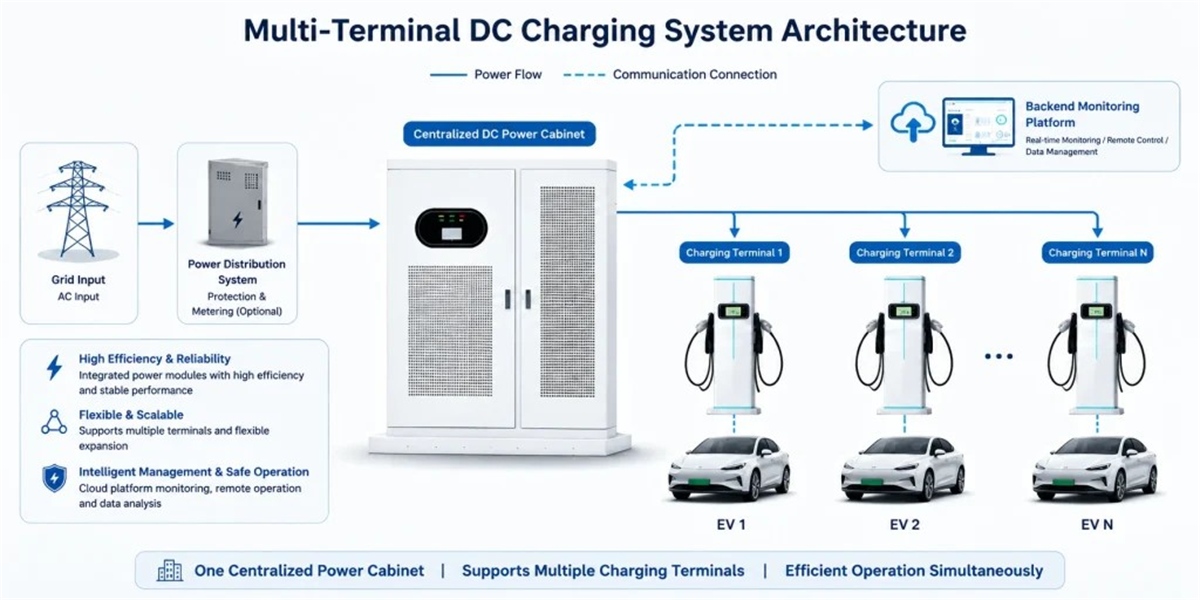
Deploying a large-scale distributed DC charging hub is a compliance exercise as much as an engineering one. The site must satisfy four overlapping safety and regulatory layers: product-level certification of the charging equipment (CE marking with IEC 61851 and IEC 62477, TUV/UL listing, EMC to EN 61000 or FCC Part 15); grid interconnection rules for the connection and any on-site generation or storage (VDE-AR-N 4105, Rule 21, IEEE 1547, national grid codes); energy-storage safety where a BESS is present (UL 9540/NFPA 855, IEC 62619, IEC 62933); and site-level safety and permitting covering fire separation, egress, emergency stop, earthing, arc-fault and DC leakage protection, signage, and maintenance procedures. For a split DC hub, the centralisation of high-voltage power electronics in one cabinet simplifies this picture: fewer live interfaces in public areas, one protection and isolation point per power zone, and one compliance file for modules, cabinets, controls, and dispensers. In 2026, certification coverage and documented compliance are pass/fail procurement criteria — not marketing claims — so the guiding principle is to specify a single, fully certified platform and design the site around it.
Key Takeaways
- Compliance has four layers. Product certification, grid interconnection, storage safety, and site permitting must all be satisfied independently — clearing one does not clear the others.
- Split DC architecture reduces compliance surface. Concentrating power electronics in a protected cabinet removes high-voltage and heat from driver areas, shrinking the number of safety-critical public interfaces.
- Specify certification on day one. CE, TUV, and UL coverage, plus EMC and grid-code conformity, are far cheaper to specify than to retrofit.
- Storage changes the rules. A BESS brings fire, separation, ventilation, and additional electrical protections that must be designed, not assumed.
- Documentation is the deliverable. Declarations of conformity, test reports, protection settings, and O&M procedures are what auditors, utilities, and insurers actually inspect.
The Four Compliance Layers
Large-scale charging hubs sit at the intersection of product safety, utility regulation, fire and building codes, and — where storage is present — energy-specific standards. The four layers are independent; a site can be fully certified at the product level and still fail to interconnect, or interconnect flawlessly and still fail a fire inspection.
| Layer | What It Governs | Representative Standards | Who Checks It |
|---|---|---|---|
| Product & EVSE safety | Charging equipment design, insulation, touch safety, EMC | IEC 61851, IEC 62477, IEC 62955, EN 61000, FCC Part 15; CE, TUV, UL | Certification bodies, buyers, insurers |
| Grid interconnection | Connection to the utility, export control, protection settings | National grid codes; VDE-AR-N 4105 (DE), Rule 21 (CA), IEEE 1547 (US) | Distribution network operator |
| Energy storage safety | Battery design, fire, ventilation, separation, monitoring | UL 9540, NFPA 855, IEC 62619, IEC 62933 | Fire authority, AHJ, insurer |
| Site safety & permitting | Fire separation, egress, earthing, signage, e-stop, maintenance | Local building, fire, and electrical codes | Building authority, fire marshal |
Product-Level Safety and Certification
Every component in a distributed DC hub should be certified to a recognised standard, and the certification should be evidenced, not implied. The essentials:
- Electrical safety of the EVSE. IEC 61851 governs conductive charging systems; IEC 62477 covers power electronic converter safety; IEC 62955 addresses residual DC current detection, which matters specifically for DC charging and is a common gap in lower-cost equipment.
- Marking and listing. CE marking for the EU/EEA, TUV approval as independent evidence of conformity, and UL listing for North America. For multi-market networks, a single vendor with broad certification coverage reduces the number of variant SKUs.
- EMC. EN 61000 series for Europe, FCC Part 15 for the US. High-power converters generate substantial conducted and radiated emissions, and EMC conformity protects both the grid and adjacent communications.
- Protection functions. Over/under-voltage, over-current, insulation monitoring, DC leakage detection, surge protection, and a functioning emergency stop — all verifiable, not merely present.
The 40kW/60kW liquid-cooling power modules at the heart of a MIDA cabinet are certified and interchangeable across cabinet sizes, which means the certified building block carries through from a single 240kW unit to a multi-megawatt hub.
Grid Interconnection: Where the Utility Decides
The distribution network operator has its own requirements, and they bind even when the product is fully certified. The main obligations are:
- Connection agreement and capacity. The contracted capacity sets the demand-charge baseline and the protection settings; exceeding it triggers penalties and, at the extreme, disconnection.
- Export control. Where the site has generation or storage, the operator will require export limitation or a formal export agreement. Grid codes such as VDE-AR-N 4105 and Rule 21 specify how inverters and converters behave on the network.
- Protection coordination. Fuse and breaker ratings, fault-current withstand, and selectivity must be coordinated with the upstream network so a fault in the hub does not disturb the feeder.
- Anti-islanding. If the site can island, the utility must be satisfied that it will not back-feed a de-energised network unintentionally.
For a distributed DC hub, centralising conversion helps here too: there is one principal interface to coordinate rather than one per dispenser, which simplifies the protection study and the utility’s review.
Energy Storage: The Rules That Change the Design
Where a BESS supports the hub — for peak shaving, resilience, or solar integration — an additional compliance layer applies, and it often drives the site layout more than the charging equipment does:
- Battery safety. UL 9540 covers energy storage systems; IEC 62619 and IEC 62933 cover battery cells and grid-connected storage. Confirm cell chemistry, thermal runaway behaviour, and the effectiveness of the fire-suppression or venting strategy.
- Fire and separation. NFPA 855 and local fire codes set separation distances between storage and occupied buildings, vehicles, and property lines; they may also impose maximum capacity per unit area and require ventilation or gas detection.
- Monitoring and isolation. The storage system needs continuous monitoring, remote shutdown, and clearly marked isolation points so first responders can safely de-energise it.
- Documentation for responders. Emergency pre-plans, hazard signage, and access instructions must be available to the fire service before the site goes live.
A BESS is a fire-safety system as much as an energy system. Treating it as such at the design stage — rather than discovering separation requirements after the layout is fixed — is the difference between a compliant site and a redesign.
Site-Level Safety: The Details That Pass or Fail an Inspection
Beyond the equipment and the utility, a hub must satisfy the building and fire authority on site-level safety. The recurring items that fail inspections are mundane and avoidable:
- Fire separation and egress. Power cabinets, storage, and dispensers must respect prescribed distances from buildings, boundaries, and escape routes, and must not obstruct egress.
- Earthing and bonding. A single, verifiable earthing arrangement across cabinets, dispensers, and storage, with test records.
- DC leakage and arc-fault protection. Especially important on long DC dispenser runs; the protection must be correctly rated and verified in operation.
- Emergency stop and isolation. Accessible, clearly labelled isolation points for each power zone, so a fault can be de-energised without entering a live area.
- Vehicle impact protection. Bollards or barriers around cabinets and dispensers in traffic-facing positions.
- Signage and instructions. Hazard marking, emergency contacts, and operating instructions visible and current.
- Flood and thermal siting. Cabinets above the flood line; storage and cabinets within their rated ambient and ventilation envelope.
Compliance Matrix: What to Specify and Verify
| Requirement | Applies To | Specify At Design | Verify Before Energisation |
|---|---|---|---|
| CE / TUV / UL listing | Cabinets, dispensers, storage | Yes | Certificates on file |
| IEC 61851 / 62477 / 62955 conformity | EVSE and converters | Yes | Declaration of conformity |
| EMC (EN 61000 / FCC Part 15) | All power electronics | Yes | Test reports |
| Grid-code conformity | Connection, storage, PV | Yes | Utility sign-off |
| UL 9540 / NFPA 855 | BESS (if present) | Yes | Fire authority approval |
| Protection coordination study | Whole site | Yes | Signed study |
| Earthing and bonding records | Whole site | Yes | Test certificate |
| Commissioning test results | Every function | Yes | Documented pass |
| O&M and emergency procedures | Site operations | Yes | Handover file |
| OCPP 2.0.1 / ISO 15118 control | Charging platform | Yes | Integration test |
The right-hand column matters as much as the middle one. Regulators, utilities, and insurers do not accept intent; they inspect evidence. A hub that cannot produce its protection study, its earthing records, and its commissioning results is not compliant, however well it was built.
How MIDA Supports Compliant Deployments
MIDA Power’s commercial DC platform is engineered for the certification regime of large-scale hubs. The 40kW/60kW liquid-cooling power modules are certified components that span every cabinet size, giving a hub a single certified building block regardless of capacity. The 360kW liquid-cooled charging station with RFID, OCPP, and POS shows the attended-hub configuration with integrated access and payment, while the 480kW ultra-fast liquid-cooled station for motorways demonstrates the platform under sustained high-power duty. All are OCPP 1.6J/2.0.1-ready and designed for the 150–1000V vehicle range, with the sealed liquid-cooling loop keeping heat — and therefore thermal risk — out of driver-facing areas. Because the platform is modular and single-source, the commercial DC fast charging range consolidates modules, cabinets, controllers, and dispensers into one compliance file instead of many.
FAQ
1. Which certifications should a large DC charging hub require?
At minimum, CE marking with conformity to IEC 61851 and IEC 62477 for the EVSE, TUV approval as independent evidence, UL listing for North American markets, EMC conformity (EN 61000 or FCC Part 15), and — where storage is present — UL 9540 or the local equivalent.
2. Does a distributed (split) hub carry more or less compliance risk than an integrated one?
Usually less. Centralising power electronics in a protected cabinet reduces the number of high-voltage, heat-generating interfaces in public areas, and gives one isolation and protection point per power zone rather than one per dispenser.
3. What extra rules apply when a BESS is added?
Battery safety per UL 9540/NFPA 855 (or local equivalents), fire separation distances, ventilation or gas detection, remote shutdown and isolation points, and emergency documentation for first responders. These frequently drive the site layout.
4. Who approves grid interconnection?
The distribution network operator. It reviews the connection capacity, export control, protection coordination, and anti-islanding behaviour against the applicable national grid code, independently of product certification.
5. What causes most inspection failures at charging hubs?
Mundane site-level items: inadequate fire separation or obstructed egress, unverifiable earthing and bonding, incorrectly rated or untested DC leakage and arc-fault protection, inaccessible emergency stops, missing vehicle impact protection, and absent documentation.
6. Is DC leakage protection different from AC protection?
Yes. DC charging can produce smooth DC residual currents that conventional AC residual current devices may not detect, which is why dedicated DC residual current detection (for example, per IEC 62955) is required in addition to standard AC protections.
7. What documentation should be assembled before energisation?
Certificates of conformity, EMC test reports, the utility’s interconnection approval, the protection coordination study, earthing test records, commissioning results for every safety function, and site O&M and emergency procedures.
The Bottom Line
Safety and compliance are not obstacles to deploying a large distributed DC charging hub; they are the specification. Four independent layers — product certification, grid interconnection, storage safety, and site permitting — must each be satisfied with evidence, and the site must be designed around them from the first layout sketch. The good news is that a well-engineered split DC platform makes this manageable: centralised, certified power electronics, one protection and isolation point per zone, hard-wired safety functions, and protocol-complete control reduce the compliance surface at the same time as they improve serviceability. Specify a single, fully certified platform, design the storage and fire strategy early, and keep the paperwork complete — and the hub will clear its inspections as cleanly as it delivers its power.
Post time: Sep-17-2026


